
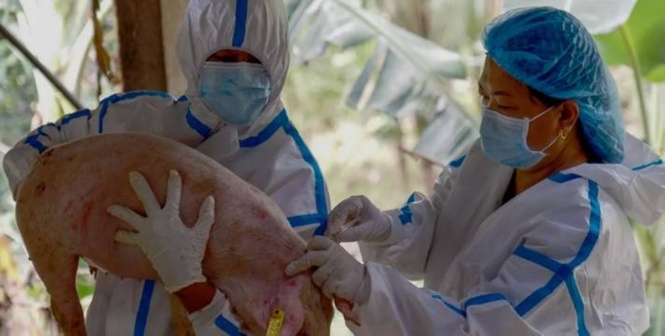
THE Bureau of Animal Industry (BAI) has approved the commercial sale of AVAC ASF LIVE, the first African swine fever (ASF) vaccine for fattening pigs, as part of government efforts to rebuild the country’s swine herd, the Department of Agriculture (DA) said on Wednesday.
AVAC ASF LIVE is a freeze-dried, live attenuated vaccine developed by AVAC Vietnam to protect healthy, meat-producing pigs against Genotype II African swine fever virus (ASFV).
Its approval comes nearly seven years after ASF first hit the Philippines in 2019, when the national hog population dropped to around 8 million heads from about 13 million before the outbreak.
“The availability of a commercially-approved ASF vaccine is crucial to our repopulation program. It gives hog raisers another tool to protect healthy animals as we work to rebuild the industry and secure a more stable supply of pork,” Agriculture Secretary Francisco Tiu Laurel Jr. said.
A second vaccine, PROVAC from South Korea, is undergoing BAI testing and could provide hog raisers with another option against ASF by next year, Agriculture Undersecretary for Livestock Constante Palabrica said.
“The commercial clearance of the ASF vaccine gives our backyard hog raisers renewed hope. More importantly, it gives government a critical tool to finally accelerate the recovery of the domestic hog industry,” Sinag Executive Director Jayson Cainglet said.
The vaccine should be considered part of the broader strategy to control ASF, rebuild the hog population and restore domestic pork production, he added.
While ASF does not infect humans, outbreaks have severely disrupted hog production by forcing farmers to cull infected or exposed animals and delaying restocking. Repeated outbreaks have also discouraged some producers from returning to hog farming.
The BAI earlier reported that ASF outbreaks had reached 76 of the country’s 82 provinces, with backyard raisers particularly vulnerable because they often have fewer resources to maintain strict biosecurity measures and absorb losses.
Palabrica has also sought P1 billion from the DA for 2027 to subsidize animal vaccination programs, including ASF vaccination for backyard hog farms, which could make the vaccine more accessible to smaller producers.
The government is positioning vaccination as part of a broader swine repopulation strategy that includes disease surveillance, biosecurity, movement controls and targeted restocking, with the goal of restoring the hog population to pre-ASF levels.
The DA said the decline in the local hog herd has contributed to supply shortages and greater reliance on pork imports, while recurring ASF outbreaks continue to threaten domestic production.
Data from the Philippine Statistics Authority showed hog production rose 5.6 percent to 412,280 metric tons (MT), liveweight, in the second quarter from 390,490 MT a year earlier.
Despite the increase in production, however, the country’s hog inventory stood at 8.93 million heads as of June 30, down 1 percent from 9.01 million heads a year earlier.