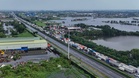
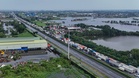
MANILA, Philippines — The government is racing to keep the North Luzon Expressway (NLEX) from turning into a flood trap, as Department of Public Works and Highways (DPWH) Secretary Vince Dizon and NLEX Corp. officials mapped out immediate measures to prevent another traffic nightmare during the rainy season.
Dizon met with former Public Works secretary Rogelio Singson, officials of the Toll Regulatory Board (TRB) and NLEX Corp., and Japanese engineering consultant Nippon Koei-CTI Engineering to map out both immediate and long-term solutions to flooding along the expressway.
The meeting came after President Ferdinand Marcos Jr. directed authorities to ensure that NLEX would not again be crippled by flooding during the southwest monsoon, or habagat, following the severe traffic disruption on Aug. 30, 2026.
Officials evaluated potential structural interventions and strategic short- and long-term measures to address the recurring flood issues paralyzing NLEX.
Among the immediate measures being pursued is the installation of sheet piles along the Tulaoc River to prevent floodwaters from spilling onto the expressway.
The DPWH and Metropolitan Manila Development Authority (MMDA) will also deploy high-capacity pumps to rapidly remove accumulated floodwater from affected portions of NLEX.
Authorities are likewise looking at deepening the Tulaoc River to increase its capacity to hold and carry away pumped-out floodwater, particularly during high tide and prolonged heavy rainfall.
The flooding problem has become a major concern because NLEX is a critical transport artery linking Metro Manila with Central and Northern Luzon. Flooding in key sections can quickly trigger long traffic queues, disrupt commuters and freight movement, and affect the movement of goods to and from provinces north of the capital.
The flooding that crippled the Tulaoc-San Simon stretch of the NLEX in late August 2026 was a troubling replay of a problem that surfaced three years earlier.
In August 2023, Super Typhoon Egay, Typhoon Falcon, and the enhanced southwest monsoon caused the Pampanga River to overflow, inundating Tulaoc and portions of NLEX and disrupting traffic for hours.
In response, the DPWH identified a 200-meter section in Tulaoc that had been submerged and raised the road by about 0.7 meter. The agency also began elevating the Tulaoc Overpass in February 2025 as part of efforts to reduce flooding in the area.
But the 2026 floods showed that the problem remained. Despite the road-raising and bridge-elevation projects, the same corridor was again inundated in late August, triggering massive traffic jams and leaving motorists stranded.
The Metro Pacific Tollways Corp. (MPTC), NLEX’s operator, has acknowledged Tulaoc as a flood-prone area. Following the 2023 flooding, the government and NLEX agreed to pursue further road- and bridge-raising measures.
The recurrence of severe flooding has now renewed calls for a more comprehensive and permanent solution, bringing the issue to the attention of Dizon and NLEX officials during their Sept. 2, 2026 meeting.