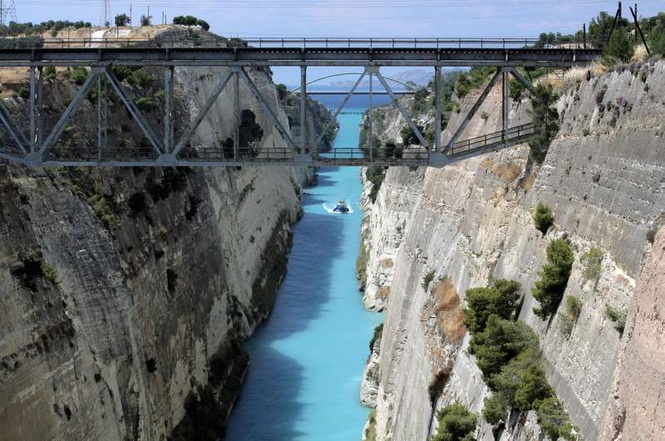
Greece has reopened its popular Corinth Canal after completing extensive repair and safety work.
The canal was closed last October so urgently needed work could be done to stabilize its steep banks.
The approximately 6.3-kilometre canal is one of Greece’s most famous tourist attractions.
The waterway, whose rock faces reach heights of up to 85 metres, significantly reduces the sea route between the Ionian Sea and the Aegean Sea, as sailors need not go all the way around the Peloponnese peninsula.
However, only ships less than 17 metres wide can pass through.
The canal was built at the end of the 19th century.
Ever since ancient times, sailors have sought to cross the Isthmus of Corinth, though building a canal was not technically possible then.
Instead, they constructed the Diolkos, a stone road with grooves along which people pulled their ships and cargo.
A journey across the Peloponnese
If you head to the Peloponnese, you may well be tempted to make an unscheduled stop at the strait.
Locals note the wickedly tempting souvlaki stands on the banks of the canal.
They point to the plates of juicy meat skewers to be consumed as you gaze on one ship after another sailing through the canal.
Travellers to the region almost always take a break at the Corinth Canal, which marks the beginning of the Peloponnese region and separates the territory from mainland Greece.
Over on the Peloponnese - the peninsula which resembles a hand with four fingers - the sites of Old Olympia are the most popular places to visit.
The ancient city of Olympia itself lies in the north-west in a mountainous region where the slopes are clad with a dense carpet of forest.
Once you reach the Peloponnese, the ancient sporting arenas, where athletes pitted themselves against each other thousands of years ago, are the highlight.
These days, only chunks of stone and the ruins of temples and other sacred buildings bear witness to the glorious sporting events of yore.
But head to a museum for an insight into how Olympia must have looked in its heyday and just how lavishly it must have been decorated for the sporting festivities.
Not everything revolves around the past in the Peloponnese. In larger towns such as Kalamata, in the south, locals enjoy spending the evenings outside on the broad promenade or in the old quarter. They can be seen strolling along the quayside with an ice cream.
Countless cafes and cake shops await the hungry visitor. Kalamata has the reputation of being a town for the sweet-toothed and is known for a whole range of tempting sweet things such as pastelli sesame bars, Greek loukoumades doughnuts along with baklava and kataifi, two honey-drenched desserts.
From Kalamata, most tourists head inland. The roads snake their way through the rocks as the car's on-board navigation device shows that a set of alarmingly narrow serpentine bends are up ahead.
The road passes through villages where goats and sheep meander across the tarmac into the adjacent fields and the locals gather in central squares to exchange the latest gossip.
Between the settlements are enormous plantations of olive trees, which gleam invitingly at sunset.