
A growing proportion of deaths in England and Wales are associated with days that have the hottest temperatures, new analysis suggests.
While cold weather has historically led to higher levels of mortality than conditions of extreme heat, the gap between the two is likely to have narrowed in recent years.
This trend is being driven by more frequent and persistent periods of very hot weather in the UK, which saw heat-related deaths peak in summer 2022 when temperatures reached 40C for the first time on record.
An estimated 0.39% of deaths in England across 2021-25 were associated with the hottest days of the year, according to findings published by the Office for National Statistics (ONS).
The rolling five-year average has been on an upwards path for much of the past decade, having stood at 0.10% for 2011-15 and 0.31% for 2016-20.
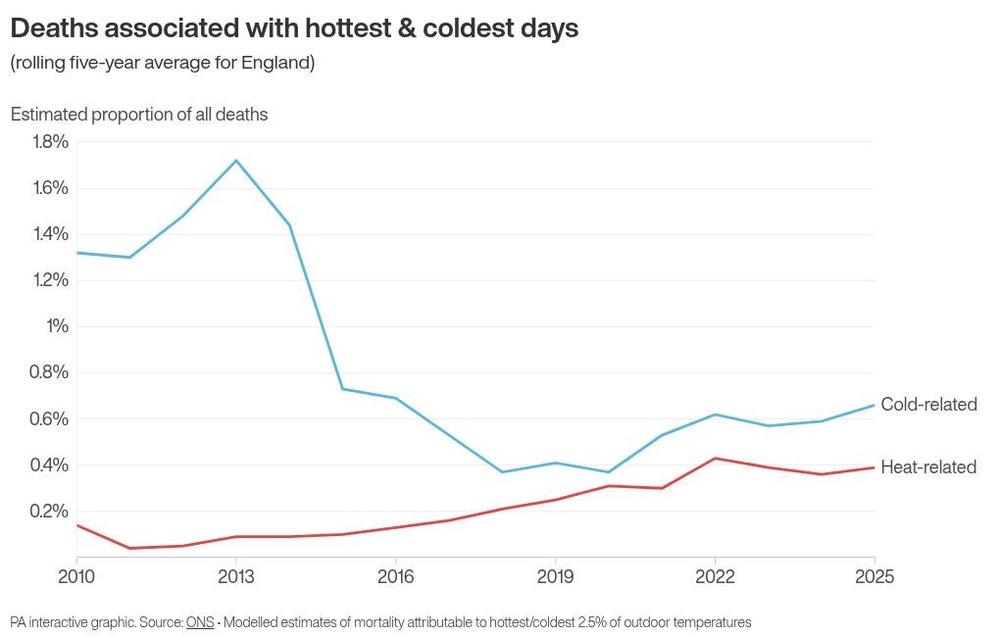
There continues to be a higher proportion of deaths linked with extreme cold weather, but the gap has narrowed.
Some 0.73% deaths in England were associated with the coldest days across 2011-15, 0.63 percentage points ahead of the equivalent figure for deaths linked with the hottest days.
But by 2021-25, this gap had shrunk to 0.27 percentage points, with cold-related deaths accounting for 0.66% of the total and heat-related deaths 0.39%.
A similar trend has been under way in Wales, where there was a gap in 2021-25 of 0.20 percentage points between the proportion of deaths associated with the coldest days (0.54%) and those for the hottest days (0.34%) – down from a gap of 0.70 points in 2011-15 (0.78% for cold, 0.08% for heat).
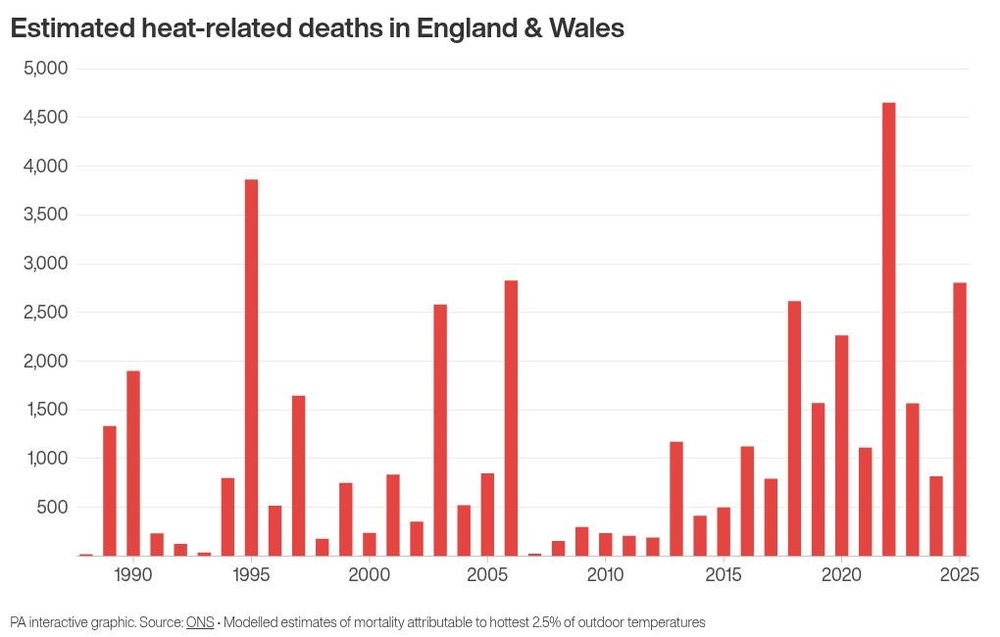
There were an estimated 4,652 heat-related deaths in England and Wales in 2022, the highest figure for any year from 1988 to 2025, which is the period covered by the ONS analysis.
Three of the top five highest estimates are for the past 10 years: 2025 (2,805 deaths) and 2018 (2,617), along with 2022.
The other peaks were in 1995 (3,864 deaths – the second highest figure since 1988) and 2006 (2,827).
Commenting on the findings, James Tucker of the ONS said: “As our climate changes, including more frequent and prolonged periods of very hot weather, it is important to understand how both heat and cold affect mortality over time.
“Our results show that the gap between heat and cold-related deaths has narrowed in recent years as the proportion of heat-related deaths has increased.”
The ONS figures are modelled estimates of mortality associated with the coldest 2.5% and hottest 2.5% of days each year, not actual counts of deaths directly caused by extreme weather.
They suggest an estimated 42,133 deaths in England and Wales were associated with the hottest days between 1988 and 2025.
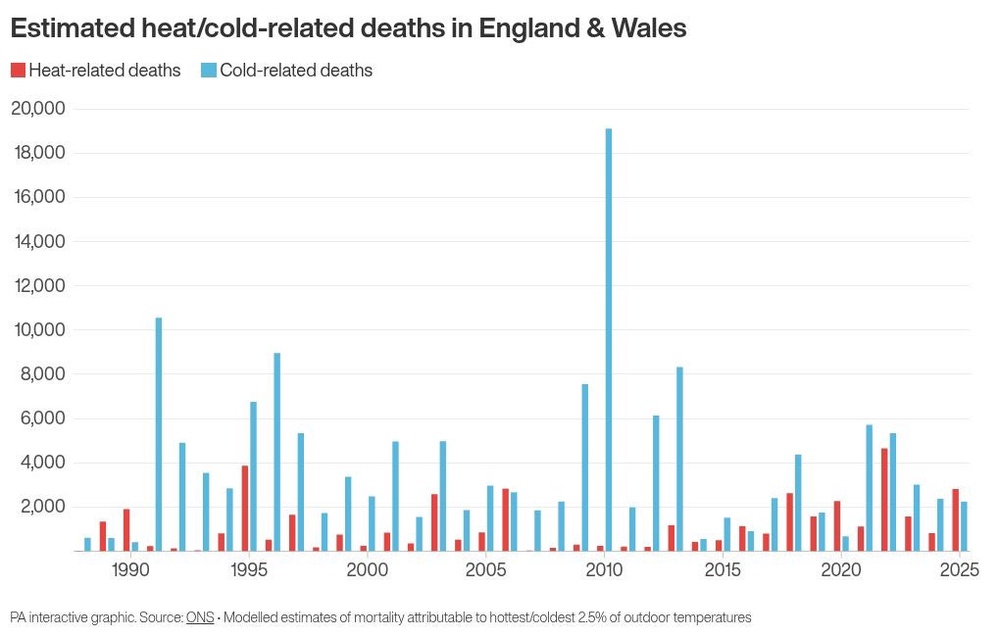
The number of deaths associated with the coldest days is far higher, at 149,042.
Annual cold-related deaths peaked in 2010, at 19,105: a year that saw the coldest December since Met Office records began in 1884, when snow fell across many areas of the country and temperatures remained below freezing during the day.
There were more cold- than heat-related deaths in England and Wales in almost every year of the ONS data, with six exceptions: 1989 and 1990, 2006, and three years in the past decade: 2016, 2020 and 2025.
Climate transition minister Katie White said: “These shocking figures represent thousands of families who have lost someone they love.
“We’re not waiting for climate change to arrive, we’re living in the middle of it, and this summer’s record-breaking heat has brought that home.
“That’s why we’re taking some of the biggest action in a generation, preparing hospitals for extreme heat, rolling out air-to-air heat pumps to cool as well as heat homes, and accelerating clean homegrown power to tackle the root causes of climate change.
“But we won’t stop there, bringing together our best minds, backing bold new ideas and pushing forward solutions that protect the people and places we love.”
Separate analysis published last month by the UK Health Security Agency (UKHSA) estimated there were 2,877 heat-associated deaths in England in May and June this year.
The overall total for 2026 will be even higher, thanks to the further periods of punishing hot weather that affected the country in July and August.
The ONS findings also suggest the impact of extreme weather varies across the regions of England.
An estimated 0.36% of all deaths in London from 1988 to 2025 were associated with days that saw the hottest temperatures, a higher proportion than in any other region.
The ONS said this might reflect “certain socioeconomic factors that influence vulnerability to heat” that are more prevalent in London, such as living costs and household overcrowding, which “may limit the capacity to adapt to high temperatures”.
The lowest figure was for north-west England, where heat-related deaths accounted for 0.15% of the total for the period.
Mike Childs, head of science, policy and research at the environmental campaign group Friends of the Earth, said: “Many of these deaths can be avoided with action to upgrade the nation’s homes – that’s why the Government must accelerate and increase spending on its Warm Homes programme, targeted in the areas that need it most.
“Homes without decent insulation are also more susceptible to over-heating when the mercury climbs.
“We’ve known for decades the fossil fuel industry is driving global heating.
“Far from giving the green light to more oil and gas extraction in the North Sea, the Government should be making the companies getting rich amid mounting death and destruction pay for the measures we need to protect people from worsening climate extremes.”
Read MoreThe US fall foliage forecast is out. Here’s where to see the most vibrant colors
40,000 climate-related deaths recorded in England over 38 years
Global sea surface temperatures are at the highest levels on record
Nepal flash floods triggered by glacier collapse that registered as earthquake
Nepal flash floods mapped: Where deadly floods hit along Tibet border
Warning over extreme weather and food prices as ‘unprecedented’ El Nino builds