
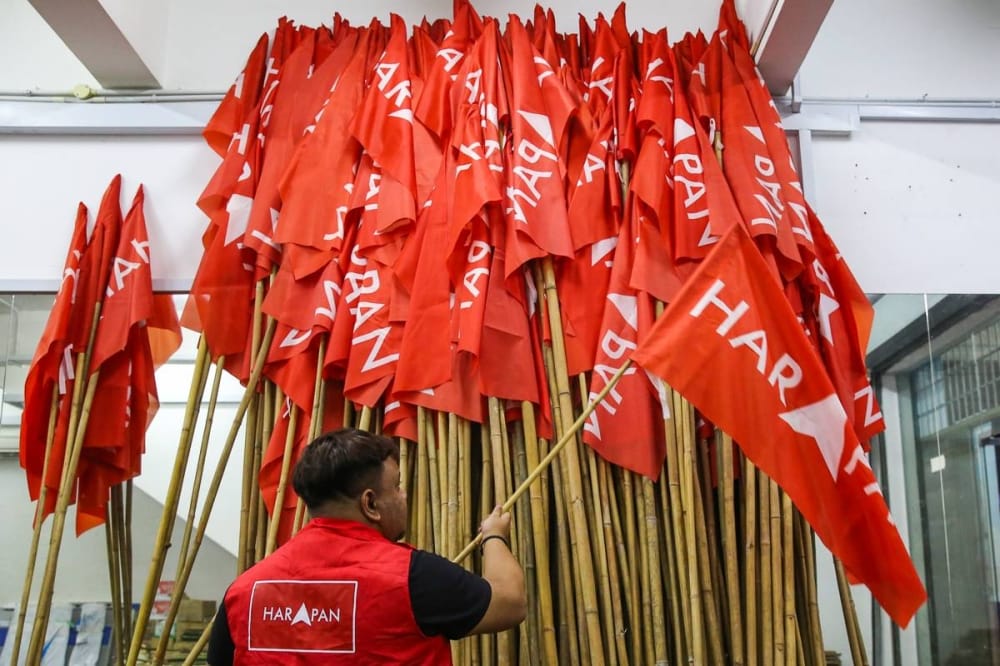
A political party does not necessarily lose public support the moment it loses an election. Sometimes, the warning signs emerge much earlier: voters become less enthusiastic, traditional supporters grow increasingly frustrated, internal divisions become more visible, and promises that once inspired hope begin to sound like familiar political slogans. For Parti Keadilan Rakyat (PKR), the party led by Prime Minister Datuk Seri Anwar Ibrahim, these warning signs are becoming increasingly difficult to ignore. PKR's political journey was built on the language of reform, justice, institutional accountability and the promise of a different kind of leadership. For years, its supporters believed that the party represented an alternative to the established political order. Its Reformasi movement attracted Malaysians who wanted stronger democratic institutions, greater transparency and a government that placed ordinary citizens above political interests. However, governing is fundamentally different from campaigning. Once a party enters government, voters judge it not merely by its historical struggles or political ideals, but by what it actually delivers. The question facing PKR today is therefore uncomfortable but necessary: Has the party lost the confidence of the people who once supported its struggle? Recent electoral setbacks, defections, coalition tensions and public dissatisfaction suggest that PKR is facing a serious political challenge. Yet the situation requires a closer examination. It would be premature to declare that the party has completely lost public support. What is increasingly evident, however, is that its traditional political advantage can no longer be taken for granted.
The Negeri Sembilan Defeat: A Warning PKR Cannot Ignore
The August 1, 2026 Negeri Sembilan state election delivered one of the most significant political setbacks for Pakatan Harapan (PH), the coalition in which PKR is a major component. The results were particularly damaging because PH had previously governed the state alongside Barisan Nasional (BN). Following the election, the BN-Perikatan Nasional partnership secured 25 of the 36 state assembly seats, ending PH's hold on the state government. According to political analysis published by the “ISEAS Yusof Ishak Institute”, PH's representation fell from 17 seats in 2023 to just 11 in 2026.PKR's performance was particularly concerning. It won only two of the 16 seats it contested, compared with five of the six seats it had contested in the previous state election. Perhaps the most politically damaging development was the defeat of Negeri Sembilan Menteri Besar Datuk Seri Aminuddin Harun, who failed to retain a state seat after contesting in Linggi. This was not simply the defeat of an ordinary candidate. It involved a prominent PKR leader who had previously been associated with the party's administration of the state. The results raise an uncomfortable question: if a party struggles to defend its position in a state where it previously governed, what does that say about its ability to maintain public confidence elsewhere? Nevertheless, the results should not be interpreted as proof that every Malaysian voter has rejected PKR. They demonstrate a substantial electoral setback in Negeri Sembilan, not a nationwide referendum on the party.
Johor Delivered Another Political Warning
Before the Negeri Sembilan election, the Johor state election on July 11, 2026 had already exposed the difficulties facing PH. BN won 48 of the 56 seats, securing a two-thirds majority. PH retained only eight seats, down from its previous 12. According to “Bernama's report on the official results”, DAP won six seats, while PKR and Amanah secured one seat each. The result strengthened BN's political position while weakening PH's bargaining power, even though both coalitions were partners in the Federal Government. An analysis by “Channel NewsAsia” highlighted the growing frustration among parts of PH's traditional support base. Some Chinese and Indian voters appeared increasingly willing to support BN candidates, rather than automatically backing PH. The “RSIS analysis by Ben Suffian” also pointed to weaker PH mobilisation, changing voter preferences and dissatisfaction with the pace of structural reforms. These findings suggest that PH's traditional support base is not necessarily disappearing, but it is becoming less predictable. For PKR, this is particularly important. The party has historically depended on its ability to appeal across ethnic and social groups. If voters who once considered PH their natural political home begin exploring alternatives, the party must ask why. Political loyalty is not permanent. It has to be earned repeatedly.
Internal Divisions Are Creating Another Political Problem
A political party facing declining electoral confidence needs unity, credibility and a clear direction. Yet PKR has also experienced internal turbulence. The departure of former economy minister Rafizi Ramli and his move into the newly established Parti Bersama Malaysia have created another challenge for Anwar's party. In a “Reuters report published on May 29, 2026”, the news agency reported that PKR members had been leaving for Bersama, with the new party claiming to have received more than 18,000 membership applications. The report also noted that Anwar retained his parliamentary majority, while PKR leaders disputed suggestions of a mass exodus and pointed to the party's continuing membership strength. These distinctions matter. Political defections do not automatically mean that the majority of PKR members have abandoned the party. However, the emergence of a new political platform led by a former senior PKR figure creates a difficult perception for the party leadership. It raises questions about internal democracy, leadership succession, policy direction and the ability of the party to accommodate differing views. A party that once positioned itself as a broad home for reform-minded Malaysians must be able to demonstrate that internal disagreement can be managed without turning into a prolonged struggle for political survival. If the party's public image becomes dominated by internal conflict rather than policy achievements, voters may begin questioning whether its priorities remain aligned with their concerns.
The Cost of Living Remains the Government's Biggest Political Test
Ultimately, political support is closely connected to people's everyday experiences. For ordinary Malaysians, political speeches about economic growth mean little if their household expenses continue to rise faster than their income. The price of food, housing affordability, transport costs, wages, employment opportunities and access to quality public services remain central to the public's assessment of government performance. A “Merdeka Center survey reported by Bernama on June 25, 2026” found that 73 per cent of respondents identified economic issues as the single biggest problem facing the country. The same survey found that 50 per cent were satisfied with the Federal Government, while 48 per cent were dissatisfied. These figures reveal a government operating in a politically competitive environment, where public confidence cannot be assumed. Importantly, Anwar himself recorded a 52 per cent approval rating in the survey, remaining the most favoured political leader among those assessed. This presents an interesting political contradiction: the Prime Minister may retain relatively strong personal approval while his party and coalition encounter serious electoral difficulties. The distinction matters because voters do not necessarily evaluate a political leader, a political party and a government as one indivisible entity. Some may support Anwar personally but remain dissatisfied with particular ministers, government policies or PKR's political direction. Others may have supported PH previously but now believe that another party deserves an opportunity. PKR cannot rely indefinitely on the Prime Minister's personal political standing to compensate for weaknesses in its party machinery or government performance.
Is PKR Losing Its Traditional Political Identity?
Perhaps the most difficult challenge facing PKR is not simply electoral competition. It is the question of identity. PKR once presented itself as a party that could unite Malaysians across ethnic, religious and social boundaries through a shared commitment to justice and democratic reform. But governing through a broad coalition inevitably involves compromises. Those compromises may be necessary for political stability, yet they can also create confusion among supporters who expect the party to maintain a clear ideological direction. When a party's decisions appear inconsistent with its earlier principles, voters may begin to question what it actually represents. Is PKR still the reformist movement that inspired its original supporters? Has it become primarily a party focused on maintaining its position within government? Or is it struggling to balance its reformist identity with the practical demands of coalition politics? These questions deserve serious attention. The “ISEAS analysis of the Negeri Sembilan election” highlights the decline in PH's support among Malay voters in the state. Its findings suggest that the coalition's narrative of administrative performance and good governance was not enough to secure the electoral support it needed. The lesson is clear: political messaging cannot replace political trust. A party may have experienced leaders, an established organisation and a powerful historical narrative. But none of these guarantees that voters will continue supporting it.
What Do You Think? I’d Love to Hear Your Opinion in The Comments Section.
It would be inaccurate to declare that PKR has completely lost the support of the Malaysian people. The available surveys measure different things, and state election results cannot automatically be treated as a nationwide verdict. However, the political warning signs are significant. PKR's weak performance in Negeri Sembilan, PH's disappointing result in Johor, internal party departures and persistent public concerns about the economy all point to a political challenge that cannot be dismissed as ordinary electoral fluctuations. For a party that once promised to transform Malaysian politics, the greatest danger is not necessarily losing one or two elections. It is losing the trust of the people who once believed that it represented something different. Anwar Ibrahim and PKR must recognise that the public does not owe any political party permanent loyalty. Voters are entitled to change their minds, question their leaders and demand better performance. The next general election will not simply test the popularity of the Prime Minister. It will test whether PKR still has a convincing political identity, a credible reform agenda and the ability to reconnect with ordinary Malaysians. A party may win power through political alliances, parliamentary negotiations and electoral strategies. But it can only retain public confidence by delivering results. And perhaps the most uncomfortable question for PKR is this: If the people who once fought alongside the party are now questioning its direction, should the party blame changing voter sentiment or should it first examine what has changed within itself?
AM World (tameer.work88@gmail.com) is a content creator under the Newswav Creator programme, where you get to express yourself, be a citizen journalist, and at the same time monetize your content & reach millions of users on Newswav. Log in to creator.newswav.com and become a Newswav Creator now!
The User Content (as defined on Newswav Terms of Use) above including the views expressed and media (pictures, videos, citations etc) were submitted & posted by the author. Newswav is solely an aggregation platform that hosts the User Content. If you have any questions about the content, copyright or other issues of the work, please contact creator@newswav.com.