KUALA LUMPUR: As haze continues to affect parts of Malaysia, children are particularly vulnerable, as standard advice to stay indoors, avoid outdoor activities and wear a mask may not be enough.
Dr Helmy Haja Mydin, head of The Lung Centre, Pantai Hospital Kuala Lumpur, said reducing exposure was particularly important for children, for whom masks were not always appropriate or practical.
“Masks are usually not sufficient on their own. For kids, protection has to come from the environment itself,” said Dr Helmy, co-founder of Asthma Malaysia.
“That means keeping windows closed when outdoor air quality is poor, running air-conditioning on recirculate and, where possible, using a properly sized HEPA (high-efficiency particulate air) purifier in the room where the child sleeps and spends the most time.”
But a purifier is only part of the equation. Indoor pollutants from cigarettes and vapes, incense, mosquito coils, aerosol sprays and cooking fumes can undermine efforts to keep a child’s air clean.
“There is little point in filtering the outdoor air and then burning something in the same room,” said Dr Helmy, who was previously on the Health Ministry’s technical committee on the effects of shisha and electronic cigarettes.
Parents should also distinguish between outdoor time and outdoor exertion, he said.
A child sitting outside briefly is exposed differently from one running around a field, as physical activity increases breathing and the amount of polluted air drawn into the lungs.
During severe haze, cancelling an afternoon of football may be more important than simply telling a child to stay indoors, he said.
Recent health surveillance data show a sharp rise in asthma-related attendances and conjunctivitis cases.
There have been reports of a nearly 300 per cent increase in asthma cases during the haze episode. However, Dr Helmy stressed that this should not be interpreted as a 300 per cent increase in hospital admissions or newly diagnosed asthma cases.
The figures refer to people attending designated sentinel health facilities who were recorded as having asthma during the relevant week, he said.
“That distinction matters as no precise percentage of asthma cases can be attributed to haze based on the available data alone. But the pattern of several conditions moving in different directions offers an important clue,” he said.
“Between epidemiological weeks 33 and 34 (Aug 23-29), asthma cases rose roughly eightfold, while conjunctivitis increased from 146 to 720. At the same time, upper respiratory tract infections fell from 3,674 to 1,857.
“The pattern does not establish causation on its own. But it is consistent with an irritant exposure rather than simply a general increase in respiratory infections.”
He added that conjunctivitis was particularly relevant because eye irritation could be a direct response to air pollutants.
Dr Helmy cautioned that the existing sentinel surveillance system has limitations as it tracks upper respiratory tract infections, asthma and conjunctivitis, rather than all causes of illness and death.
A fuller assessment will require wider morbidity and mortality data.
For children with asthma, getting the medical side right is also important.
“The preventer inhaler taken properly every day protects far more than any mask can, and a written action plan matters more than equipment,” he said.
The responsibility, however, cannot sit entirely with parents.
Children spend a substantial part of their day in school, where families have little control over indoor air quality.
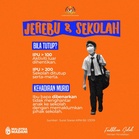
“To be fair, we are not starting from nothing. Schools already have to suspend outdoor activity above API 100 and close above 200,” he said.
“In Sarawak, 591 schools across 10 districts were closed recently. The escalation ran all the way to a declaration of emergency, which is what happened in Serian on Sept 4, when the API reached 519.
“So, thresholds do exist, and the machinery works.”
Dr Helmy reiterated that keeping the air as clean as possible at home, in school and during outdoor activities remains the most important line of defence for children.
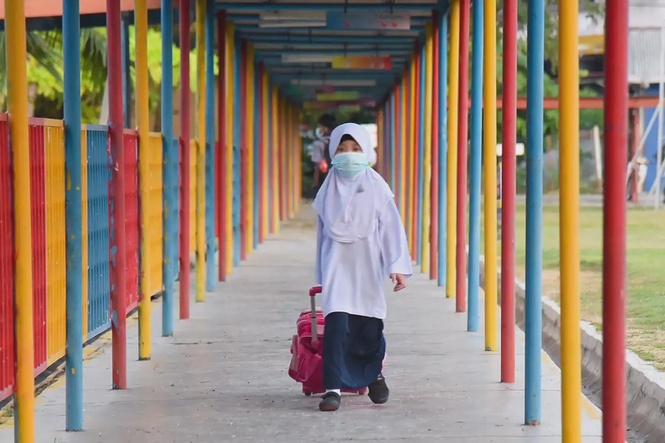
Main image: File pic of a student wearing a mask in school – Information Department.