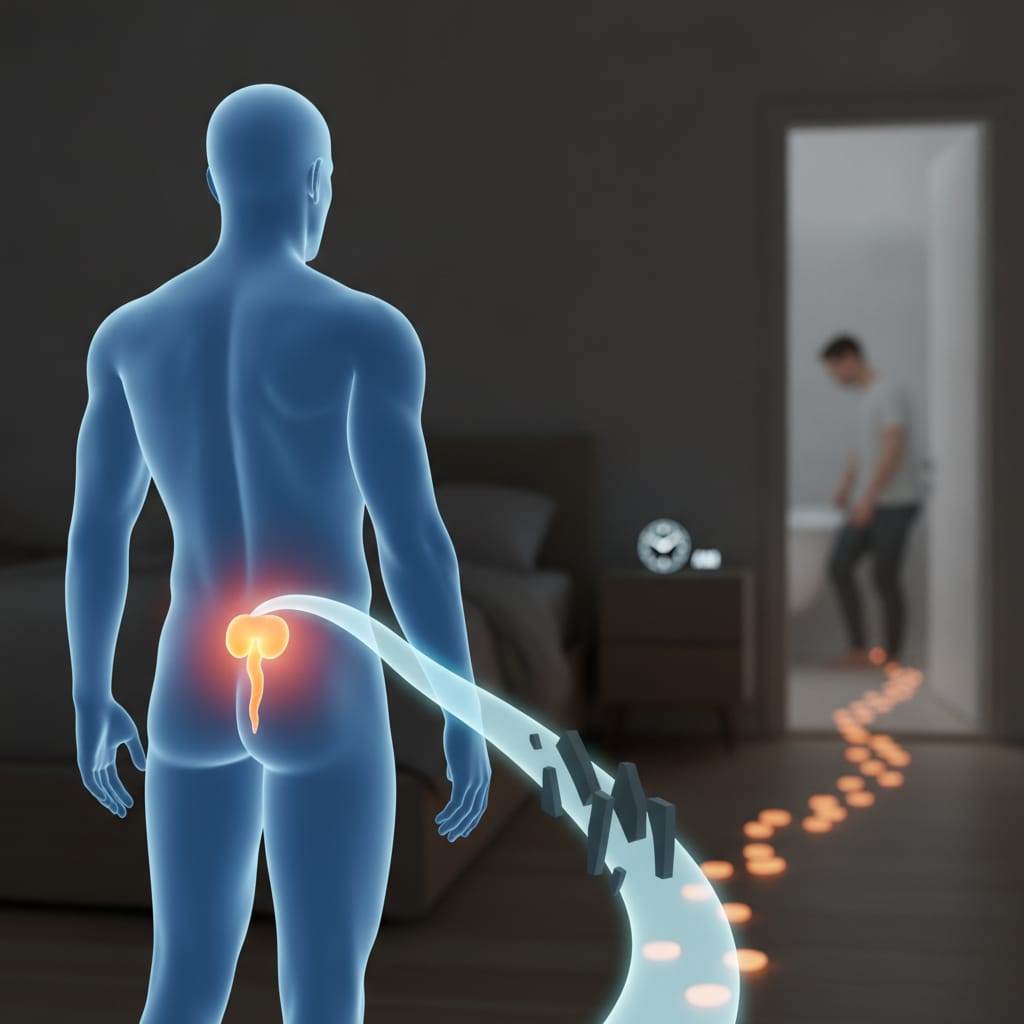
There is a particular stage in a man’s life when going to the toilet at night becomes less of a quick visit and more of a regular appointment.
You wake up.
Go to the toilet.
Get back into bed.
And just as you’re getting comfortable, you’re thinking:
“I need to go again.”
A lot of men simply accept it as part of getting older.
Sometimes it is.
But when urinary symptoms become persistent or troublesome, the prostate may be involved.
One of the most common causes is benign prostatic hyperplasia, or BPH.
What is BPH?
The prostate is a small gland sitting underneath the bladder.
The urethra — the tube that carries urine out of the body — passes through it.
As men get older, the prostate commonly increases in size.
This is called benign prostatic hyperplasia.
The word benign is important.
BPH is not prostate cancer.
An enlarged prostate does not mean you have cancer, although the two conditions can exist at the same time.
The problem is that as the prostate enlarges, it can squeeze the urethra and interfere with the flow of urine.
What symptoms does it cause?
The classic symptoms include:
A weak urine stream.
Difficulty getting the flow started.
Having to wait before urine starts.
Stopping and starting during urination.
Dribbling afterwards.
Feeling that your bladder hasn’t completely emptied.
Needing to urinate more frequently.
Sudden urgency.
And getting up repeatedly during the night.
That last one can be particularly exhausting.
Poor sleep affects concentration, mood and energy during the day.
Why do men get up so much at night?
It isn’t always just the prostate.
As we get older, the bladder may hold less urine, the kidneys may produce more urine at night, and other conditions can contribute.
Diabetes, certain medicines, sleep problems and excessive evening fluid intake can all play a role.
So if you’re getting up four or five times every night, don’t automatically assume it’s just your prostate.
It deserves proper assessment.
Is BPH dangerous?
Usually BPH itself isn’t dangerous.
But significant obstruction can cause complications.
The bladder may struggle to empty properly.
Urinary tract infections can occur.
Bladder stones can develop.
And in severe cases, urine can become completely blocked.
Acute urinary retention — suddenly being unable to pass urine despite having a painfully full bladder — is an emergency and requires urgent medical treatment.
Don’t sit at home waiting for it to sort itself out.
What about prostate cancer?
This is where men often get confused.
BPH and prostate cancer are different conditions.
BPH does not turn into prostate cancer.
But the symptoms can overlap.
And importantly, early prostate cancer often causes no urinary symptoms at all.
So a man shouldn’t assume that because he can urinate normally, his prostate must be fine.
This is why prostate health and appropriate PSA testing need to be discussed with a doctor, particularly as men get older or if they have increased risk.
What can be done about BPH?
It depends on how troublesome the symptoms are.
For mild symptoms, sometimes monitoring and lifestyle changes are enough.
Things such as reducing large amounts of fluid late in the evening, limiting caffeine and alcohol, and making sure constipation is managed can help some men.
But if symptoms are affecting quality of life, medicines are available.
Alpha-blockers
Medicines such as tamsulosin relax the muscles around the prostate and bladder outlet.
This can make urine flow easier.
They can work relatively quickly.
But they can also cause dizziness, particularly when standing up.
That matters because falls can be serious, especially in older men.
Some men can also experience ejaculation problems.
5-alpha reductase inhibitors
Medicines such as finasteride and dutasteride work differently.
They reduce the production of dihydrotestosterone, or DHT, which gradually reduces prostate size.
They can be particularly useful when the prostate is significantly enlarged.
But they don’t work overnight.
It can take several months before the full benefit becomes apparent.
They can also reduce libido and cause erectile or ejaculation problems in some men.
And there is another important point:
Finasteride lowers PSA levels.
Doctors need to know that a man is taking it when interpreting his PSA result.
Sometimes both medicines are used
For men with significant symptoms and an enlarged prostate, an alpha-blocker and a 5-alpha reductase inhibitor may be used together.
The first helps improve urinary flow.
The second works gradually to reduce prostate size and the risk of progression.
The choice depends on the individual man, the size of the prostate, symptoms and other health factors.
What if medicines don’t work?
There are several procedures available.
One well-known treatment is TURP, where prostate tissue obstructing the urine flow is removed through the urethra.
There are also newer minimally invasive and laser techniques.
The appropriate procedure depends on the size and anatomy of the prostate, the severity of symptoms and the individual’s circumstances.
The important thing is that persistent symptoms don’t mean you simply have to live with them.
What can men do themselves?
Don’t drink huge amounts of fluid immediately before going to bed.
Cut back on caffeine and alcohol if they make your symptoms worse.
Keep physically active.
Maintain a healthy weight.
Avoid constipation.
And don’t routinely hold your urine for very long periods.
If you’re taking medicines that may affect urination, discuss them with your pharmacist or doctor rather than simply stopping them yourself.
My view as a pharmacist
There is still a tendency among men to put urinary symptoms down to ageing.
“I’m getting older. It’s normal.”
Some change with age is common.
But constantly struggling to urinate, getting up repeatedly every night, having a weak stream or feeling that your bladder never empties properly shouldn’t simply be accepted.
And don’t confuse BPH with prostate cancer.
They are different conditions.
The sensible approach is to get the symptoms assessed and discuss whether prostate examination, urine testing, PSA testing or other investigations are appropriate.
Most importantly, if you suddenly become unable to pass urine, particularly with severe lower abdominal pain or a very full bladder, seek urgent medical attention.
Your prostate may be small.
But when it starts causing problems, it can have a surprisingly large effect on your life.
And there is usually something we can do about it.
Until next time take care of yourself.
The Daily Durian (zaynp100@yahoo.com) is a content creator under the Newswav Creator programme, where you get to express yourself, be a citizen journalist, and at the same time monetize your content & reach millions of users on Newswav. Log in to creator.newswav.com and become a Newswav Creator now!
The User Content (as defined on Newswav Terms of Use) above including the views expressed and media (pictures, videos, citations etc) were submitted & posted by the author. Newswav is solely an aggregation platform that hosts the User Content. If you have any questions about the content, copyright or other issues of the work, please contact creator@newswav.com.