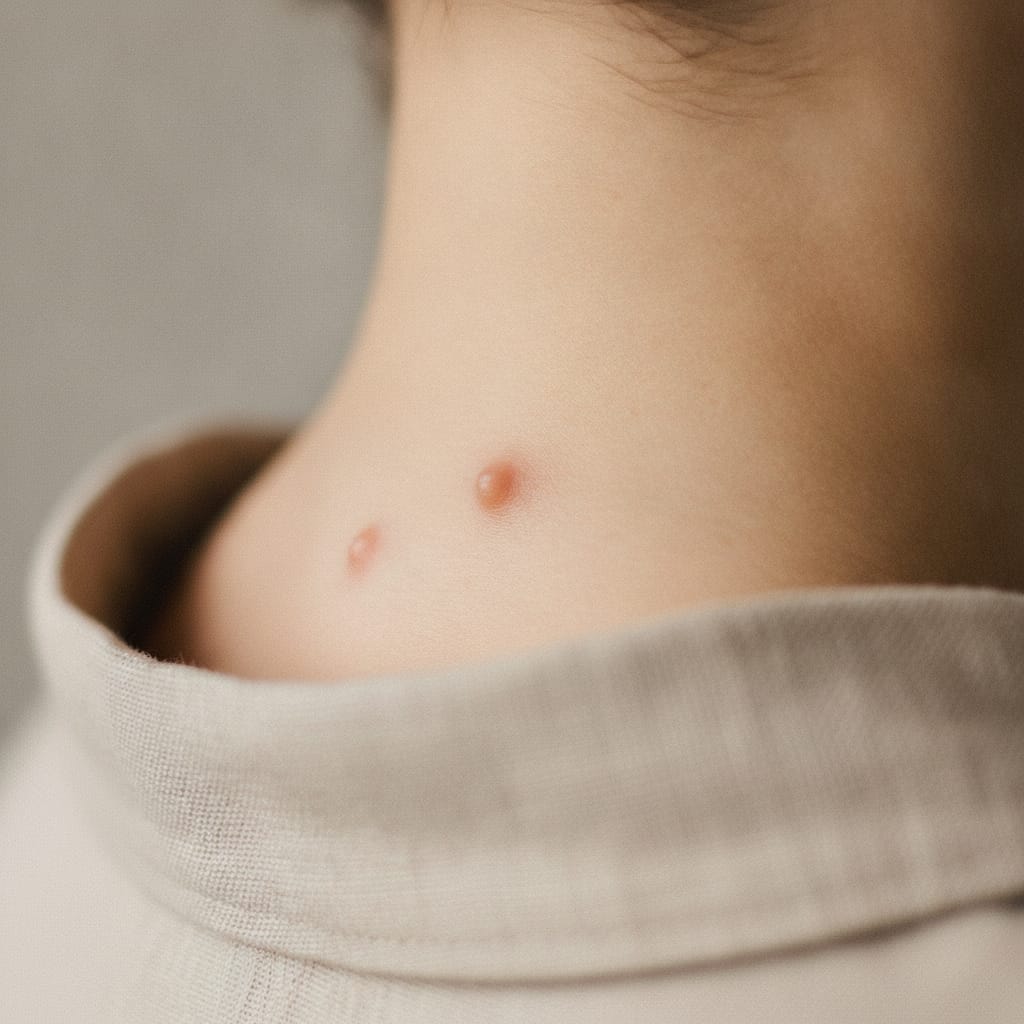
Have you ever looked in the mirror and noticed a tiny piece of skin hanging from your neck? Perhaps you have one under your arm that catches on your clothing, or a small growth near your eyelid that seems to have appeared out of nowhere.
Your first thought might be, “What on earth is that?”
Skin tags are extremely common, particularly as we get older. Most are harmless, but they can be irritating, unsightly and, occasionally, mistaken for something that needs medical attention.
In the pharmacy, people often ask whether they should leave them alone, buy something to remove them or get them checked. The answer depends on what the growth actually is.
What exactly is a skin tag?
A skin tag is a small, soft growth made up of loose collagen fibres and blood vessels covered by skin. It is usually flesh-coloured or slightly darker and often hangs from the skin on a narrow stalk.
They commonly appear around the neck, under the arms, beneath the breasts, around the groin and on the eyelids. Some are barely noticeable, while others can grow to several centimetres. (NHS – Skin tags)
They are not caused by poor hygiene, and ordinary skin tags are not contagious. You cannot catch them from another person.
They are also different from warts, which tend to have a firmer, rougher surface. Moles are different again and may be flat or raised, often with their own characteristic colour and shape.
The difficulty is that not every small growth is a skin tag. If you are unsure what you are looking at, it is better to have it assessed rather than assume.
Why do we get them as we get older?
There is no single explanation for every skin tag, but friction appears to play a part.
Think about the areas where they usually develop. The neck rubs against collars and jewellery. The armpits and groin are areas where skin folds and rub together. Over time, repeated friction may encourage these little growths to develop.
Age is another factor. Skin tags become more common as people get older, although younger adults can develop them too.
They are also more common in people living with obesity, partly because there may be more skin folds and friction. Hormonal changes during pregnancy can contribute as well. (NHS – Skin tags)
There is another association worth knowing about: type 2 diabetes and insulin resistance.
People with insulin resistance may develop multiple skin tags. However, having a few skin tags does not mean you have diabetes, and skin tags alone cannot diagnose it.
If you have noticed many new skin tags, particularly alongside other risk factors for type 2 diabetes, it may be worth discussing your overall diabetes risk with your GP. Do not panic or assume the worst simply because you have found one on your neck.
Should you leave them alone?
If a skin tag has been identified as such, is stable and causes no discomfort, usually the simplest option is to leave it alone.
There is no medical need to remove every skin tag.
However, some catch on necklaces, collars or shaving equipment. Others become irritated by rubbing, or people simply dislike their appearance. That is understandable; even a harmless growth can be bothersome when it is in a prominent place.
If removal is important to you, speak to your GP or an appropriately qualified healthcare professional about the options.
Depending on the size and position, removal may involve freezing, heat or cutting the tag away using a suitable medical technique. There can be bleeding, infection, scarring or changes in skin pigmentation afterwards. These risks are particularly worth considering if the growth is on the face or eyelid. (NHS – Skin tags)
In England, removal for cosmetic reasons is generally not provided by the NHS. Treatment may be considered where there is a medical reason, depending on the circumstances and local arrangements.
Please don’t cut them off at home
This is the advice I would emphasise most strongly.
It may be tempting to snip off a skin tag with scissors, tie cotton around it or try an online remedy promising instant removal. Resist the temptation.
Even a small growth contains blood vessels. Cutting it can cause bleeding, and using unsterile equipment or unsuitable products can lead to infection, burns and scarring.
Be particularly cautious with products marketed for wart removal. A wart is not the same as a skin tag, and treatments designed for warts may damage the surrounding skin. Never use an over-the-counter wart treatment on a growth unless the product specifically permits that use and you have confirmed what the growth is.
Do not attempt to remove a tag on the eyelid yourself. The eye and surrounding skin are especially vulnerable to injury.
The NHS specifically advises against removing skin tags yourself unless a GP recommends it. (NHS – Skin tags)
When should you get a skin tag checked?
Most skin tags are harmless, but there are times when a growth should not simply be dismissed.
Arrange a GP appointment if it:
- grows noticeably or changes in appearance
- becomes painful
- starts bleeding without an obvious explanation
- looks unusual or you are not sure it is a skin tag
- appears alongside a sudden increase in the number of growths.
A growth that changes colour, develops an irregular appearance or repeatedly bleeds deserves particular attention. These features do not automatically mean cancer, but they are reasons to get the diagnosis checked rather than treat the growth yourself. The NHS also advises getting changing or bleeding skin growths assessed. (NHS – Skin tags)
If a growth has been removed and subsequently returns, or a lump is persisting and you are unsure what it is, seek medical advice too.
Can we prevent skin tags?
Unfortunately, there is no guaranteed way to prevent them. Some people develop them despite being otherwise healthy and having no obvious risk factors.
If friction is a problem, comfortable clothing and avoiding unnecessary rubbing may help reduce irritation, although this will not guarantee that new tags will not appear.
Maintaining a healthy weight and looking after your general health are worthwhile for many reasons, but there is no need to embark on a drastic diet simply to get rid of a few skin tags. Nor should you buy expensive creams claiming to dissolve them without good evidence.
The sensible approach is to recognise what they are, avoid damaging them and seek advice if anything changes.
A little growth, a sensible response
Skin tags are one of those small changes that can make us worry more than we expect. We notice something new, search online, and suddenly a harmless bump becomes a source of anxiety.
Most of the time, there is no reason to be alarmed. But the first step is making sure it really is a skin tag.
As a pharmacist, I would rather someone ask about a small growth than attempt to burn, cut or freeze it at home. A quick assessment can provide reassurance, and if it needs treatment, there are safer ways to go about it.
Until next time, look after yourself.
This article is for general health information and is not intended to replace individual medical advice.
Health Matters (zaynp100@yahoo.com) is a content creator under the Newswav Creator programme, where you get to express yourself, be a citizen journalist, and at the same time monetize your content & reach millions of users on Newswav. Log in to creator.newswav.com and become a Newswav Creator now!
The User Content (as defined on Newswav Terms of Use) above including the views expressed and media (pictures, videos, citations etc) were submitted & posted by the author. Newswav is solely an aggregation platform that hosts the User Content. If you have any questions about the content, copyright or other issues of the work, please contact creator@newswav.com.