
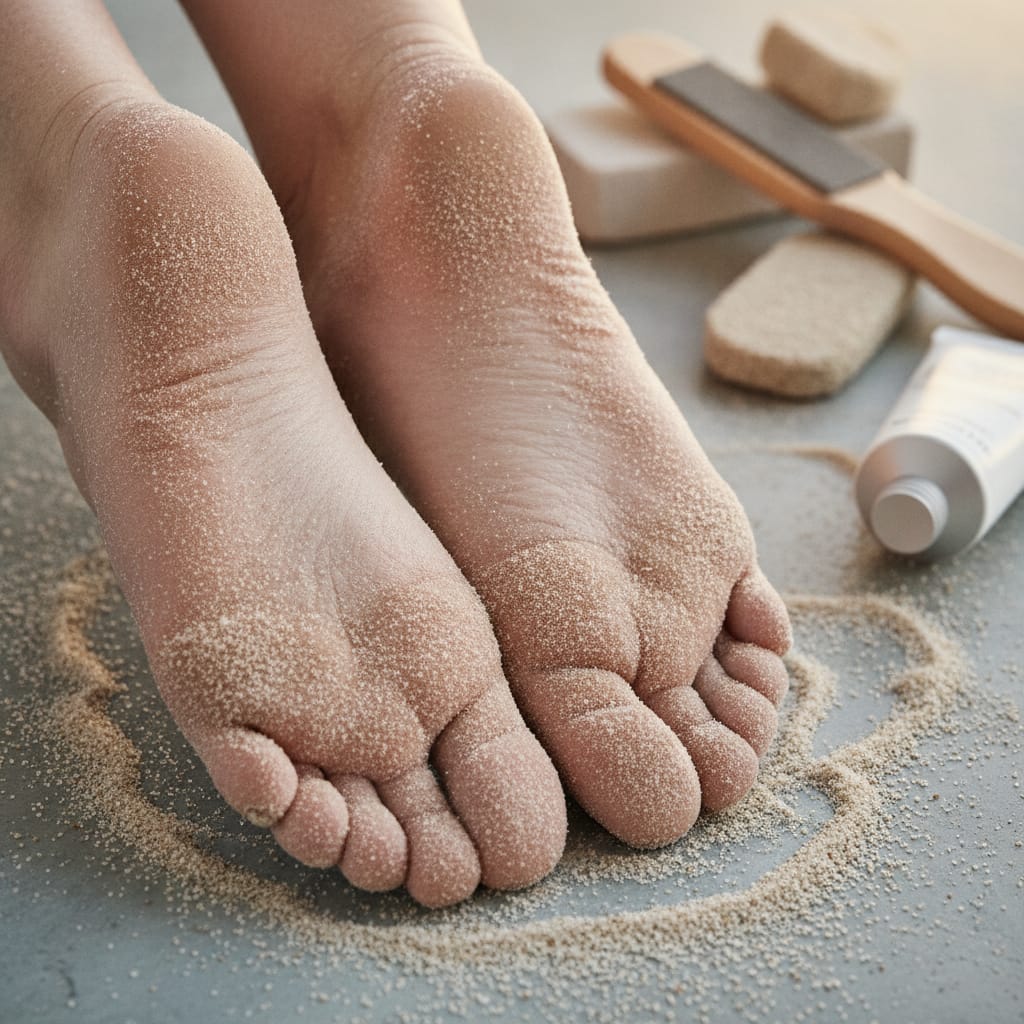
There is something rather unglamorous about getting older that nobody really warns you about.
Your feet start changing.
The heels become rough. The skin underneath the ball of the foot feels thick and dry. You run your fingers over it and it feels like sandpaper. Sometimes there are little cracks, and occasionally the skin catches on your socks.
Then you start attacking it with a pumice stone, foot file or whatever happens to be within reach.
I have seen this many times in pharmacy. Usually it is nothing serious, but there is a reason it becomes more common as we get older — and simply rubbing away the hard skin isn’t always the best answer.
Why does it happen?
The skin on the soles of our feet has a difficult job.
It has to carry our entire body weight, absorb pressure and cope with friction from walking and footwear.
Over time, repeated pressure and friction stimulate the skin to become thicker. This is the body’s protective response and produces what we commonly call a callus. DermNet: Corns and calluses
The ball of the foot is particularly prone to this because it takes considerable pressure when we walk.
The heels are different. The skin there can become extremely dry, and as we get older our skin generally becomes less effective at retaining moisture. Dry skin can develop cracks and fissures, particularly when combined with pressure. DermNet: Cracked heel
Put pressure, friction, ageing skin and dryness together and you have the perfect recipe for feet that feel rather like fine-grade sandpaper.
Is it just dry skin?
Not always.
There are several things that can produce a rough sole.
Dry skin tends to feel tight, flaky or rough and is often worse around the heels.
Calluses are usually thicker areas of hard skin over pressure points, such as the ball of the foot or heel. DermNet: Corns and calluses
Corns are smaller, more concentrated areas of hard skin caused by pressure. They can be surprisingly painful when you walk.
There are also skin conditions, including eczema and psoriasis, which can make the soles dry, thick and cracked.
And sometimes what looks like ordinary hard skin can actually be a wart, particularly if there are small black dots within it or the area is painful when squeezed from the sides.
So not every rough patch should automatically be attacked with a foot file.
Why does it seem worse after 50?
Ageing changes the skin throughout the body.
It generally becomes drier and less able to retain moisture. Dry skin is particularly common in older adults. DermNet: Dry skin
The cushioning in the foot can also change with age. The fatty padding under the heel and ball of the foot doesn’t necessarily provide the same protection it once did.
That means some people start putting pressure on areas of the foot differently.
Foot shape can change too, and old footwear that was perfectly comfortable for years may suddenly start creating pressure points.
There is also a simple issue that many people overlook:
we don’t moisturise our feet as regularly as we moisturise the rest of ourselves.
Nobody wakes up thinking, “I must remember to moisturise my heels.”
Until they crack.
What are the symptoms?
The usual complaints are pretty straightforward.
The skin feels rough, thick or dry. It may look white, flaky or yellowish, particularly where there is significant callus.
The heels may develop cracks or fissures.
A callus under the ball of the foot can feel as though you are walking on a small lump.
Sometimes the area becomes tender or painful, particularly when wearing hard-soled shoes or walking for long periods.
If a crack becomes deep enough, it can bleed and become vulnerable to infection. Severe cracked heels can occasionally become infected and may require professional treatment. DermNet: Cracked heel
So what can you do?
The first thing I usually recommend is remarkably simple:
Moisturise regularly.
For very dry, thickened feet, look for a foot cream containing urea.
Urea is particularly useful because it acts as a moisturiser and, at higher concentrations, also helps soften and loosen thickened, hardened skin. Urea-containing preparations are commonly used for dry, thickened and callused skin.
For ordinary dryness, a lower-strength urea preparation may be sufficient. For very thick callused skin, stronger preparations are available.
Apply it regularly, ideally after washing and drying the feet.
One important rule:
Don’t put moisturiser between the toes.
The skin between the toes tends to stay moist already, and adding more moisture can make the area soggy and increase the risk of skin problems, including fungal infection. Diabetes UK: Taking care of your feet
What about pumice stones and foot files?
They can be useful.
But moderation is the word.
Gently removing some dead, thickened skin after bathing can make the feet feel considerably smoother. Pumice stones and files are recognised options for reducing hard skin. NHS: Corns and calluses
What I don’t recommend is aggressively filing until the skin is pink and tender.
Remember, the callus developed partly because the skin was trying to protect itself from pressure.
If you remove huge amounts of it and continue subjecting the foot to exactly the same pressure, the skin will simply try to build it back.
It becomes a never-ending battle.
Sort out the shoes as well
If you repeatedly develop a thick callus in exactly the same place, ask yourself why.
Is the shoe pressing there?
Are you spending a lot of time standing?
Are your feet changing shape?
Are you walking differently because of knee, hip or back problems?
Sometimes the best treatment for a callus isn’t another cream.
It is reducing the pressure that caused it in the first place.
Comfortable, properly fitting footwear can make a considerable difference. Cushioned insoles or heel pads can also help redistribute pressure. NHS: Corns and calluses
Don’t cut it off yourself
This is particularly important.
Please don’t take a razor blade, scissors or other sharp instrument to thick skin on your feet.
I’ve heard some inventive methods over the years, but cutting away callus yourself can result in wounds, bleeding and infection.
This is especially important for people with diabetes, poor circulation or reduced sensation in their feet.
For people with diabetes, foot problems can become serious because nerve damage may reduce sensation and circulation problems can make wounds more difficult to heal. Diabetes UK: Taking care of your feet
If you have diabetes and significant callusing, cracks, wounds or changes in the skin of your feet, get professional advice rather than treating it aggressively yourself. Diabetes UK specifically advises against using blades on corns or tough skin.
When is it more than ordinary dry skin?
See a pharmacist, GP or podiatrist if the problem isn’t improving, particularly if you notice:
- Deep or bleeding cracks
- Increasing pain
- Redness, warmth or swelling
- Pus or discharge
- A wound that isn’t healing
- Sudden changes in the skin
- Significant swelling
- Loss of sensation
- A painful thickened area that doesn’t improve with ordinary care
If you have diabetes, don’t simply treat persistent corns, calluses or cracks yourself. Professional assessment is recommended because seemingly minor foot problems can become more serious. Diabetes UK: Taking care of your feet
And if the skin is intensely itchy, peeling or cracking between the toes as well as underneath the foot, athlete’s foot could be involved rather than simple dryness.
The good news
For most people, the sandpaper feeling under the feet is not a sign that something is seriously wrong.
It is usually the result of a combination of dry skin, pressure and callus formation. DermNet: Corns and calluses
The trick is not to wage war on your feet once a month.
A little daily maintenance works much better.
Wash them, dry them properly, moisturise the dry areas, wear comfortable footwear and deal with excessive pressure before it produces a thick callus.
And don’t forget to look at your feet occasionally.
We spend most of our lives looking after our faces, yet our feet are the ones carrying us around all day.
After 50, they deserve a little more attention.
Because when your feet start feeling like sandpaper, the answer isn’t necessarily a bigger file.
Sometimes they just need a little moisture, a little cushioning and a little kindness.
Until next time, look after your feet — they’re carrying more than just your weight.
The Daily Durian (zaynp100@yahoo.com) is a content creator under the Newswav Creator programme, where you get to express yourself, be a citizen journalist, and at the same time monetize your content & reach millions of users on Newswav. Log in to creator.newswav.com and become a Newswav Creator now!
The User Content (as defined on Newswav Terms of Use) above including the views expressed and media (pictures, videos, citations etc) were submitted & posted by the author. Newswav is solely an aggregation platform that hosts the User Content. If you have any questions about the content, copyright or other issues of the work, please contact creator@newswav.com.