
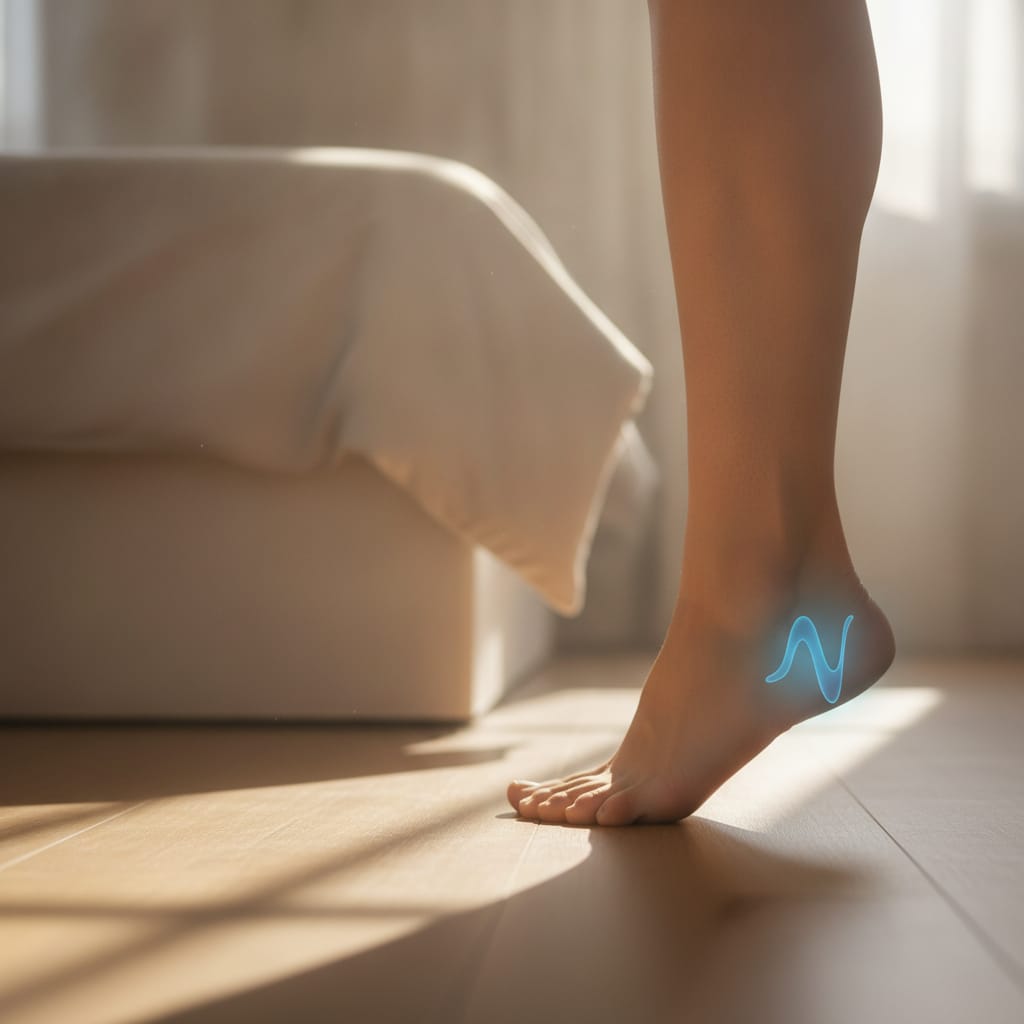
There is a particular type of foot pain that catches people out.
You get out of bed in the morning.
You take your first step.
And suddenly:
“Ouch!”
It feels as though you’ve stood on something sharp.
You limp towards the bathroom.
After a few minutes of walking around, strangely, it starts to ease.
So you think nothing more of it.
Until the following morning.
Same thing.
And then again.
Eventually, you find yourself getting out of bed like an elderly penguin, trying to avoid putting your heel down properly.
This is something I’ve heard plenty of times in the pharmacy.
And one of the common explanations is plantar fasciitis, sometimes referred to more broadly as plantar heel pain.
The first few steps are the clue
The plantar fascia is a strong band of tissue running along the bottom of your foot.
It helps support the arch and takes a considerable amount of load when you stand, walk and run.
When this area becomes irritated or overloaded, pain can develop underneath the heel or along the arch. (nhs.uk)
One of the classic features is that the pain is particularly bad when you first start walking after sleeping or resting.
Then you walk around for a while and it may ease.
Unfortunately, that doesn’t necessarily mean the problem has gone away.
Stand or walk for a long time and the pain may return.
That pattern is one of the reasons I would ask someone complaining of heel pain:
“Is it worst when you first get out of bed?”
It isn’t necessarily because you’ve injured yourself
This is another thing people find surprising.
Plantar heel pain often develops gradually.
There may not have been one particular accident.
You haven’t fallen.
You haven’t twisted your ankle.
You haven’t kicked anything.
Instead, the tissues of the foot have simply been subjected to more stress than they are coping with.
That can happen if you’ve suddenly increased your walking or running, spent a lot more time standing, changed the surface you’re exercising on, gained weight, or started wearing shoes that don’t give your feet much support. (Berkshire Healthcare)
I’ve also seen people develop it after going away on holiday.
They spend a week walking considerably more than usual, often in sandals or flip-flops, and come home wondering why their heels are complaining.
Your feet remember.
And your shoes really do matter
If your usual footwear consists of something very flat, thin or unsupportive, your feet may be working considerably harder than you realise.
The NHS recommends shoes with cushioned heels and good arch support for plantar fasciitis and advises avoiding walking barefoot on hard surfaces while the heel is painful. (nhs.uk)
This doesn’t mean you need to spend hundreds of pounds on specialist footwear.
A properly fitting pair of supportive shoes may be all that is needed.
Simple insoles or heel pads can also help some people.
This is another area where a pharmacist can be useful because we can talk through the symptoms and suggest appropriate over-the-counter options.
What about the painkillers?
This is where I would be a little more careful than simply saying:
“Take ibuprofen.”
Yes, anti-inflammatory medicines such as ibuprofen can sometimes be used for foot and heel pain.
But they aren’t suitable for everyone.
If you have a history of stomach ulcers, kidney problems, certain heart or circulation conditions, are taking particular medicines, or have been advised to avoid anti-inflammatory medicines, you should check with a pharmacist or doctor before using them.
Even an over-the-counter medicine isn’t automatically suitable for everybody.
Depending on the individual, paracetamol or a topical anti-inflammatory gel may be more appropriate.
The important thing is to match the medicine to the person rather than treating the heel in isolation.
Don’t completely stop moving
This is another common mistake.
Someone develops heel pain and decides:
“Right. I’m not walking at all.”
Some reduction in the activity that aggravates the pain can certainly help.
But complete inactivity isn’t necessarily the answer.
The NHS recommends gentle stretching and suggests activities that put less pressure on the feet, such as swimming, while symptoms settle. (nhs.uk)
The idea is to reduce the irritation without turning yourself into a permanent sofa resident.
If running is causing the pain, for example, temporarily reducing running and maintaining fitness with a lower-impact activity may make more sense than doing nothing at all.
Stretching can help
Regular gentle stretching of the foot and calf is commonly recommended for plantar heel pain. (nhs.uk)
And there is one practical point I think is particularly useful.
If your heel hurts most when you first get out of bed, don’t leap straight up and start walking around.
Sit on the edge of the bed for a moment.
Move your ankle gently.
Stretch the calf and sole of the foot.
Then stand up.
It won’t magically cure plantar fasciitis, but for some people it can make those first few steps more manageable.
Don’t blame the “heel spur”
I often hear people say:
“My doctor told me I’ve got a heel spur.”
And immediately they assume the spur must be what’s causing all the pain.
Not necessarily.
Heel spurs can be seen alongside plantar heel pain, but the presence of a spur doesn’t automatically mean it is the source of the pain.
The important thing is the clinical picture rather than simply what happens to appear on an X-ray.
So I wouldn’t become obsessed with finding a “spur” and getting rid of it.
The focus should be on the pain, the underlying factors and appropriate treatment.
It can take longer than you expect
This is perhaps the most frustrating part.
People often expect a painful heel to settle within a few days.
Sometimes it does.
But plantar heel pain can take considerably longer to improve.
That is why consistency matters.
Wear supportive footwear.
Reduce activities that aggravate it.
Do the stretches regularly.
Use appropriate pain relief if required.
And give the tissue time.
Trying something for three days, deciding it hasn’t worked and then moving on to something else isn’t necessarily going to solve the problem.
But don’t assume every heel pain is plantar fasciitis
This is important.
Heel pain has many possible causes.
Achilles tendon problems can cause pain at the back of the heel.
Bursitis can cause pain and swelling.
An injury can fracture the heel.
Nerve problems can cause pain, tingling or loss of sensation.
So if you have severe pain following an injury, heard a snap or pop, cannot walk properly, or have significant swelling or bruising, don’t simply assume you have plantar fasciitis. The NHS recommends urgent assessment in these circumstances. (nhs.uk)
Likewise, if you have diabetes and develop heel or foot pain, it is important to seek medical advice because foot problems can be more serious in people with diabetes. (nhs.uk)
When would I tell someone to see the doctor?
If the pain is severe, getting worse, keeps returning or is stopping you doing your normal activities, it deserves assessment.
The NHS advises seeking medical advice if heel pain has not improved after about two weeks of appropriate self-care, or if there is tingling or loss of sensation. (nhs.uk)
And if you’re unsure what is actually causing the pain, don’t spend months treating the wrong problem.
A GP, physiotherapist, podiatrist or other appropriate healthcare professional can assess it properly.
Your feet carry you all day
We don’t tend to think much about our feet until they hurt.
Then suddenly every trip to the kitchen becomes an event.
Heel pain can be surprisingly disabling because you can’t exactly avoid using your feet.
So if those first steps in the morning feel like you’ve stepped on a nail, don’t simply accept it as another inevitable part of getting older.
Look at your footwear.
Think about whether you’ve suddenly increased your activity.
Give the foot a chance to settle.
Try appropriate stretching.
And speak to your pharmacist about pain relief or insoles if you’re unsure what is suitable.
And if the pain persists or doesn’t fit the usual pattern, get it checked.
Because sometimes the difference between limping through the day and walking normally again is not some miracle treatment.
It is simply understanding what is actually causing the pain.
Until next time, look after yourself.
This article is for general health information and is not intended to replace individual medical advice.
Health Matters (zaynp100@yahoo.com) is a content creator under the Newswav Creator programme, where you get to express yourself, be a citizen journalist, and at the same time monetize your content & reach millions of users on Newswav. Log in to creator.newswav.com and become a Newswav Creator now!
The User Content (as defined on Newswav Terms of Use) above including the views expressed and media (pictures, videos, citations etc) were submitted & posted by the author. Newswav is solely an aggregation platform that hosts the User Content. If you have any questions about the content, copyright or other issues of the work, please contact creator@newswav.com.