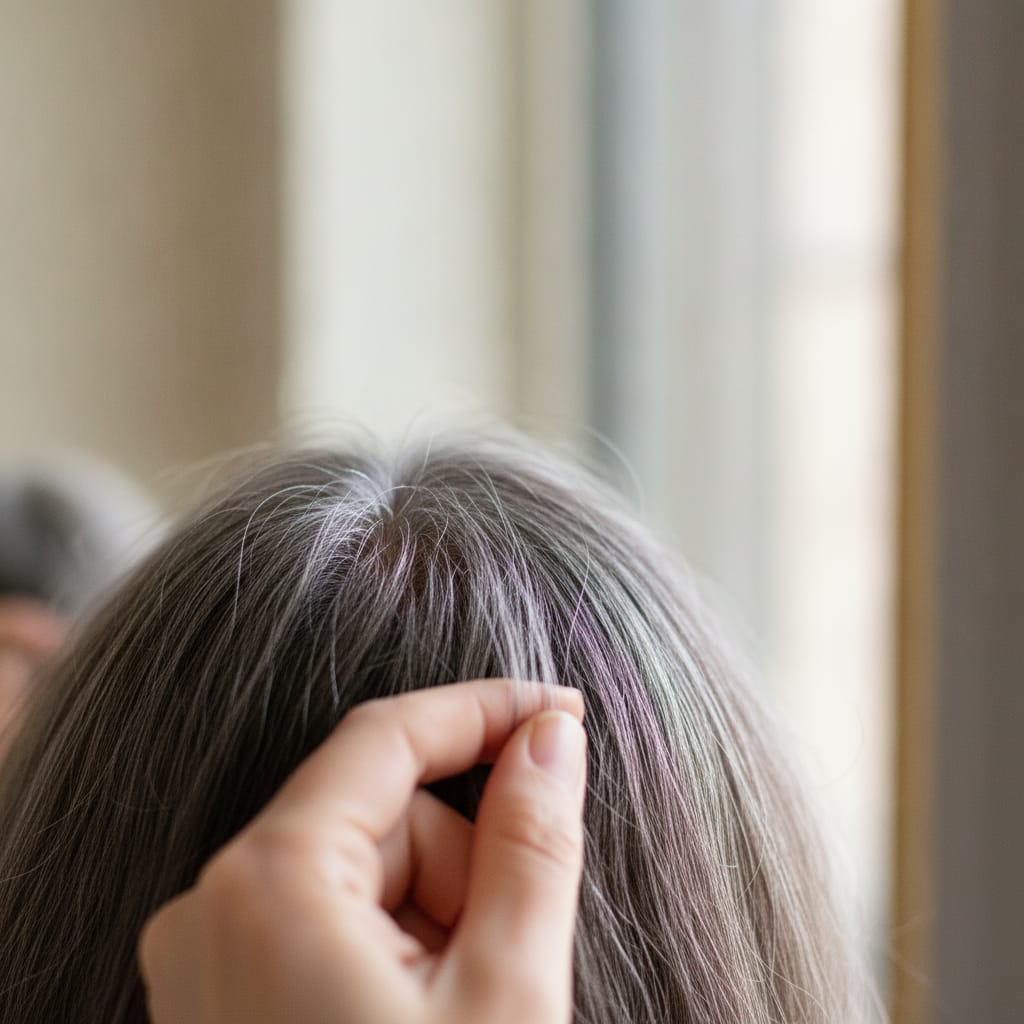
There is a moment many of us remember.
You look in the mirror, spot one white hair and immediately reach for the tweezers.
Then you find another.
And another.
Before long, you are standing there wondering whether your hair has suddenly decided to betray you.
White and grey hair is one of those things we tend to associate with getting older. And, in most cases, that is exactly what it is. But there is more to the story than simply blaming age, stress or “bad genes”.
What actually makes hair white?
The colour of our hair comes from a pigment called melanin. Special cells in the hair follicle, called melanocytes, produce this pigment and transfer it into the growing hair.
As we get older, the melanocytes and their pigment-producing system gradually become less effective. Eventually, less and less melanin reaches the growing hair.
The result is hair that becomes grey, silver and eventually white.
Technically, white hair isn’t really white because of a new pigment. It contains little or no melanin, so it appears white because of the way light is reflected from the hair shaft. Grey hair is generally a mixture of pigmented and non-pigmented hairs. (PMC)
The timing varies enormously between people.
Some people start noticing grey hairs in their twenties. Others still have plenty of their natural colour much later in life.
And this is where your parents may deserve some of the blame.
Blame your genes
If your mother or father went grey early, there is a reasonable chance you may do the same.
Genetics is one of the major factors determining when your hair starts losing its pigment.
This is why two people of exactly the same age can look completely different. One may have a full head of dark hair while the other has been silver for years.
There isn’t a magic age when everyone is supposed to turn grey. Hair greying is a complex process involving ageing, genetics and changes within the pigment-producing cells of the hair follicle. (PMC)
Does stress cause white hair?
This is one of the questions I hear regularly in practice.
People will say:
“I never had grey hair until I went through a stressful period.”
There is some science behind the idea that significant stress can affect the biology of hair pigmentation, although the relationship isn’t as simple as “stress equals white hair”.
Normal day-to-day stress isn’t going to turn your hair white overnight.
Hair itself is not alive once it has grown out of the scalp. So a dark hair shaft doesn’t suddenly turn white because you had a bad day.
What can happen is that changes within the hair follicle affect pigmentation as new hair grows.
Research has found that stress can affect melanocyte stem cells involved in maintaining hair pigmentation. However, some of the strongest experimental evidence comes from animal research, so it would be an exaggeration to say that every stressful period in humans directly causes grey hair. (Nature)
Genetics and ageing remain the major explanations for ordinary greying.
What about vitamin deficiencies?
This is where things become more interesting.
Although most greying is simply genetic and age-related, certain nutritional deficiencies and medical conditions have been associated with premature greying.
Vitamin B12 deficiency is one example. Thyroid disorders, autoimmune conditions and some nutritional deficiencies have also been associated with premature changes in hair pigmentation. (PMC)
That doesn’t mean everyone with grey hair needs a battery of blood tests.
If someone is otherwise healthy and their hair is gradually becoming grey in their thirties, forties, fifties or later, there is usually no underlying disease to find.
But if greying occurs unusually early, develops rapidly or is accompanied by other symptoms, it is worth discussing with a doctor.
Does pulling out a white hair make more grow?
No.
This is one of those myths that refuses to die.
If you pull out one white hair, you haven’t caused the surrounding hairs to turn white.
That follicle will generally grow another hair, and if the pigment-producing cells have stopped producing melanin, the replacement hair will probably be white or grey too.
But repeatedly plucking hairs isn’t a great habit. It can irritate or traumatise the follicle and, with repeated damage, contribute to local hair problems.
So if the white hairs are bothering you, colouring them is probably a better option than conducting daily warfare with tweezers.
Can you turn white hair back to its original colour?
This is where I have to disappoint anyone hoping for a miracle shampoo.
For ordinary age-related greying, there is currently no proven treatment that reliably restores the original hair colour. (PMC)
If greying is associated with an underlying nutritional deficiency or medical condition, treating that problem may help prevent further changes and, in some circumstances, pigmentation may return.
But taking handfuls of vitamins when you aren’t deficient is unlikely to turn a silver head back to black.
The same applies to the endless collection of shampoos, oils and supplements marketed as “anti-greying” solutions.
If somebody promises to reverse normal age-related greying simply by applying a particular oil to your scalp, keep your wallet firmly in your pocket.
Is white hair healthier or weaker?
White hair isn’t necessarily unhealthy.
However, hair that has lost pigment can sometimes feel different. It may appear coarser, drier or more wiry, although this varies from person to person.
Good general hair care still matters: avoid excessive heat, harsh chemical treatments and unnecessary damage.
And remember that a thinning scalp with grey or white hair still needs protection from the sun. Wearing a hat is a remarkably simple way of reducing direct sun exposure to the scalp.
Should you worry about going grey?
Usually, no.
For most people, grey or white hair is simply another part of getting older — although how early it happens is largely influenced by your genes.
If you notice a few silver hairs appearing, there is no reason to panic, rush out for supplements or start blaming every stressful conversation you’ve ever had.
But if the change is very sudden, unusually early, associated with significant hair loss, changes in your skin, tiredness, weight changes or other unexplained symptoms, speak to your doctor. Sometimes the hair is simply the first thing that makes us notice that something else needs checking.
And if you don’t like your new silver highlights, there is always hair dye.
Personally, I think grey hair is one of the few things that nature gives us for free and the hairdresser charges us to cover.
Until next time, embrace the silver — or don’t. At least now you’ll know what’s happening up there.
The Daily Durian (zaynp100@yahoo.com) is a content creator under the Newswav Creator programme, where you get to express yourself, be a citizen journalist, and at the same time monetize your content & reach millions of users on Newswav. Log in to creator.newswav.com and become a Newswav Creator now!
The User Content (as defined on Newswav Terms of Use) above including the views expressed and media (pictures, videos, citations etc) were submitted & posted by the author. Newswav is solely an aggregation platform that hosts the User Content. If you have any questions about the content, copyright or other issues of the work, please contact creator@newswav.com.