
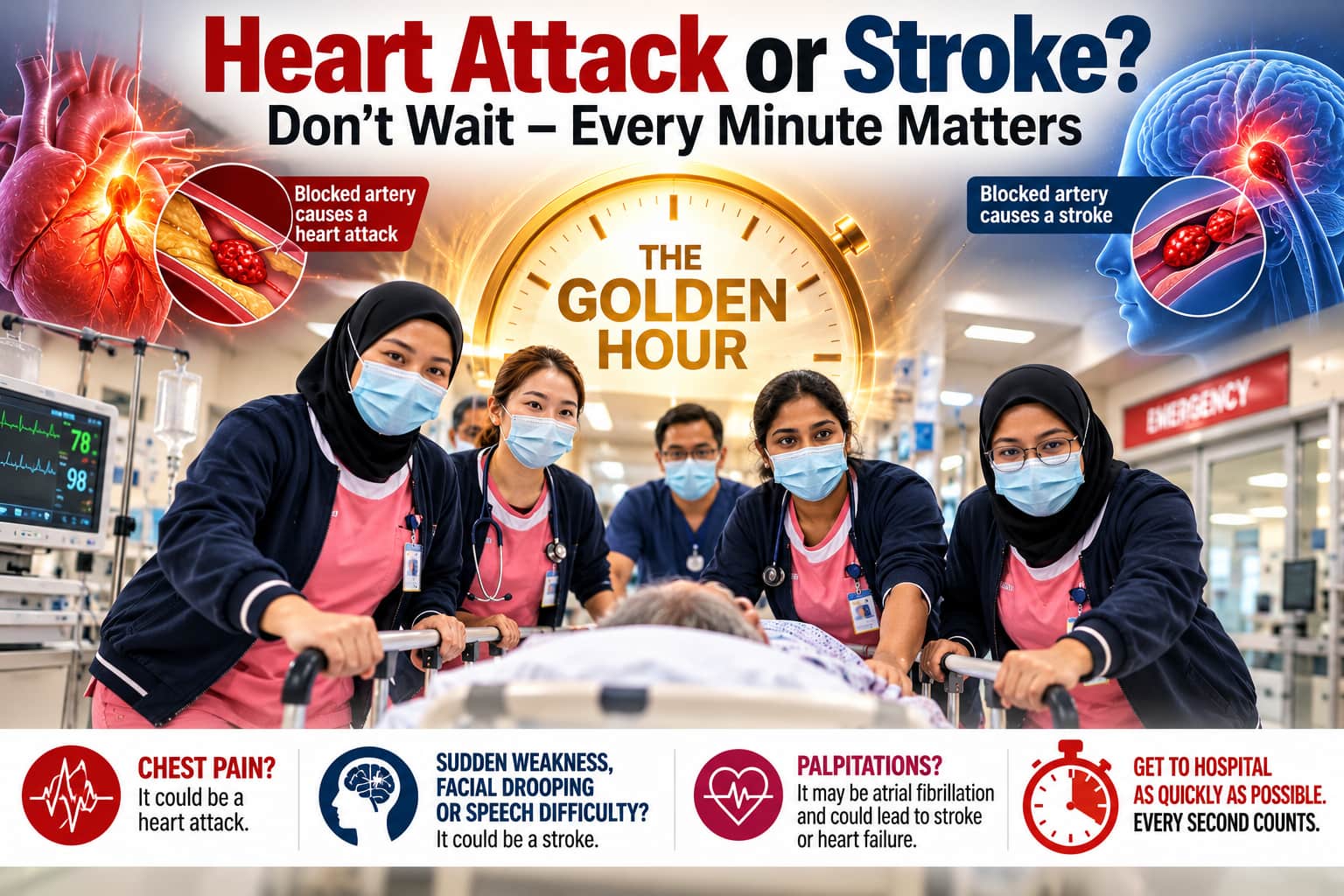
I had just returned after 2 peaceful days of birding in Fraser’s hill. It was 930 am. I was processing the bird photographs that I had taken when the phone rang – Emergency Room (ER) flashed on my phone and I knew that the peace I had felt the last 48 hours was going to be abruptly ended. Dr Paran, my ER physician was calling to say that Mr Tan, a diabetic and hypertensive who was last seen in my clinic two years ago had presented with chest pain, which had started the evening before. The ECG was showing a massive anterior myocardial infarction (large heart attack). This means that one of the arteries (coronary artery) supplying blood to the heart muscle has become abruptly blocked by a blood clot, and that heart muscle in the affected area was dying. Left untreated a whole host of complications would arise, including irregular heart rthymns that will stop the heart and result in death and heart failure with both short and long term consequences. It is now established medical practice that this illness be treated urgently with procedures that will open up and re-establish blood flow down the blocked coronary vessel. There are 2 options – infusion of a powerful drug (thrombolytic agent) that can dissolve the occluding blood clot or more effective than this, a procedure called coronary angioplasty, where a wire and balloon are passed across the area of blockage, the blockage cleared and blood flow reestablished. Heart attack is a medical emergency and the clock for treatment starts ticking from the moment the patient walks through the hospital door. Treatment given is now monitored by KPIs and any delay in delivering treatment will result in the responsible hospital team to be questioned by a hospital appointed committee. All this is to ensure that the patient gets prompt treatment because the faster the occluded artery gets unblocked, the more heart muscle that will get saved. The best results are obtained if the blocked artery can be re-opened within 1 hour of the onset of chest pains – the Golden Hour – in this circumstance all the heart muscle can potentially be saved and the patient can walk out of the hospital with his heart completely salvaged and I have seen this happen several times over the years. Besides prompt treatment given by the hospital team, this can happen only if the patient comes to hospital soon after onset of symptoms.
So the moment I received Dr Paran’s call, I drove to the hospital immediately. Traffic was light at that hour so I was in ER in 15 minutes. Dr Paran had alerted the team in the catheterization laboratory (a special room in the hospital equipped to perform angioplasty) at the same time that he had called me – the nurses and technicians were ready to receive the patient. I took a quick history and did a physical exam. I was disappointed that Mr Tan had missed the Golden hour – the pain had started before midnight, but he had rested at home thinking that it was muscular pain and that it would settle. Only when he started perspiring in the morning that he felt something serious was happening and decided to seek medical help. I was grateful however as his blood pressure was normal and that he was not in heart failure (some patients with this type of heart attack would present with low blood pressure and or fluid in the lungs - the result of the heart being significantly damaged). The procedural risks in this latter type of patient would be high and patients could die as the procedure to unclog their artery was being done. The ECG (electrical pattern of the heart) done on Mr Tan upon arrival showed that the heart attack was still fresh and he was still having chest pain – all signs that he would benefit from the emergency angioplasty. We rushed him to the catheterization lab. Angiograms (dye injected into the heart arteries to determine the site of the block) confirmed that a major heart artery was totally blocked in its proximal position. Angioplasty promptly reestablished flow down the artery, Mr Tan started feeling better and his ECG looked better. Mr Tan was discharged home well 5 days later.
Soon after I settled Mr Tan, the ER called again. This time Dr Paran informed me that Mrs Lee, aged 80, an old neighbour of mine had been having palpitations from the night before and was requesting for me to treat her. She had moved out of our neigbourhood following the passing of her husband and had not seen me for about 15 years. My clinical examination revealed that she had not lost the cheerfulness that had been her trademark, that she was comfortable but that her heart was beating irregularly and fast – a well known abnormal irregular rthymn of the heart, that, left untreated, could result in heart failure but even more importantly result in a stroke (blocked artery in the brain). The stroke happens because during this abnormal heart rthymn, the upper chambers of the heart stop contracting – this causes blood to stagnate within the chamber and form a clot. This clot can then flow out of the heart chamber and go obstruct any blood vessel in the body – if the blood vessel is the one supplying blood to the brain, a stroke will result. This abnormal rthymn is called Atrial Fibrillation (AF) and in the last 10 years or so, major advances have been made in its management which have resulted in vastly improved outcomes for patients. Alcohol abuse, high blood pressure, abnormal heart valves and blockages in heart arteries are some of the causes of AF. Mdm Lee had none of these. I admitted her to the intensive care(CCU). A drug (Amiodarone) known to be very effective to revert her abnormal heart beat to normal was started as an injection. I also gave her an injection of a blood thinner to prevent formation of blood clots within the heart chamber. Mdm Tan remained comfortable and about 10 hours after admission her heart rthymn returned to normal. Everyone was happy. Being the ebullient person that she was, Mdm Tan chatted happily with my CCU nurses. The following morning the nurses gave Mdm Tan a body wipe. She was chatting happily when she suddenly stopped talking, the left side of her face drooped and she was unable to move the right side of her body. Credit goes to staff nurses Nur Aina, Sueyanne, Gowri and Syaidatul who were on duty and who immediately recognised the signs of a stroke and immediately called me. It was 630 hrs in the morning. In the first case described above a blood clot blocking an artery in the heart was damaging heart muscle ; in Mrs Lee’s case a blood clot that had formed within her heart chamber had travelled to her brain and was blocking a brain artery causing her symptoms. Just as in the heart it was vital to reopen this artery as quickly as possible to avert irreversible brain damage. The Golden Hour rule. In Mrs Tan’s case, there was an added advantage – the stroke had happened in front of our eyes. If we all worked fast, her brain could be completely saved. As I dressed quickly, I telephoned my neurologist(brain specialist) on call, Dr Dr Siva Seeta Ramaiah – recognising the urgency of the situation both of us arrived at Mrs Tan’s bedside almost simultaneously. She was unable to talk, the left side of her face drooped and the right side of her body was immobile – all signs of a major stroke. Dr Siva moved fast – Mrs Lee was rushed to the radiology department for a CT scan of the brain to exclude the possibility of bleeding in the brain – thankfully there was none. A decision was made to infuse a powerful clot buster – a drug that had a high chance of dissolving the offending blood clot. About 20 minutes later, almost like a miracle, Mdm Tan smiled – there was no more drooping of her face, she started talking and could move the right side of her body again – full recovery !.
The two cases above illustrate medical emergencies involving the blood vessels supplying two vital organs – the heart and the brain – where time is of the essence. The sooner blood flow is restored, the greater the chance of limiting permanent damage and achieving a good outcome.
What can we learn from these cases?
1. Act quickly. If you develop sudden chest pain, weakness or numbness of a limb, facial drooping, or difficulty speaking, get to hospital as quickly as possible. Every second counts. “Time is Muscle” has long been used to emphasise the importance of early treatment in a heart attack. The same principle applies to stroke – a “brain attack” – where every minute of delay can mean the loss of precious brain tissue.
2. Do not ignore palpitations. A persistently or recurrently fast or irregular heartbeat, particularly in older people, deserves early medical evaluation. It may be atrial fibrillation, a common heart rhythm disorder that, if left untreated, can increase the risk of stroke and may also lead to heart failure.
These two cases remind us of a simple but important message: when it comes to heart attacks and strokes, recognising the warning signs and seeking medical attention early can make the difference between disability and recovery – and, in some cases, between life and death.
Dr. Kannan Pasam (kannan.pasam@gmail.com) is a content creator under the Newswav Creator programme, where you get to express yourself, be a citizen journalist, and at the same time monetize your content & reach millions of users on Newswav. Log in to creator.newswav.com and become a Newswav Creator now!
The User Content (as defined on Newswav Terms of Use) above including the views expressed and media (pictures, videos, citations etc) were submitted & posted by the author. Newswav is solely an aggregation platform that hosts the User Content. If you have any questions about the content, copyright or other issues of the work, please contact creator@newswav.com.