
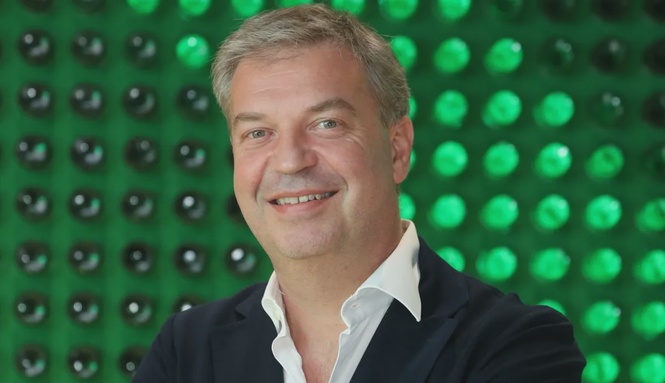
PETALING JAYA: Heineken Malaysia Bhd has begun modernising its brewery in Sungei Way, Petaling Jaya, with a new bottling line as it prepares to support production for the Singapore market under the brewer’s regional supply chain restructuring.
Managing director Martijn van Keulen said the project has already commenced and will strengthen the brewery’s manufacturing flexibility as Heineken gradually transitions Singapore to an import-based supply model.
“This project has commenced already. We will see the first steps in the civil works in the months to come. Basically, we will put a new bottling line on the side there of the brewery,” he said during the group’s second-quarter financial results briefing.
Van Keulen described the project as “a high investment” that would deliver “a top-notch modernised bottling line”, enabling greater production flexibility and supporting different bottle formats.
“It’s much more about modernisation, for the future need from our market here, and also for Singapore and other export markets that might follow as well,” he said.
The brewery upgrade comes as Heineken Malaysia prepares to progressively take over production currently carried out by Asia Pacific Breweries Singapore (APBS) for the Singapore market.
Van Keulen said the company will brew the brands and variants currently produced by APBS in bottles, draught and kegs as brewing operations in Singapore are gradually wound down. “It is definitely true that by the ramp-down of the brewing in Singapore, Heineken Malaysia will start to brew all the brands and variants in bottles, pints, draught and kegs for the Singapore market.”
The entire portfolio for the Singapore market will eventually be integrated into Malaysia’s production.
“The whole portfolio will be integrated, brewed here in Malaysia, and then we export it into Singapore. There’s not a specific brand that we go first or last, it’s much more on how do you phase out the production in Singapore and integrate it here in Malaysia,” Van Keulen said, adding the production transfer will be phased to ensure continuity of supply.
“Closing a brewery is not something that you do in five minutes. You need to ramp that down gradually, and then you have a safe closure of the brewery,” he said.
Asked whether the Sungei Way brewery has sufficient capacity to support the additional production, Van Keulen said the investment is intended to modernise operations rather than expand brewing capacity.
“Yes, it will be sufficient, and it’s really about modernisation of the production line rather than looking at capacity in that sense. Yes, we have sufficient capacity, we are not worried about that. And we have the possibility to further expand as well,” he said.
Heineken Malaysia reported weaker second-quarter earnings, with softer consumer demand and continued inventory normalisation across its customer and distributor network weighing on sales.
Net profit for the second quarter ended June 30, 2026 (Q2’26) fell 39.1% to RM50.53 million from RM83 million a year earlier, while revenue declined 19.4% to RM434.75 million from RM539.73 million.
The quarterly earnings and revenue were the group’s lowest since the third quarter of FY2021, when it recorded a net profit of RM51.02 million on revenue of RM389.85 million.
The brewer said the weaker performance reflected softer consumer sentiment and the continued impact of demand-led inventory normalisation, which began in the first quarter of 2026 as customers and distributors adjusted inventory levels.
The board declared a single-tier interim dividend of 40 sen per share, unchanged from a year earlier, payable on Oct 14.
For the first six months ended June 30, 2026 (H1’26), net profit declined 24.5% to RM154.99 million from RM205.15 million, while revenue fell 15.7% to RM1.10 billion from RM1.30 billion.
Despite the softer operating environment, Van Keulen said the group remains focused on strengthening the business for long-term growth through its EverGreen 2030 strategy.
“Amid softer consumer demand and inventory normalisation in the first half of 2026, we remained focused on strengthening the foundations of the business for long-term growth,” he said in a statement.
The company continues to advance its EverGreen 2030 priorities by strengthening execution, accelerating digital transformation and preparing for export opportunities.
The group said its export activities remain on track to commence in the third quarter of 2026, supporting its EverGreen 2030 strategy to optimise supply chain capacity, enhance economies of scale and improve operational efficiency.
Chief financial officer Jana Hanneman said another initiative is with procurement, where they are looking into how they can leverage the scale, not only in Malaysia, but also with the production that they now do for Singapore, for example, that really drives their costs down.
She said the company has also invested in new equipment to improve the maintenance of returnable bottles, reducing long-term operating costs.