HIGH prices, unclear pricing and hidden charges are the leading reasons Filipinos distrust businesses, with no industry earning a high level of public confidence in the country’s first Philippine Business Trust Index.
The 2026 Philippine Business Trust Index, developed by the EON Group in partnership with Ateneo de Manila University, gave Philippine businesses an overall trust score of 72 out of 100, placing them in the study’s conditional trust category.
The nine sectors, ranked by trust index were Food and Agriculture (75.6); Healthcare and Pharmaceuticals (75.4); Commerce, E-Commerce, and Retail (75.0); Energy and Utilities (73.0); Manufacturing (70.9); Financial Technology (70.8); BPO, ICT, and Technology (68.6); Tourism and Travel (68.6); and Real Estate and Construction (67.7).
None of the nine business sectors examined reached the Robust Trust category, indicating that public confidence in businesses remains limited despite their importance in Filipinos’ daily lives.
Among respondents who identified their least-trusted business sector, 19.7 percent cited prices they considered too high or unreasonable as a reason for distrust. Another 14.7 percent pointed to unclear prices or fees, while 11.7 percent cited hidden charges.
By comparison, 18.6 percent of respondents identified value for money as a reason for trusting their most-trusted business sector.
The findings suggest that consumers’ confidence in businesses depends heavily on whether they believe the products and services they pay for are worth the price and whether companies are transparent about their charges.
The study’s findings come amid rising household expenses, although its survey fieldwork was conducted from May to August, before headline inflation reached 7.8 percent in October.
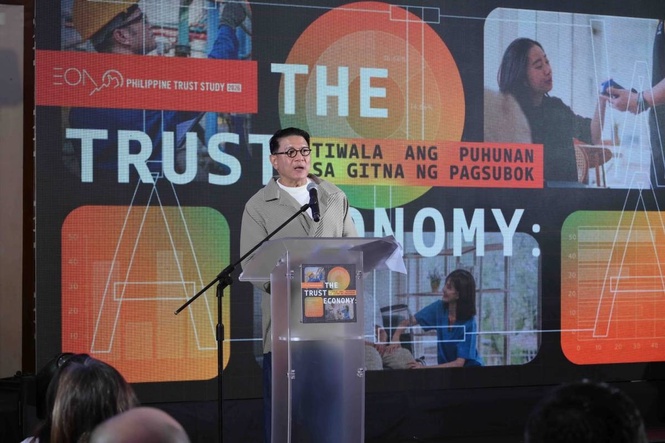
“Are customers staying because they trust a business, or because they have no other choice?” EON Group President and Chief Operating Officer Malyn Molina said.
“Filipinos should not have to keep absorbing the cost of poor value and unclear pricing. It is up to businesses to give people real reasons to choose them, and to keep choosing them,” she added.
The study also found that honesty was the most important attribute Filipinos associated with business trustworthiness, with 34.6 percent of respondents ranking it first among 16 attributes examined.
Product and service quality, competence, social or interpersonal trust, genuine care, and accountability and transparency followed.
Reputation, meanwhile, ranked last among the 16 attributes. Only 6.8 percent cited it as a reason for trusting their most-trusted business sector.
The findings suggest that a company’s reputation alone is insufficient to earn consumer confidence without consistent performance and honest dealings with customers.
“The prominence of honesty in the findings is significant. It tells us that Filipinos place great importance on whether businesses can be trusted to deal with them truthfully,” said Wilfred Luis Clamor of Ateneo’s Department of Sociology and Anthropology.
Across the nine sectors surveyed, food and agriculture, healthcare and pharmaceuticals, and commerce, e-commerce and retail formed the top tier, each scoring around 75.
The study said the differences among the three sectors were too small to establish a meaningful ranking.
At the lower end were business process outsourcing and information and communications technology, and tourism and travel, both with scores of 68.6. Real estate and construction scored 67.7.
All three fell within the study’s Fragile Trust category.
FinTech received a score of 70.8, placing it near the boundary between the study’s lower and higher trust-score bands.
The survey also found little difference in public confidence between large enterprises and micro, small and medium enterprises.
Large businesses scored 72.3, compared with 71.7 for MSMEs. The 0.6-point difference was within the study’s margin of error, indicating comparable levels of reported public confidence.
Business representatives who participated in focus group discussions said companies with clean compliance records could benefit from regulatory incentives, including longer license validity periods and green-lane arrangements.
They also observed that trusted brands may be better positioned to retain customers even when prices increase.
The study combined a nationwide face-to-face survey of 800 Filipino adults across 160 villages in 84 cities and towns, with focus group discussions involving 82 participants and interviews with 18 business executives.
It had a margin of error of plus or minus 3.5 percentage points for percentages.
EON said the study was descriptive and exploratory, with survey results reflecting public perceptions rather than independently verified assessments of business conduct.
The 2026 edition introduced the first Philippine Business Trust Index, establishing a baseline for measuring public confidence across nine major business sectors.
EON has been conducting studies on public trust in the Philippines since 2011.