
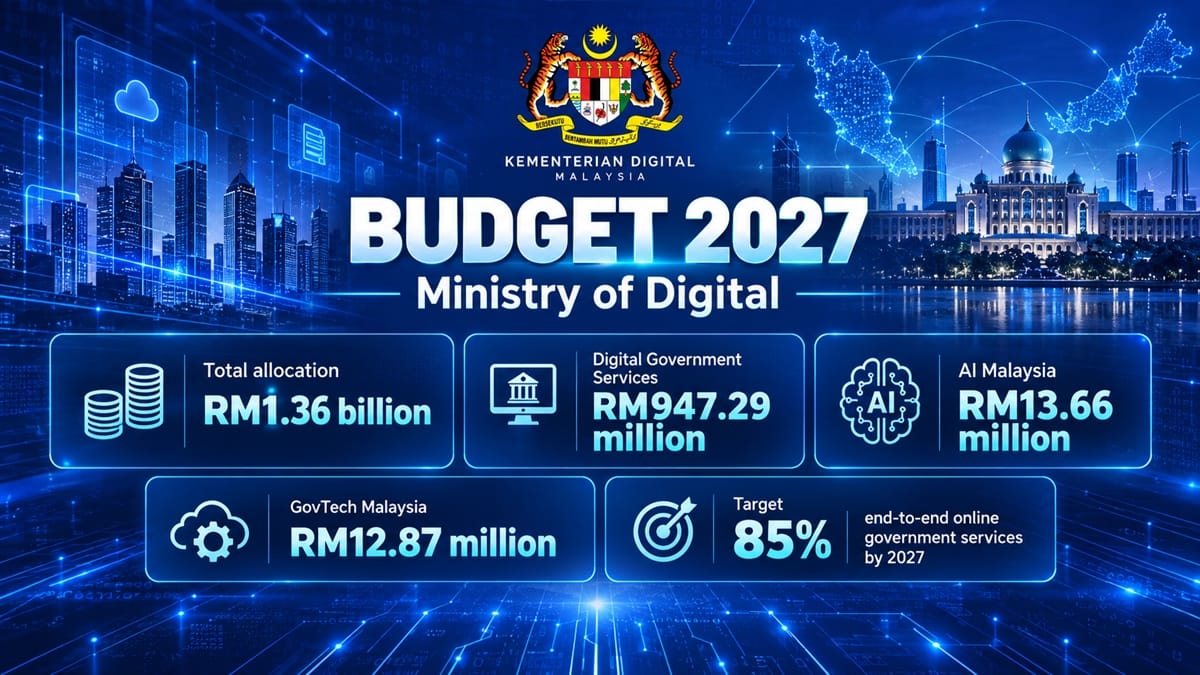
In the glass-walled tech hubs of Cyberjaya and Kuala Lumpur, the discourse around Malaysia’s economic future sounds almost futuristic. Cloud computing, sovereign AI models, automated public portals, and high-speed data centers dominate high-level policy discussions. Yet, just a few hours' drive away in rural rubber smallholdings, fishing villages, and peri-urban PPR flats, a vastly different scene unfolds daily. Elderly citizens struggle to navigate multi-step digital government forms, small hawkers find themselves baffled by complex online tax portals, and parents search for affordable smartphones so their children can complete basic school assignments. When Prime Minister Datuk Seri Anwar Ibrahim presented Budget 2027 in Parliament, the federal government made its technological roadmap crystal clear: positioning Malaysia as an regional hub for Artificial Intelligence (AI) and modernizing state administration through GovTech initiatives. Backed by a substantial RM1.36 billion allocation for the Ministry of Digital including nearly RM947 million earmarked specifically for end-to-end Digital Government Services the administration aims to digitize 85% of public interactions by 2027. However, as Putrajaya accelerates its high-tech evolution, an enduring socio-economic dilemma comes into sharp focus. While advanced GovTech tools promise unprecedented efficiency, they risk widening the gap for millions of grassroots citizens who lack fundamental digital literacy and reliable device access. Bridging this divide requires examining whether high-level AI ambitions can harmoniously coexist with grassroots digital empowerment without leaving vulnerable communities behind in the digital dark.
GovTech Accelerations, the AI Frontier, and the Grassroots Divide
To understand the institutional momentum driving Budget 2027’s tech strategy, one must look at how digital infrastructure has become a central pillar of national competitiveness. The allocation of RM947.29 million toward Digital Government Services represents a clear push to eliminate bureaucratic friction. By migrating routine citizen services from license renewals to social welfare applications onto unified GovTech platforms, the government seeks to curb corruption, save operational costs, and deliver fast, transparent public administration.
Simultaneously, the budget actively champions artificial intelligence across both public and corporate domains. Through a dedicated RM15 million operational injection for AI Malaysia Berhad, alongside an MDEC allocation of RM30 million to help 4,000 small and medium enterprises (SMEs) adopt AI, Putrajaya is signaling that future productivity depends on high-tech integration. The government has even extended individual lifestyle tax reliefs to cover personal AI subscriptions and announced an additional 100,000 free AI tool access slots for youth through the Inisiatif Rakyat Digital framework.
However, technology analysts caution that rapid digital migration can inadvertently create new forms of social exclusion if grassroots digital literacy is overlooked. Across rural areas and lower-income urban communities, thousands of everyday citizens face acute digital anxiety. When essential public services transition strictly to digital-first or app-only channels, elderly individuals, persons with disabilities, and low-income families who lack stable internet or modern hardware risk feeling disenfranchised by the very systems meant to serve them.
Addressing this structural friction requires ensuring that physical community hubs and human-assisted helpdesks remain accessible alongside digital portals. Initiatives like NADI (Sebaran Maklumat Nasional) centers play a vital role in translating complex digital workflows into accessible grassroots guidance. Without ground-level digital literacy programs that teach cybersecurity awareness, basic digital navigation, and practical tool usage, high-tech GovTech platforms risk becoming exclusive tools that benefit tech-savvy urbanites while alienating the broader public.
Ultimately, a truly inclusive digital nation is measured not merely by the sophistication of its AI algorithms or the speed of its government portals, but by the confidence of its most vulnerable citizens in navigating them. Balancing top-tier GovTech investments with sustained, compassionate grassroots digital education ensures that technological progress strengthens social cohesion rather than deepening socioeconomic divides.
What Do You Think? I’d Love to Hear Your Opinion in The Comments Section.
The dynamic interplay between Budget 2027’s ambitious AI agenda and grassroots digital literacy highlights a fundamental truth: technology is only as powerful as the people it empowers. As Malaysia invests heavily in modernizing public services and positioning itself as a regional digital powerhouse, keeping everyday citizens at the heart of this transformation remains paramount. By pairing cutting-edge GovTech innovations with patient, accessible community education, the nation can build a digital ecosystem that works equitably for everyone.
AM World (tameer.work88@gmail.com) is a content creator under the Newswav Creator programme, where you get to express yourself, be a citizen journalist, and at the same time monetize your content & reach millions of users on Newswav. Log in to creator.newswav.com and become a Newswav Creator now!
The User Content (as defined on Newswav Terms of Use) above including the views expressed and media (pictures, videos, citations etc) were submitted & posted by the author. Newswav is solely an aggregation platform that hosts the User Content. If you have any questions about the content, copyright or other issues of the work, please contact creator@newswav.com.