
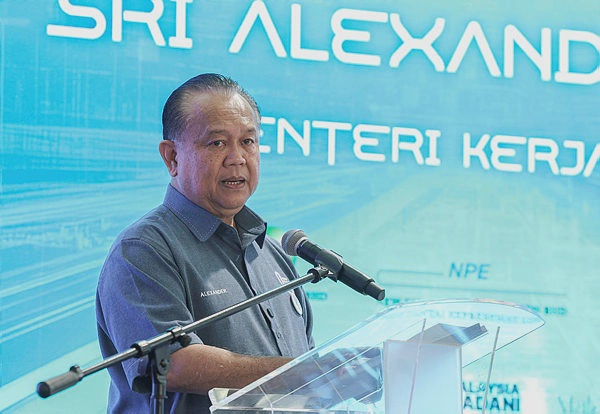
Works Minister Alexander Nanta Linggi highlights AI-driven traffic centres, real-time monitoring and accident data to make Malaysia’s highways safer and smarter.
KUALA LUMPUR: Highways need to evolve from mere physical infrastructure to a safer, smoother and more efficient smart mobility ecosystem, in line with the increasing number of vehicles on the road, which is estimated at six million vehicles daily across the entire highway network.
Works Minister Datuk Seri Alexander Nanta Linggi said that, as such, his ministry was committed to accelerating the implementation of Intelligent Transport Systems (ITS).
He said its implementation would be guided by the Malaysia ITS Roadmap 2030, which encompasses the use of artificial intelligence (AI), big data analytics, the Internet of Things (IoT), dynamic lane management, real-time travel information and integrated traffic management centres.
“In this case, the Malaysian Highway Authority (LLM) will regulate and coordinate the operation of tolled highways, while the Public Works Department (JKR) is responsible for the development, management and maintenance of Federal roads.
“Our goal is clear, that is to ensure the technology used provides actual benefits to the people, especially in terms of safety, smooth traffic flow and travel quality,” he said when officiating the IJM Toll Group Traffic Control Centre here today.
Nanta described the Traffic Management Centre (TMC) as the pulse of smart highway management, integrating traffic monitoring, incident detection and coordination of responses with relevant parties.
He said that through the LLM TMC, traffic conditions are monitored around the clock via 873 closed-circuit television (CCTV) cameras and 278 Variable Message Signs (VMS), enabling incidents such as accidents, breakdowns, objects on the road, lane closures and unusual congestion to be detected earlier.
“Coordination between the LLM TMC and the traffic management centres of concessionaires is crucial, especially during peak hours, festive seasons, major accidents, disasters and bad weather.
“Traffic data can also be analysed to identify congestion patterns and high-risk locations to assist in lane management planning, deployment of patrol teams, asset maintenance and increasing highway capacity,” he said.
Nanta said that based on data from the Malaysian Highway Road Accident Database System (MHROADS), 26,675 accidents were recorded on tolled highways in 2025, including 839 fatal cases, with 85.4 per cent attributed to human factors, while 14.6 per cent involved vehicle and environmental factors.
He said the transformation towards smart highways required cooperation between the ministry, LLM, concessionaires, enforcement agencies, emergency response teams and technology players.
Meanwhile, Nanta told a media conference that no highway patrol personnel would be laid off following the implementation of the Smart Highway Traffic Control Centre.
He said its implementation was aimed at strengthening traffic management to make it smarter, safer and more responsive, while enabling patrol teams to respond more effectively, reducing response times from more than 15 minutes to between eight and 10 minutes.
On Malaysia’s transition to the Multi-Lane Free Flow (MLFF) toll system, Nanta said the matter was still being discussed with almost all highway concessionaires.
He also welcomed IJM’s initiative to introduce the Virtual Reality (VR) Highway Safety Programme to raise safety awareness among students as an early educational measure to prevent accidents.
