
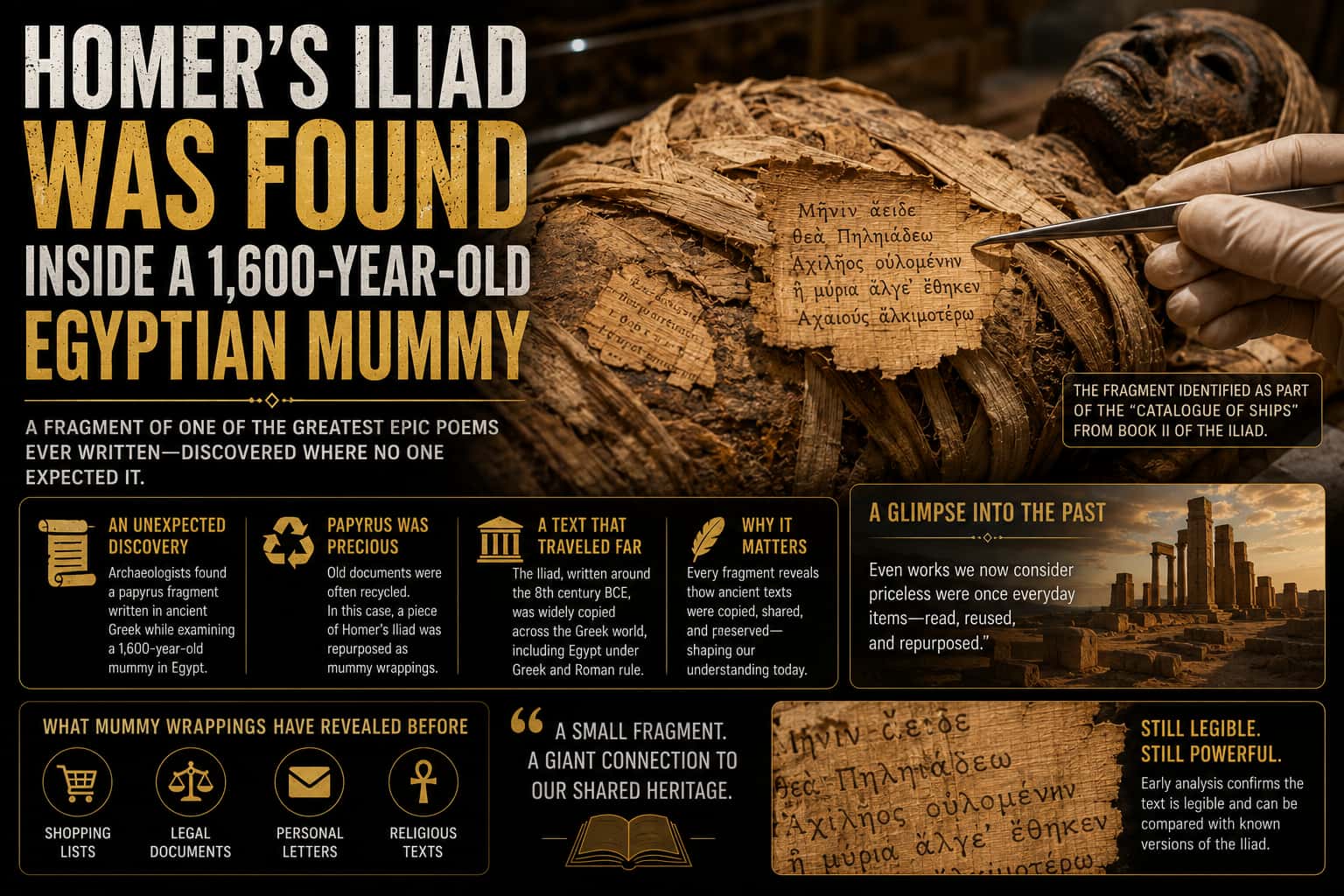
Archaeologists have made plenty of unusual discoveries inside ancient mummies. Jewellery, amulets, preserved organs in canopic jars. But a fragment of one of the most important literary works in Western civilization? That is a first.
A team of researchers examining a 1,600-year-old mummy discovered in Egypt found something unexpected during the embalming layers. Tucked into the wrappings was a piece of papyrus that turned out to be a fragment of Homer's Iliad. The text, written in ancient Greek, had been repurposed as material for the mummification process.
This is not as surprising as it might sound once you understand how papyrus was used in the ancient world. Paper was expensive. Writing materials were valuable. When documents were no longer needed, they were often recycled. In Egypt, that sometimes meant using old scrolls as wrapping material for mummies. The practice is well documented, but finding a fragment of the Iliad in this context is rare.
The Iliad, composed around the 8th century BCE, tells the story of the Trojan War. By the time this mummy was prepared, roughly in the 4th or 5th century CE, the text would have been centuries old. Copies circulated widely across the Greek-speaking world, including Egypt, which had been under Greek and then Roman influence for hundreds of years.
What makes this discovery valuable is not just the content but the physical artifact itself. Every surviving fragment of ancient texts helps scholars piece together how these works were copied, distributed, and preserved across different regions and periods. Small differences in wording, spelling, or formatting can reveal details about scribal traditions and the transmission of knowledge.
The fragment was identified as part of the "Catalogue of Ships" from Book II of the Iliad, one of the best-known passages in Western literature, which lists the Greek forces sailing to Troy.
The fragment also tells us something about the everyday economy of the ancient world. Someone had a copy of the Iliad. At some point, that copy was no longer being read, studied, or stored. So it was cut up and put to practical use. That casualness is a reminder that even works we now consider priceless were, in their own time, just things people had lying around.
Mummy wrapping fragments have yielded important texts before. Scholars have recovered shopping lists, legal documents, personal letters, and religious texts from similar finds. Each one offers a small window into ordinary life in the ancient world. But a fragment of Homer carries extra weight because of the Iliad's outsized influence on literature, philosophy, and culture across millennia.
The research team has not yet published a full analysis of the fragment, but early reports suggest it is legible enough to identify the specific passage and compare it with known versions of the text.
My Opinion
There is something strangely moving about an ancient epic poem being repurposed as packing material. It is a reminder that the things we consider timeless were, to the people who lived alongside them, just part of the furniture. Today's bestseller could end up as tomorrow's recycled paper. The Iliad survived not because anyone planned for it to last forever, but because enough copies existed that a few always managed to slip through.
Ronny M (ronny76netstuff@gmail.com) is a content creator under the Newswav Creator programme, where you get to express yourself, be a citizen journalist, and at the same time monetize your content & reach millions of users on Newswav. Log in to creator.newswav.com and become a Newswav Creator now!
The User Content (as defined on Newswav Terms of Use) above including the views expressed and media (pictures, videos, citations etc) were submitted & posted by the author. Newswav is solely an aggregation platform that hosts the User Content. If you have any questions about the content, copyright or other issues of the work, please contact creator@newswav.com.