
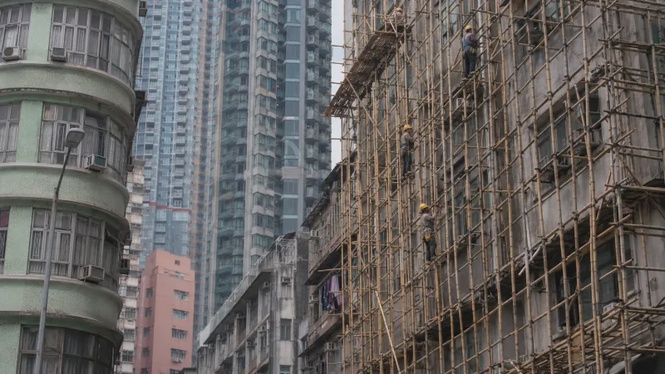
Walk down almost any street in Hong Kong and you are likely to see something that stops first-time visitors in their tracks: dozens of floors of a glass-and-concrete tower wrapped not in steel tubes but in an intricate latticework of bamboo poles, bound together with nylon strips and climbing skyward in ways that seem to defy gravity. The image is striking precisely because everything else about Hong Kong signals modernity — world-class infrastructure, a skyline that rivals Manhattan, construction technology that raises skyscrapers in record time. Yet the bamboo scaffolding remains.
The question most visitors ask is a reasonable one: is Hong Kong simply behind? The short answer is no. Bamboo scaffolding survives in one of Asia's most advanced cities not because alternatives do not exist, but because — under specific conditions — it still outperforms them.
Why Bamboo Still Works in Hong Kong's Urban Maze
The most immediate explanation is geography. Hong Kong's older districts were built long before modern planning codes required generous setbacks or wide lanes for construction vehicles. Streets in Sham Shui Po, Yau Ma Tei and Wan Chai can be extremely narrow, and many buildings in those areas were not designed to handle the loads that metal scaffolding systems impose.
When the Development Bureau consulted the construction industry on a bamboo-to-metal transition at the end of 2025, officials openly acknowledged that bamboo retained a clear advantage in tight spots. Not because steel is inferior, but because bamboo poles can be arranged around the irregular silhouettes of older buildings in ways that rigid metal frames simply cannot. That physical flexibility also extends to the city's large stock of ageing private residential blocks, many of which require external work — window replacements, drainage pipes, façade tiles, signage — rather than ground-up construction. The Buildings Department lists three standard bamboo configurations for Hong Kong: the double-row type, the cantilevered type and the signboard type, each adapted to a specific category of small-scale external repair work.
A Strict Safety Framework, Not an Improvised Practice
One common misconception is that bamboo scaffolding is informal or left to the judgment of individual workers. It is not. Hong Kong's Labour Department publishes a dedicated Code of Practice for Bamboo Scaffolding Works, covering erection, alteration, dismantling, inspection and worker qualification requirements at every stage. The Buildings Department's own guidelines on bamboo scaffold design specify structural requirements, wall ties, wind load calculations and supervision protocols. Any design that deviates from the standard systems must be certified by a qualified structural engineer.
As recently as July 31, 2026, both the bamboo and metal scaffolding codes were updated simultaneously, adding new requirements for fire-resistant protective screens and anti-combustion mesh. The fact that both documents were revised in tandem underlines something important: Hong Kong currently maintains two parallel sets of safety standards, and neither has been declared obsolete.
The Workforce Behind the Poles
The bamboo scaffolding industry is also underpinned by a formal certification system. As of June 2025, Hong Kong had 2,534 registered bamboo scaffolding workers — 491 semi-skilled and 2,043 skilled — alongside 7,830 registered metal scaffolding workers and 276 workers qualified in both trades. These figures matter because any meaningful transition involves more than swapping one material for another. It means retraining thousands of workers, restructuring contracting arrangements and building a supply chain for metal components at a scale the market has not yet reached.
Industry representatives at the Development Bureau's 2025 consultations flagged three practical constraints on a rapid shift to metal: the weight of steel tubes in streets too narrow for large delivery vehicles, the load-bearing capacity of older buildings that may struggle to anchor heavier frames, and the question of where to store equipment between jobs in a city with almost no surplus space.
What the Cost Data Actually Shows
Cost is part of the equation, though a more nuanced one than it first appears. Government data presented to the Legislative Council in 2025 showed that, in public-works contracts for new government buildings, metal scaffolding accounted for roughly 2 percent of total construction costs, compared with 1 percent for bamboo. Officials were careful to note that this does not mean switching to metal would double scaffolding expenses — materials are only one variable among many. What it does suggest is that, in the universe of small private repair jobs where margins are tightest, bamboo's lower cost share remains commercially attractive to contractors who could legally use either option.
Cultural Resonance, Carefully Distinguished
Beyond engineering, bamboo scaffolding has become part of Hong Kong's visual identity. The sight of thin poles rising floor by floor alongside a glass curtain wall appears on postcards, in documentaries and on the social media feeds of every first-time visitor. A 2012 University of Hong Kong thesis on conservation described bamboo scaffolding as one of Hong Kong's "living heritages" — something that keeps adapting to meet regulatory and operational demands rather than being preserved in a museum.
It is worth drawing a clear distinction, however, between building scaffolding and the separate craft of constructing temporary bamboo theatres for festivals. Hong Kong's Representative List of Intangible Cultural Heritage formally includes the skill of erecting bamboo theatrical sheds for occasions such as the Hungry Ghost Festival and Ta Chiu ceremonies. The government clarified in a 2025 Legislative Council reply that these festive structures and construction scaffolding — though both made of bamboo — are distinct practices, and building scaffolding is not itself on the heritage list. The overlap many people assume exists is more about cultural familiarity than formal designation.
The Transition Is Underway, Just Not Overnight
None of this means Hong Kong plans to keep bamboo scaffolding indefinitely. From March 2025, the Development Bureau began requiring that half of all government contracts for new public buildings put to tender include a metal scaffolding specification, though the rule did not apply to façade repair work and in practice covered only one or two projects in the first year.
By the end of 2025, the government and the industry had agreed on a transition roadmap that prioritises metal scaffolding for new construction and for repair jobs on buildings located along wider streets, while continuing to allow bamboo where site conditions genuinely preclude the alternative. Development Secretary Bernadette Linn confirmed that a blanket ban is neither practical nor imminent. The transition will be gradual, sector by sector, site by site.
What This Tells Us About Urban Construction
The persistence of bamboo scaffolding in Hong Kong is, in the end, less a story about tradition triumphing over technology and more a story about a city whose physical constraints have outlasted the assumptions of the modern construction industry. Steel did not make bamboo redundant because Hong Kong's streets did not become wider, its old buildings did not become stronger, and its construction sites did not acquire more space.
That may eventually change. Metal scaffolding has genuine advantages in rigidity, durability and standardisation, and Hong Kong's government is clearly moving in that direction. But the pace will be determined by the city itself — by the width of its lanes, the age of its walls and the practicalities of moving heavy material through a place that was never designed for it.
As of 2026, Hong Kong simultaneously maintains safety codes for both systems and continues updating them. The bamboo scaffolding visible on its skyline today is not a relic — it is a working solution that a very particular kind of city still needs.
