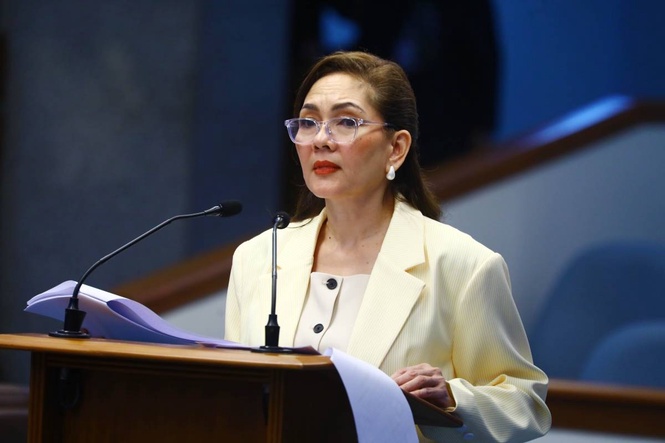
MANILA, Philippines — Sen. Risa Hontiveros said reforms in the country's civil registration and citizenship verification systems are crucial to national security.
During a public hearing of the Senate Committee on Justice and Human Rights on Thursday, Hontiveros cited the case of businessman Joseph Sy as an example of how weaknesses in the civil registration system can pose broader national security concerns.
Sy, chairman of Global Ferronickel Holdings Inc. and a former chairman of a major mining company, came under scrutiny after the Bureau of Immigration (BI) found that his fingerprints matched those of Chinese Chen Zhong Zhen.
The investigation seeks to establish whether Sy is Joseph Cue Sy, as stated in his Philippine birth certificate, or the Chinese identified through the fingerprint match. Hontiveros said Sy's birth was registered only when he was 41 years old, with authorities subsequently finding serious irregularities in the documents supporting his late registration.
These included the absence of records of the purported marriage of his declared parents, certifications that Sy and his supposed parents were not residents of their declared barangay, and a residential address that was reportedly found to be a vacant lot.
A baptismal certificate submitted to support his birth registration also could not be authenticated by the purported parish, while the Philippine Statistics Authority (PSA) reportedly found no civil registry records for his supposed parents.
Despite these red flags, the birth certificate was accepted into the country's civil registry.
Hontiveros said that the consequences of questionable birth registrations extend beyond the issuance of a single government document, as birth certificates can serve as the foundation for obtaining Philippine passports, claiming citizenship rights, and accessing privileges reserved for Filipinos.
These include eligibility to own land, participate in constitutionally restricted industries, and hold positions in institutions where nationality is a determining factor. In Sy's case, Hontiveros said that the businessman had become chairman of a major mining company and a member of the Philippine Coast Guard Auxiliary.
Hontiveros said the problem is also reflected in raids on illegal Philippine Offshore Gaming Operators (POGOs), where foreign nationals have reportedly been found in possession of fraudulent Philippine identification documents.
"Every government document is ultimately an expression of trust. When the government declares that a person is Filipino, every other institution relies on that declaration. If the foundation of that identity can be manipulated, then the vulnerability does not end with the civil registry. It travels with that person throughout the entire government system. That is the loop we intend to close today," she said.
Sy was absent from Thursday's hearing after reportedly being rushed to the emergency room of Makati Medical Center, according to his lawyer, Alma Fernandez-Mallonga.
"Early this morning, Mr. Sy called me up to say that he was in the emergency room of Makati Medical Center. He had been feeling unwell since last night," Mallonga told the panel.
She said Sy had prepared to attend the hearing and respected the Senate proceedings but was unable to do so because of his medical condition. Mallonga committed to submitting medical documents to support her client's absence. She also informed the panel that Sy had been released from immigration detention almost a month ago and had undergone surgical procedures.
Sy was arrested at the Ninoy Aquino International Airport in 2025 after arriving from Hong Kong. The reported fingerprint match subsequently raised questions about the authenticity of the documents supporting his claim to Filipino citizenship.