
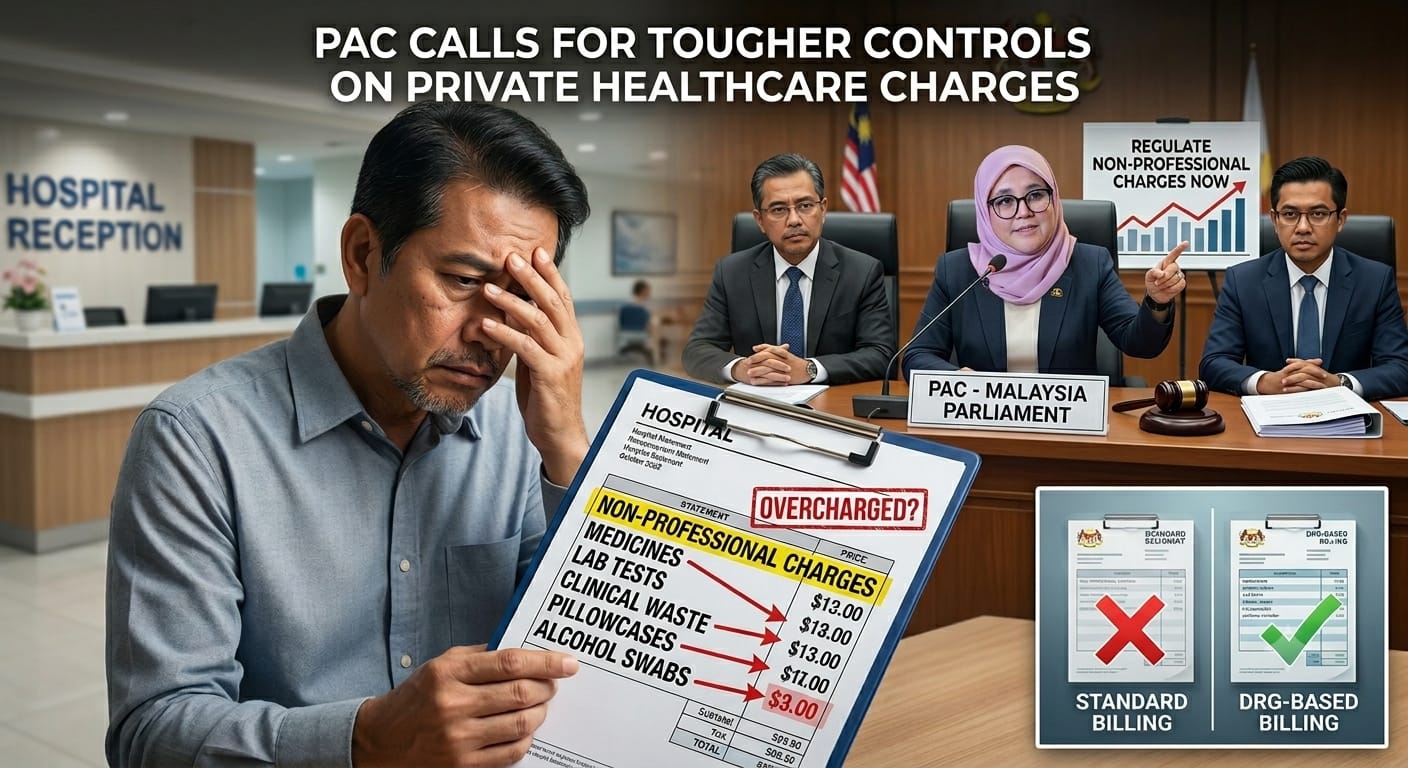
Malaysia’s rising healthcare costs have once again come under the spotlight after the Public Accounts Committee (PAC) called for stronger government intervention to regulate private hospital charges.
The committee has urged the Ministry of Health (KKM) to be granted broader powers to oversee not only doctors’ professional fees but also the wide range of non-professional charges that have become a major contributor to medical inflation.
The recommendation was made as part of PAC’s report examining soaring health insurance premiums, escalating private hospital fees, and their growing impact on both patients and the nation’s healthcare system.
PAC chairman Datuk Mas Ermieyati Samsudin revealed that the committee’s findings challenged a common perception that doctors’ fees are the main driver of rising medical costs. In reality, professional fees have been regulated under the Private Healthcare Facilities and Services Act 1998 since 2013.
Instead, the committee found that non-professional charges imposed by private hospitals have been increasing at a much faster pace. These include costs associated with medicines, medical supplies, laboratory tests, diagnostic procedures, advanced medical technologies, and hospital operational expenses.
According to Mas Ermieyati, PAC is recommending amendments to Act 586 to empower KKM to regulate private hospital charges beyond doctors’ fees. Such a move would provide the government with greater authority to curb excessive pricing and improve transparency in healthcare billing.
One of the most concerning findings highlighted in the report is the lack of a standardised billing structure among private hospitals. Patients often struggle to understand what they are paying for, with some hospitals charging separately for basic items that many would expect to be included in standard room or service fees.
The committee cited examples where patients were billed individually for items such as clinical waste disposal, pillowcases, and alcohol swabs. While these charges may appear minor on their own, they can accumulate into substantial amounts, contributing to unexpectedly high hospital bills.
PAC also raised concerns about alleged price discrimination within the healthcare sector. The report found cases where patients covered by guarantee letters (GLs) from insurers or employers were charged higher rates compared to those who paid cash upfront or used a pay-and-claim method.
Such practices have sparked questions about fairness and transparency, particularly at a time when many Malaysians are already struggling with rising living costs and increasingly expensive health insurance premiums.
Another area of concern involves the pricing of medicines. PAC discovered significant mark-ups throughout the medicine supply chain, with some generic medicines reportedly being sold at prices higher than their branded counterparts. This situation undermines the purpose of generic drugs, which are generally intended to provide more affordable treatment options.
To address these issues, the committee has recommended closer collaboration between KKM and the Ministry of Domestic Trade and Cost of Living to establish mechanisms that regulate the prices of medicines and medical equipment, ensuring that excessive profiteering does not occur.
Beyond price controls, PAC also urged the government to accelerate the implementation of the Diagnosis-Related Group (DRG) payment system within the private healthcare sector. The system is designed to standardise treatment costs by grouping similar medical conditions and procedures under predetermined payment categories, potentially reducing cost variations and improving efficiency.
The committee further called for the full implementation of healthcare reform initiatives outlined under the government's Health White Paper and RESET framework. These reforms are seen as crucial in addressing long-term challenges surrounding healthcare affordability, medical inflation, and the sustainability of health insurance coverage.
As healthcare expenses continue to rise faster than general inflation, PAC’s recommendations signal a growing recognition that stronger regulatory oversight may be necessary to protect patients from excessive charges. For millions of Malaysians, the debate is no longer merely about healthcare quality - it is increasingly about whether quality healthcare remains financially accessible at all.
The government now faces mounting pressure to ensure that private healthcare remains transparent, fair, and affordable before rising costs place essential medical treatment beyond the reach of ordinary citizens.
By: Kpost
Information Source:
Kpost (ckhorsk@gmail.com) is a content creator under the Newswav Creator programme, where you get to express yourself, be a citizen journalist, and at the same time monetize your content & reach millions of users on Newswav. Log in to creator.newswav.com and become a Newswav Creator now!
The User Content (as defined on Newswav Terms of Use) above including the views expressed and media (pictures, videos, citations etc) were submitted & posted by the author. Newswav is solely an aggregation platform that hosts the User Content. If you have any questions about the content, copyright or other issues of the work, please contact creator@newswav.com.

