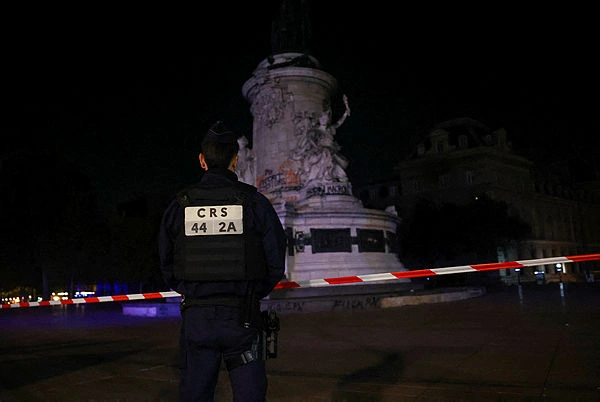
France is under nightly curfews, troop deployments, and protest bans after the worst rioting the country has seen in years. More than half a million people marched nationwide on October 17, and the government now admits it briefly "lost control" of the streets.
Interior Minister Laurent Nuñez put turnout at about 550,000, Reuters reported; the CGT union estimated 800,000. Masked groups looted hundreds of businesses, broke into town halls in Marseille and Lille, set fire to a tourist office in Lyon, and torched the 143-year-old city hall in Limoges. Justice Minister Gérald Darmanin said 2,500 people had been taken into custody, 174 jailed, and 917 formally prosecuted, AFP reported on October 22.
The movement behind the chaos began a month earlier with a far smaller complaint: students at one suburban high school said they had no teachers.
One Suburban School Lit the Fuse
The protests started at Lycée Saint-Exupéry in Créteil, a suburb southeast of Paris, TIME reported. British magazine Dazed dates the first blockade to September 17 and reports that the school was missing several staff members and a headteacher, on top of frequent teacher absences.
The shortage is national, not local. TIME cited Education Ministry data showing that nearly 10% of teaching hours in public secondary schools went untaught in the 2024 to 2025 school year, and that about 7.5% of those lost hours were due to a failure to find substitutes.
"There are 35 of us per classroom," a 17-year-old in Strasbourg told AFP. Dazed reported shortages of desks and equipment, "crumbling" classrooms that became "unbearable" in summer heat waves, and videos filmed inside schools showing insects, rodents, broken toilets, and holes in windows and walls.
Students are also angry about Parcoursup, the national online platform French high school students must use to apply to university, which protesters describe as "a source of stress and mistrust," according to TIME. The Spectator noted that France has had seven education ministers since 2022, leaving little continuity in policy.
The blockades spread fast. TIME reported that the number of disrupted schools rose from 180 to more than 500 in a single week, with protests reaching Nantes, Rennes, Brest, Bordeaux, Toulouse, Marseille, Grenoble, Strasbourg, Lille, and beyond. Public sympathy ran high: one poll cited by The Spectator found 62% of French people supported the high school demonstrators.
Suburban Inequality Turned a School Protest National
Créteil sits in the banlieue, the ring of Paris suburbs where many working-class and immigrant families live. "Compared with schools in Paris we don't have the same resources," Olympe, a 16-year-old student, told Al Jazeera. "We're given less money, and we don't have the same privileges."
Nicholas Bequelin, a senior fellow at Yale Law School, wrote in TIME that "political power, economic opportunity, cultural prestige, and elite education remain extraordinarily concentrated in the capital." The grandes écoles, the elite institutions that feed France's top jobs, remain largely out of reach for disadvantaged students. "The Yellow Vest revolt of 2018 to 2019 was an earlier social explosion of precisely that resentment," Bequelin wrote.
University students share the grievance. "One student out of two cannot eat properly," Alice Cohen-Morzadec, a spokesperson for the French Student Union, told AFP. "One student out of three doesn't have a permanent house to live in. We cannot study in these conditions."
Yellow Vests, Unions, and Teachers Joined the Students
The student protests soon merged with wider anger over living costs and fuel prices. Al Jazeera reported that a website tracking Yellow Vests actions, the movement born of a 2018 fuel tax revolt, listed more than 1,750 planned protest locations for October 17. Teachers, trade unions, and university students joined the high schoolers.
"High school students are fighting for their future. Workers are fighting to earn a living from their labour," said Jerome Rodrigues, a prominent Yellow Vests activist.
Bruno Cautrès, a researcher at Sciences Po's Center for Political Research in Paris, told Al Jazeera the anger was ultimately about the country's direction: "The French are asking themselves where are we going as a country? How are we going to get out of this budget crisis?"
France's Debt Crisis Sits at the Heart of the Anger
The deepest driver of the unrest is money. France's public debt has hit a record $4 trillion, or 119% of gross domestic product, the highest ratio since the immediate aftermath of World War II, Fortune reported. That is nearly double the European Union's reference limit of 60%.
Markets are growing nervous. The yield on France's 10-year government bond rose above 5% on October 21, AFP reported, making every euro the state borrows more expensive. Moody's is expected to downgrade France's debt rating on October 23.
To stem the bleeding, Prime Minister Sébastien Lecornu's government unveiled its 2027 budget on October 1. According to AFP, it relies on €43 billion in spending cuts and other measures to bring the deficit down from 5.4% of GDP this year to 5% in 2027; Reuters puts the government's overall savings target at €54 billion. The plan includes €5.1 billion in health savings, partly through lower reimbursements; an end to full inflation indexing for pensions above €1,260 a month; and more than €7 billion in additional value-added tax revenue. Even so, a ministry source told AFP that public debt would still climb to 121.7% of GDP in 2027.
For people already angry about missing teachers and fraying public services, the message was blunt: fewer services and a heavier burden.
| France's Fiscal Picture | Figure |
| Public debt | About $4 trillion, 119% of GDP |
| Projected 2027 debt | 121.7% of GDP |
| Projected 2026 deficit | 5.4% of GDP |
| 2027 deficit target | 5% of GDP |
| 2027 budget measures | €43 billion in spending cuts and other measures |
| 10-year bond yield | Above 5% (October 21) |
Sources: Fortune, AFP
Thousands Arrested and a Historic Landmark in Ruins
The October 17 demonstrations were the largest of the movement so far. In Paris, protesters fired firework mortars at police and set a car and a newspaper stand ablaze, while officers answered with tear gas and stun grenades, Al Jazeera reported. Lecornu condemned "violence of extreme intensity" and blamed ultraleft groups joined by delinquents, Euronews reported. He had already said more than 900 police officers were injured in earlier protests, according to Reuters.
Protesters were hurt too. One person died of a heart attack in Paris, a 17-year-old girl lost an eye in Mulhouse, and a protester lost a hand in Saint-Étienne, the Associated Press reported; all three cases are under investigation. On October 5, a 15-year-old in the northern city of Lens had lost a hand to a police stun grenade.
"You couldn't look shopkeepers in the eye after hundreds of shops had been looted and say we hadn't lost control," Nuñez told French radio, according to ABC News. He offered to resign, but Macron turned him down and instead ordered "transparency over the failures in planning and intelligence," Al Jazeera reported.
The Limoges city hall, built in 1883 and listed as a historic monument, was gutted. Its roof collapsed onto the lower floors and two thirds of the exterior was destroyed, local prefect Maurice Barate told AFP, calling it "a deliberate act by hooligans" and "a catastrophe for heritage." Darmanin said counterterrorism investigators had joined the case, writing on X that the fire "affects us just as much as that of Notre-Dame." Le Figaro reported that a 40-year-old man described by police as a far left activist was arrested.
Courts are moving quickly. In Lille, three men aged 20 to 25 with no criminal records were each sentenced to 10 months in prison for looting a video game store, the AP reported. Darmanin has told prosecutors to appeal sentences they consider too lenient, and Digital Affairs Minister Anne Le Henanff has asked online platforms to remove listings of looted goods. National Assembly Speaker Yaël Braun-Pivet said lawmakers will open an inquiry into the violence and police tactics, with findings due "by the end of the year."
Macron Promises Looters Will Pay for the Damage
"No room for violence in our Republic," Macron wrote on X late on October 17, promising that those who looted shops and attacked public buildings "will be prosecuted and punished." A day later he went further in a televised address. "Those who looted will have to pay for the damage, and those who sought to bring down the Republic will be held accountable," Macron said, according to the AP. "How can French people do this to France?"
Just a day before the riots, speaking in Brussels on October 16, he had struck a different note: "There is a constitutional right to protest and to express oneself."
Curfews, Troops, and Protest Bans as France Braces for More
Nighttime curfews took effect on October 19 in parts of Paris, including Place de la République and the streets around Les Halles, as well as in Lyon, Nice, Bordeaux, and around Lille, according to Al Jazeera and ABC News. Some apply only to minors. Lecornu said it was "out of the question to put all of Paris under curfew" and that a state of emergency could be declared if necessary.
After the first quiet night, Lecornu wrote on X that "the targeted curfews helped keep last night calm" and that new ones would be imposed "wherever the situation requires," the AP reported. Prefects, the national government's regional representatives, decide on curfews together with local mayors.
The government is also bringing in the army. Nuñez told parliament that soldiers from Operation Sentinelle, the 10,000-strong counterterrorism patrol force created in 2015, will take over static guard duties so police can focus on crowd control, Euronews reported. Lecornu has promised a "massive" security operation for the next round of protests.
On October 22, Paris police banned protests from 8 a.m. to 8 p.m. around the Élysée Palace, both houses of parliament, the Louvre, the Champs-Élysées, Bastille and République squares, and the Châtelet-Les Halles shopping district, AFP reported.
Organizers show no sign of backing down. The Yellow Vests plan a march from Bastille on October 24 and nationwide demonstrations on November 5. After meeting Lecornu, CGT leader Sophie Binet called for a "new phase" of protests, with strikes in early November, according to AFP.
Five Prime Ministers in Two Years Leave Macron Boxed In
The fiscal problem is compounded by political paralysis. "France has had five prime ministers in two years," Bequelin noted, and with no stable majority in the National Assembly, almost any reform stalls.
Macron cannot run again when France votes for president in April and May 2027. Polls currently show Marine Le Pen of the far right National Rally (RN) in the lead, with Jean-Luc Mélenchon of the hard left France Unbowed (LFI) in second place, according to AFP.
That has given the protests a sharp political edge. Lecornu blamed the "far-left" and criminals for the violence, and on X he addressed "those who clearly want to use this violence as a 'warm-up' before the presidential election," Reuters reported. Le Pen and Mélenchon have both been accused of exploiting the unrest ahead of the vote.
The government has tried to calm the students. TIME reported that Lecornu introduced five initiatives to address their demands, including making Parcoursup more transparent, while Education Minister Édouard Geffray launched an online platform for reform proposals.
Unrest Draws Fire From Washington and Spreads Beyond France
The riots have also become a talking point abroad. U.S. Vice President JD Vance shared video of the burning Limoges city hall and wrote on X that "Western liberals imported the third world into France and other countries in the name of diversity and compassion," AFP reported. President Donald Trump linked the unrest to "migrants, jihadists, and communists" while campaigning for the U.S. midterm elections.
Speaking in Doha, Macron accused foreign leaders "in campaign mode" of exploiting France's turmoil, without naming Trump. Le Pen called his remarks "conspiratorial" and said the scenes from October 17 showed the reality of France after 10 years of Macron's rule. Several analysts have rejected claims that migrants drove the protests, AFP reported.
Neighboring countries are watching nervously. Italy has ordered 500 troops to Milan, with Prime Minister Giorgia Meloni saying "criminals" sought to "exploit demonstrations to seek confrontation and sow chaos." In Lisbon, protesters set up a tent camp in Rossio Square over rents and housing costs, ABC News reported.
The Budget Showdown Will Decide What Comes Next
The next political flashpoint is the National Assembly's first vote on the 2027 budget. A vote on the bill's tax section had been scheduled for October 20 but was pushed back to October 27 because lawmakers still had a large number of amendments to debate, Reuters reported.
If the bill stalls, the government could force it through without a vote under Article 49.3 of the constitution, a step likely to trigger a no-confidence motion that could topple the government, according to Reuters. Fortune noted that if Le Pen instructs her lawmakers to abstain, the budget could pass and avert an immediate crisis.
"France, truly, is on the brink." Mujtaba Rahman, managing director for Europe at Eurasia Group
Writing in The New York Times, Rahman argued that France faces three crises at once: a crisis of liberal democracy, a crisis of fiscal mismanagement, and a crisis of youth disaffection. He considers the fiscal crisis the most dangerous, warning that if the budget fails, "France could be forced to seek assistance from the International Monetary Fund."
Put simply, students are demanding more teachers and better schools just as a debt-laden government is being forced to cut spending. That collision is why the unrest will be so hard to calm.
Sources: Reuters, Reuters (budget explainer), Associated Press (Macron address), Associated Press (curfews), AFP (protest ban), AFP (budget), AFP (Vance), Euronews (Macron), Euronews (security operation), Al Jazeera, Al Jazeera (Yellow Vests), Al Jazeera (curfews), Al Jazeera and AFP, ABC News, Fox News (Limoges), TIME, TIME (Bequelin), Fortune, Dazed, The Spectator