Behind every cup of coffee is a journey that begins long before the beans reach a café. In the highlands of West Papua, Indonesia, that journey is taking on a wider significance as local communities turn Arabica coffee cultivation into an opportunity to improve livelihoods while protecting their surrounding environment.
In the Arfak Mountains, coffee grown at elevations of approximately 1,800 to 2,000 metres above sea level is increasingly gaining recognition through community-led agricultural practices and efforts to strengthen production quality.
Supported by local organisation Bentara Papua, the initiative now involves 37 farmer groups across seven districts, with coffee cultivated in household gardens covering approximately 35 hectares.
Marketed under the Kopi Anggi brand, the coffee has reached cafés in Manokwari and attracted interest from international buyers in Poland, Germany and the Netherlands.
Yet the story extends beyond coffee production. For communities in the Arfak Mountains, cultivation is also connected to forest conservation, traditional agricultural knowledge and the protection of natural resources.
The initiative illustrates how a crop once regarded as having limited economic value is gradually becoming part of a community-based approach to sustainable livelihoods.
 |
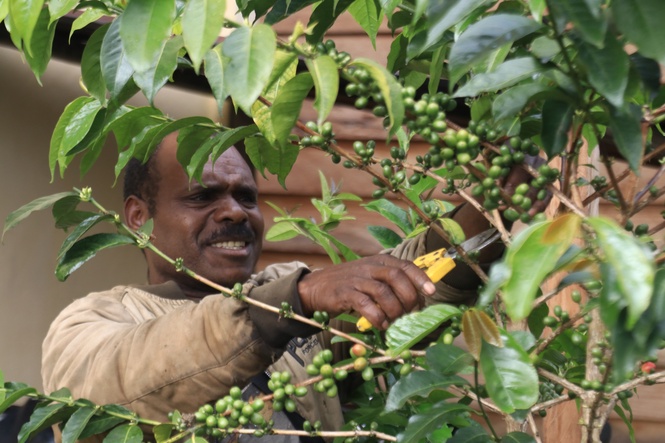
| Permas Towansiba demonstrates water shoot pruning techniques in Koffo Village as part of efforts to improve Arabica coffee cultivation in the Arfak Mountains. |
From Household Coffee Trees to a Growing Agricultural Opportunity
Coffee has long been cultivated in the Arfak Mountains, where the highland climate provides conditions suitable for Arabica plants.
Traditionally, coffee trees were grown alongside vegetables, fruits and other crops in household gardens rather than in large-scale commercial plantations.
For many families, however, coffee was not considered a significant source of income. Production was limited, and some plants were left unmanaged because farmers had little access to technical support or established markets.
Barto Inden, a local youth involved in developing Arfak coffee, recalled how the crop was previously viewed within the community.
"Before 2018, coffee was only one or two trees per farmer. Some planted it but did not know what to develop it into. Some were even cut down because they were considered to have no value," he said.
This began to change as communities recognised that better cultivation and processing practices could improve the crop's economic potential.
Rather than replacing existing agricultural traditions, the initiative has focused on developing the skills and resources already available within local villages.
 |
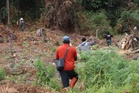
| Residents of Koffo Village work together to prepare land for Arabica coffee cultivation, reflecting the community-led nature of the agricultural initiative. |
Bentara Papua Supports Coffee Farmers Through Community-Based Training
The development of Arfak coffee gained momentum in 2019, when Bentara Papua began working with local communities to improve cultivation methods, processing techniques and access to markets.
Rather than introducing an entirely new agricultural system, the organisation worked with farmers to understand existing practices and identify areas where additional knowledge or equipment could improve production.
Demius Aud, Coordinator of the Udohotma Station of Bentara Papua, described the approach as a process of learning alongside the communities themselves.
"We did not bring a finished system. We learned together with the community from their own gardens, and from there we assessed the potential of this coffee in accordance with the community culture," he said.
Through the Merdesa Village School (SEKAM), local youth have received training in coffee cultivation, natural resource management and processing techniques.
The Udohotma Station also functions as a learning and production centre, where participating farmers can improve their agricultural practices and share knowledge.
Training covers several stages of coffee production, including nursery management, organic fertiliser preparation, pest management and post-harvest handling.
The initiative also encourages the use of locally available materials, helping farmers make use of resources within their communities.
 |
| Seed sowing in Sibiogud Village, Anggi Gida District, forms part of efforts to develop Arabica coffee cultivation in the Arfak Mountains. |
Protecting Forests and Water Sources Through Sustainable Cultivation
The environmental value of coffee cultivation is an important part of the initiative, particularly as communities in the Arfak Mountains face pressure on their surrounding landscape.
According to the source account, land clearing, heavy rainfall and upstream activities have created concerns about soil conditions and water sources relied upon by neighbouring communities.
Participating farmers are encouraged to adopt mixed planting practices and avoid land burning, allowing coffee to be cultivated alongside other crops while reducing some of the pressures associated with land preparation.
The programme also promotes organic fertilisers made from materials such as livestock waste, fallen leaves and kitchen scraps.
Locally available plants are used in natural pest management practices, reducing reliance on externally sourced agricultural inputs.
These methods are intended to help maintain healthier soil and support the protection of water catchment areas.
The approach is especially relevant in highland communities where agriculture, forests and water resources are closely connected.
Although coffee cultivation is being promoted as part of the conservation effort, its environmental impact depends on how land is managed. Expanding coffee planting into intact forest areas would not necessarily deliver the same benefits as improving production within existing gardens.
 |
| Community members practise water shoot pruning in Koffo Village to improve coffee plant management and cultivation techniques. |
Improving Coffee Quality From Nursery to Harvest
Beyond developing sustainable cultivation techniques, the programme has also focused on strengthening the quality and consistency of Arfak coffee.
Participating farmers receive guidance on plant management and post-harvest processing, including coffee cherry sorting, fermentation, washing and solar drying.
These processes are important because the quality of coffee beans can be affected by how cherries are selected, handled and dried after harvesting.
Improved processing methods can help farmers produce more consistent batches, an important consideration when supplying coffee shops and buyers seeking particular quality standards.
The initiative also supports farmers in planning new cultivation areas and maintaining suitable spacing between coffee plants.
Rather than focusing only on increasing the number of trees, the training encourages attention to plant health, soil management and the handling of harvested coffee.
 |
| Barto Ahoren, husband of Yunita Ahoren, helps measure planting distances for Arabica coffee on a prospective cultivation plot. |
37 Farmer Groups Across Seven Districts Take Part
The Arfak coffee initiative now involves 37 farmer groups across seven districts, with approximately 35 hectares of household garden cultivation.
The programme's development represents a change from the earlier situation described by local farmers, when households typically maintained only a small number of coffee trees and had limited opportunities to generate income from the crop.
An important feature of the current approach is the practice of purchasing coffee directly at production sites, reducing farmers' dependence on intermediary traders.
This arrangement is intended to allow more of the value generated by coffee production to remain within participating communities.
However, the source does not provide individual farmer income figures or a quantified assessment of changes in household earnings.
The initiative also places emphasis on involving younger community members through training and participation in coffee production, creating opportunities to develop agricultural skills locally.
 |
| Farmers measure planting distances for Arabica coffee seedlings as part of efforts to improve cultivation planning and plant management. |
Kopi Anggi Reaches Coffee Shops and International Buyers
The coffee produced through the initiative is marketed under the Kopi Anggi brand and is available in several formats, including green beans, roasted beans and ground coffee.
According to the source account, Kopi Anggi has reached coffee shops in Manokwari and received interest from international buyers in Poland, Germany and the Netherlands.
The growing attention indicates opportunities for the region's coffee to reach a wider market, particularly among buyers interested in distinctive origins and the communities behind their products.
Nevertheless, the initiative is not pursuing rapid expansion at the expense of quality. Its stated approach is to maintain production standards while gradually developing market opportunities.
For participating communities, the emphasis remains on ensuring that coffee production can provide economic benefits without undermining the local environment.
Barto Inden described this longer-term ambition as extending beyond commercial success.
"My hope is that this is not just about production, but about the future of the people and nature of the Arfak Mountains," he said.
 |
| Yunita Ahoren adjusts the baby carrier holding her child, Bika. Family livelihoods are among the considerations behind community-based agricultural development in the Arfak Mountains. |
Why the Origin of Coffee Matters to Malaysian Consumers
The story of Arfak coffee comes as interest in specialty coffee continues to grow, including among Malaysian consumers who are increasingly familiar with single-origin beans and different brewing methods.
According to Grand View Research, the global specialty coffee market is projected to record a compound annual growth rate of 10.4% between 2025 and 2030.
The source article also identifies Asia-Pacific as a region where interest in higher-quality and traceable coffee is contributing to market growth.
For consumers, information about a coffee's origin can provide insight into its growing conditions, production methods and the people involved in cultivation.
In the case of Kopi Anggi, the connection between farming and environmental management is central to the story being developed around the coffee.
The initiative demonstrates how improvements in agricultural knowledge, processing and market access can create opportunities for smallholder communities while encouraging the protection of the landscapes on which they depend.
For coffee drinkers interested in what happens before beans reach the roaster or café, Arfak offers an example of how the value of coffee can extend beyond its flavour and into the communities producing it.