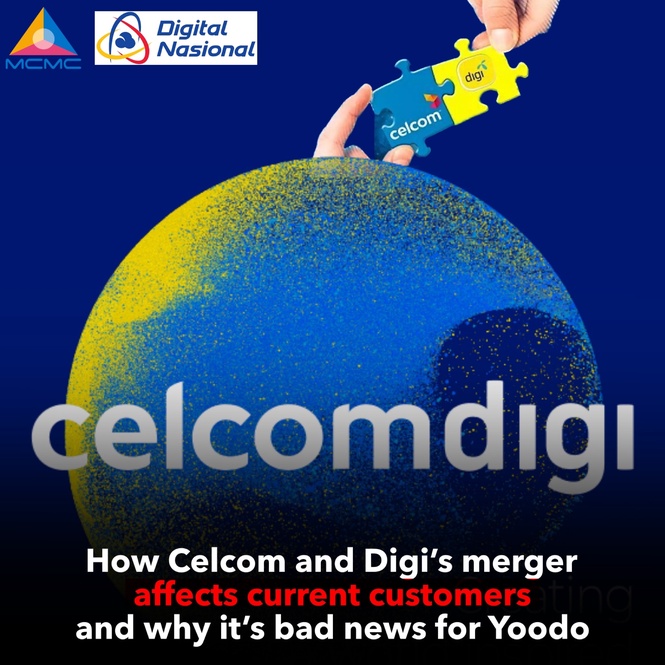
2022 is turning out to be the year of unity. While all the headlines are focused on the Unity Government under Prime Minister Datuk Seri Anwar Ibrahim and the merger of PH, BN, GPS and others within one administration, there was another colossal merger that went under the radar. Of course, I am talking about the unity of two of the biggest telco companies in Malaysia, Axiata’s Celcom and Telenor’s Digi that happened on 30 November 2022 (SoyaCincau).
Finally, after almost 2 years of rumours and dealings behind the scene, both companies have now combined to become one entity. With a rather disappointingly uncreative name of CelcomDigi, the new entity also became the largest local listed technology company on Bursa Malaysia.

Furthermore, just like Anwar’s Unity Government, the fusion of Celcom and Digi has also caused confusion and concerns from the public, especially from their customers. Do they have to change their SIM cards? Can Celcom customers use Digi’s line and vice versa? What will happen to the telco plans they’re subscribed to? And so on.
It also raises important questions about our local telco industry. Surely, with Celcom and Digi’s combined resources, infrastructure and marketing, the competition would be put at a disadvantage, right?
Besides that, there’s also the question of Malaysia’s 5G rollout being affected. Both companies signed the 5G service agreement with Digital Nasional Bhd (DNB) as well as own equity stakes in the company BEFORE their merger, so does that mean the agreement needs to be restructured?
Well, if you’re in the dark and want answers, worry not as this article will go into depth on the matter. Here’s everything you need to know:
1) How current Celcom and Digi customers are affected by the merger?
According to the official Digi website, as of right now, both Celcom and Digi customers do not need to do anything because, despite the merger, the status quo will remain the same for the near future. CelcomDigi clarified that all customers will continue enjoying their existing networks, stores, plans and services that they are doing.
That means that if you’re a Celcom or Digi customer, you do not need to change your SIM cards and will probably never have to. This is because the merged companies are combining their resources, meaning that when the Celcom and Digi networks become one, your existing SIM cards will automatically be identified as belonging to that new network.
Speaking of which, CelcomDigi further clarified that for now, customers are still restricted to their existing networks, meaning that Celcom customers can only use the Celcom network and Digi customers can only use the Digi network. It is only in the future that the merged company will start rolling out an infrastructure upgrade that will merge both networks and make them accessible to all CelcomDigi customers.
This also has something to do with a directive from the Malaysian Communications and Multimedia Commission (MCMC) regarding CelcomDigi’s spectrum divestment post-merger. This article will go in-depth regarding that matter as well as when the merged company must consolidate all of Celcom and Digi’s offerings under one single brand further down the line.
As for Celcom’s and Digi’s brands, they both will remain the same for now, though Malaysians can expect an additional CelcomDigi logo together with these brands. Accordingly, only these selected bluecube and Digi Stores can serve both Celcom and Digi customers right now, with the rest of them operating as per usual and only able to serve their respective customers.
For new customers, there are no CelcomDigi plans as of right now. Hence, you have to choose between signing up for a Celcom or Digi plan, with current rates unaffected by the merger.
2) Potential bad news for Yoodo customers
What will definitely change post-merger is Yoodo, a brand under Celcom that allows consumers to customise their data, voice and SMS plans. As part of the requirements set by MCMC in approving the Celcom and Digi merger, the new entity must divest from the former’s Yoodo brand.
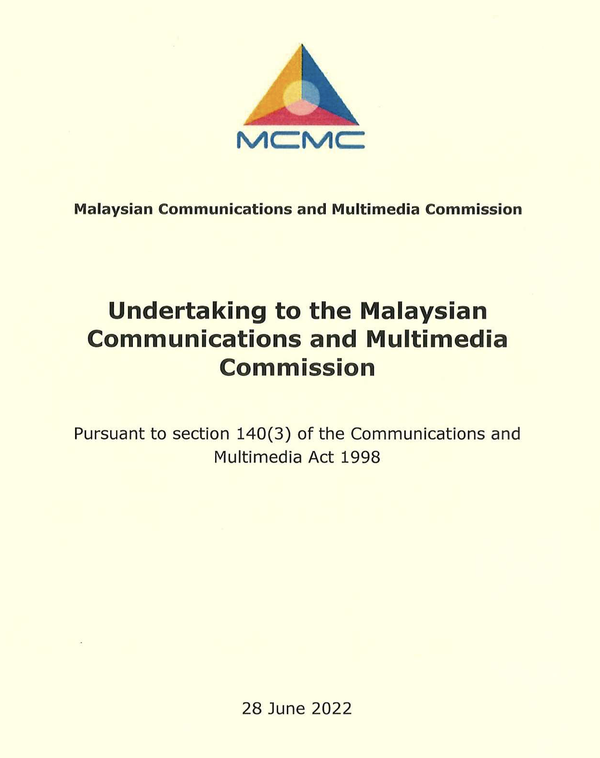
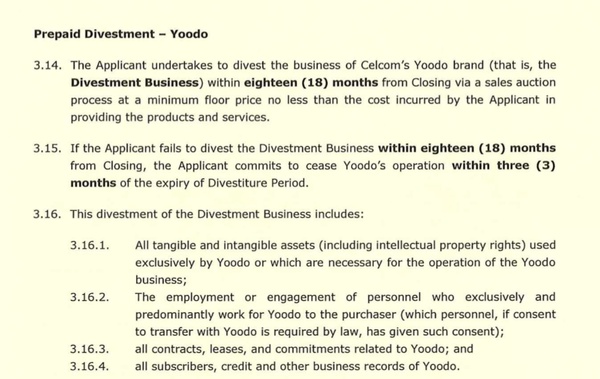
In the undertaking to MCMC which you can view here, CelcomDigi has 18 months from the closing of the merger to sell off Yoodo via a sales auction process. This is in accordance with Section 3.14 of the undertaking.
Moreover, CelcomDigi was instructed to sell Yoodo at the minimum floor price of no less than the cost incurred by Celcom in providing the brand’s products and services. If the sale of Yoodo is unsuccessful within the aforementioned period, CelcomDigi must completely shut down Yoodo’s operation within 3 months.
Besides that, MCMC also prohibits CelcomDigi from directly or indirectly absorbing Yoodo’s subscribers for a period of 3 years. It must also not restore or revive the Yoodo brand after its cessation.
Hence, if you’re a Yoodo customer, do expect a change of network as your telco will no longer be powered by the Celcom network as how it is right now. Worse, if CelcomDigi is unable to sell the brand within the specified period, Yoodo customers will have to find a new telco line as the company will seize to exist.
3) What does this mean for the 5G subscription agreement with DNB?
Another issue that may arise regarding the merger is regarding CelcomDigi’s role with DNB, specifically the share subscription agreement (SSA) and 5G network access agreement. In case you’re not familiar, under the previous government, our nation’s 5G network rollout is via a single-wholesale network under the government-owned DNB, with 4 mobile network operators (MNOs) holding a shared 65 per cent equity stake in the company.
Currently, YTL Communications (YES) holds 20 percent, Telekom Malaysia (TM) 20 percent, Digi 12.5 percent and Celcom 12.5 percent. The remaining 35 percent is owned by the government as a golden share. U Mobile and Maxis both declined to be part of the agreement.
As for the 5G network access agreement, it is exactly how it sounds. Through the agreement, all telco companies in Malaysia (except Maxis which is still deliberating) are leasing the 5G network from DNB for rollout to their customers.
Hence, given that Celcom and Digi are now one entity, does this affect both agreements? Will CelcomDigi have an added advantage by having a combined 25 percent equity in DNB? Well, simply put, no.
This is because both agreements were made with Celcom and Digi’s imminent merger in mind and steps have been put in place to avoid any unfair advantage. For example, the DNB SSA already has a clause saying that no single entity company can hold more than a 25 percent stake in DNB. Besides, the government will still have the golden share anyways, even though CelcomDigi has 5 percent more equity than the other two MNOs.
As for the 5G network access agreement, the agreement itself safeguards fair competition as all telcos are given the same access to the 5G infrastructure in Malaysia under DNB. This means that regardless of the telco you’re using, the 5G network is from the same cell tower that is owned by DNB, with the only difference being the data plan being offered by each respective telco.
4) Won’t this merger cause uneven competition in our telco industry?
Speaking of fair competition, MCMC has set up several safeguards to ensure that the merger would not reduce telco competition in our country. In a statement issued back in April this year, the commission asserted that both Celcom and Digi have submitted an undertaking containing their commitment to addressing the competition issues highlighted by MCMC.
The commission stressed that it has assessed the commitment offered by CelcomDigi and was satisfied that it will significantly reduce the competition issues that will or may arise as a result of this merger. The undertaking is the same as mentioned earlier in this article, with Yoodo’s divestment being one of the conditions.
Other notable requirements set by MCMC include the divestment of a total of 70MHz of spectrum in the 3 bands to avoid spectrum concentration post-merger. The bands in question are the 10MHz in the 1800MHz spectrum band, the 20MHz in the 2100MHz spectrum band and the 40MHz in the 2600MHz spectrum band.
Furthermore, CelcomDigi must also ensure that any Mobile Virtual Network Operators (MVNO) that were under both companies are no worse off post-merger. The new entity must also ensure continuity of access for existing and new MVNOs to wholesale services for a duration of 3 years from closing.
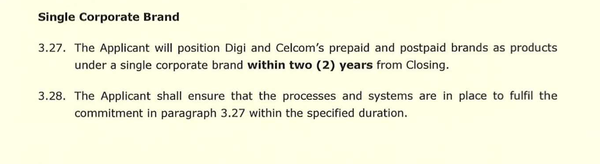
CelcomDigi is also given 2 years from the closing of the merger to consolidate all of Digi and Celcom’s prepaid and postpaid brands as products under a single corporate brand. In doing so, the merged company must ensure that the processes and systems are in place to fulfil this commitment.
So, are you a Digi or Celcom customer? What do you guys think of the two companies’ merger into CelcomDigi? Share your thoughts in the comments!
Jamie is a content creator under the Newswav Creator programme, where you get to express yourself, be a citizen journalist, and at the same time monetize your content & reach millions of users on Newswav.
Log in to creator.newswav.com and become a Newswav Creator now!
Newswav is solely an aggregation platform and hosts the content. The views expressed and content above including media (pictures, videos, etc) were provided by the author. If you have any questions about the content, copyright or other issues of the work, please contact Newswav.