
Transport Minister and DAP Secretary-General Anthony Loke stood before a crowd at the historic Pay Fong High School in Melaka. He announced that the federal Cabinet had officially approved new admission pathways to public universities for graduates from non-governmental streams, including tahfiz institutions and Chinese Independent Secondary Schools holding the Unified Examination Certificate (UEC). To a casual observer of Malaysian current affairs, what followed was an entirely predictable, almost ritualistic script. The opposition erupted in fierce denunciation, claiming that the Madani government was covertly eroding the foundations of the national education system. Meanwhile, conservative factions painted the move as a dangerous capitulation to localized, non-Malay linguistic interests.
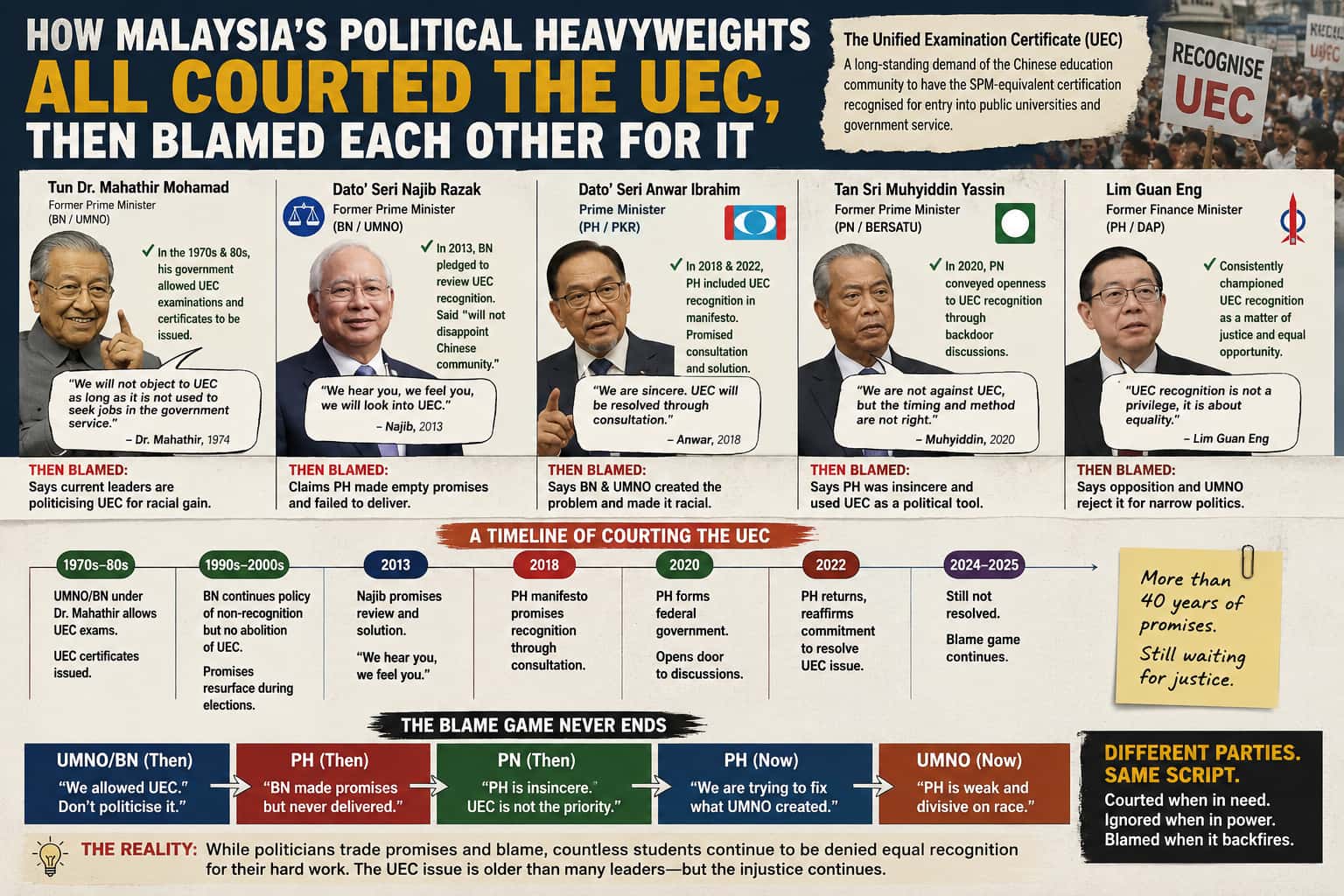
Yet, beneath the aggressive press releases, a deeply ironic collective amnesia pervades the country’s political class. The furious theater of modern Malaysian politics masks a historical reality that most parties would prefer their voters forget: nearly every major political coalition in the country whether Malay-nationalist, multi-ethnic, Islamist, or Bornean has at one point or another flirted with, promised, or actively implemented the recognition of the UEC when electoral survival demanded it.
The contemporary UEC debate is rarely about academic rigor, pedagogical frameworks, or administrative feasibility. Instead, it is an engineered tool of identity mobilization a political currency minted in times of electoral desperation and spent during periods of opposition grandstanding. To understand how Malaysia arrived at this impasse, one must look past the immediate outrage and dissect the long, calculated history of political courtship surrounding this decades-old certificate.
The Genesis of an Educational Fault Line
To comprehend why a high school certificate carries enough political explosive power to destabilize governments, one must look back to the structural framework of the post-independence state. Following the enactment of the Education Act 1961, Chinese secondary schools across the country were faced with a stark institutional ultimatum: convert into English- or Malay-medium national-type schools to receive state funding, or retain Mandarin as their primary medium of instruction and forfeit all financial support.
Those that chose the latter path became Chinese Independent High Schools. Deprived of a state-sanctioned standardized exam, the United Chinese School Committees' Association of Malaysia (Dong Zong) established the UEC in 1975 to provide a uniform academic benchmark for its students. For over half a century, this system survived entirely outside the financial ambit of Putrajaya, relying instead on community philanthropy and tuition fees.
Because the UEC operates independently of the Ministry of Education, it has long been viewed by Malay-nationalist parties as a structural challenge to the National Education Policy, which prioritizes Bahasa Melayu as the primary tool for social cohesion. Sociologically, this split created parallel educational universes. While international institutions and domestic private universities warmly welcomed UEC graduates, the federal government maintained a rigid barrier, barring certificate holders from entering public universities (IPTAs) and the civil service. This structural exclusion laid the groundwork for an enduring socio-political grievance and created a potent pool of voters that political strategists would eventually seek to exploit.
Pakatan Harapan: The Long-Term Champions and the Burden of Governance
For the parties that now comprise the Pakatan Harapan (PH) coalition, advocating for the UEC was long a cornerstone of their progressive, reformist identity. Throughout their years in the political wilderness as Pakatan Rakyat, components like the Democratic Action Party (DAP) and the People’s Justice Party (PKR) positioned the non-recognition of the UEC as a glaring example of state-sponsored discrimination and systemic human capital flight.
This advocacy culminated in the historic 2018 General Election (GE14). In their election manifesto, Buku Harapan, the coalition explicitly promised that a PH government would recognize the UEC for entry into public universities, provided applicants possessed a credit in Bahasa Melayu at the Sijil Pelajaran Malaysia (SPM) level. It was a historic vow that helped mobilize an unprecedented wave of non-Malay voter turnout, fundamentally altering Malaysia's political landscape.
However, the realities of state power quickly collided with the delicate mechanics of a multi-ethnic coalition. Upon taking office in 2018, Prime Minister Tun Dr. Mahathir Mohamad adopted a highly cautious posture, famously noting that he had never outright rejected the certificate, but that implementation required careful consideration of Malay cultural anxieties. To manage the brewing political storm, the administration appointed a special UEC Task Force (PPDUEC) to gather stakeholder perspectives. Yet, before the committee's findings could see the light of day, the government collapsed during the political realignment of 2020.
Even as the political landscape shifted, key PH figures continued to champion the cause. In analytical circles, figures like PKR’s Rafizi Ramli argued that Malaysia must prepare for a trilingual global future and structurally integrate diverse qualifications. When the coalition returned to power under the Madani banner, the rhetoric shifted from sweeping ideological pronouncements to incremental, pragmatic policy adjustments. This strategy is vividly apparent in the current approach led by Higher Education Director-General Azlinda Azman, who carefully clarified that the new pathways do not amount to formal, outright recognition of the UEC, but are instead highly specific technical channels aimed at human capital development.
Barisan Nasional: The Desperate Courtship of 2018
While Pakatan Harapan's alignment with the UEC is widely known, the historical record of Barisan Nasional (BN) and more specifically, its dominant partner, the United Malays National Organisation (UMNO) is often obscured by modern partisan rhetoric. For decades, UMNO positioned itself as the unyielding vanguard of Malay political and linguistic primacy, routinely dismissing calls for UEC recognition as an existential threat to national unity.
However, when structural shifts threatened their hold on power, ideological red lines proved remarkably flexible. Following the 2008 and 2013 general elections, BN suffered severe electoral erosion among urban and non-Malay demographics. In a bid to reverse this trend, the administration of Datuk Seri Najib Razak began a quiet, calculated rapprochement with the Chinese educational establishment.
As early as 2013, Najib invited the leadership of Dong Jiao Zong to the prime minister's official residence to negotiate terms for recognition, [proposing a passing mark in SPM Bahasa Melayu as the primary bridging requirement](https://plm.org.my/mca-dap-berebut-jadi-jaguh iktiraf-uec/). MCA President Datuk Seri Wee Ka Siong later detailed how the BN government had successfully passed resolutions in Parliament allowing UEC holders to enter Teacher Training Institutes (IPGs) an intake process that operated continuously from 2011 until the change of government in 2018.
The ultimate ideological concession arrived in April 2018. Facing an existential electoral challenge from a united opposition, Barisan Nasional launched its GE14 manifesto. For the first time in its history, the manifesto explicitly stated that BN would allow UEC holders to enter public higher education institutions, provided they met the threshold for Malay language and history.
As Keadilan leader Amidi Abdul Manan recently observed, this pivotal policy shift originated under a BN administration led by the nation's largest Malay party, driven by a pressing need to revive its flagging coalition dynamics. Yet, following their historic defeat in 2018, BN swiftly pivoted back toward conservative, ethno-nationalist rhetoric, effectively burying their previous manifesto commitments in a bid to consolidate their core traditional voting base.
Perikatan Nasional: The Pragmatic Opportunism of PAS and Bersatu
The contemporary opposition vanguard, Perikatan Nasional (PN) comprising the Malaysian Islamic Party (PAS) and the Malaysian United Indigenous Party (Bersatu) consistently frames the UEC as an unacceptable parallel system. PAS leaders regularly utilize their media channels to issue stern warnings, with state chapters like PAS Negeri Sembilan asserting that any attempt to recognize the UEC, whether directly or through subtle policy adjustments, directly violates the National Education Policy. Following the Cabinet's recent announcement, Bersatu President Tan Sri Muhyiddin Yassin immediately called for a formal review, demanding that the state return to established, traditional pre-university pathways like the STPM and matriculation.
Yet, an examination of historical coalitions reveals that both PAS and Bersatu have previously compromised on these exact principles when political survival or coalition building required it.
During the Pakatan Rakyat era in 2013, PAS officially endorsed a common platform that advocated for the UEC's eventual integration into the state apparatus. Similarly, when Bersatu was formed as an offshoot of UMNO and joined Pakatan Harapan in 2018, its leadership fully endorsed the Buku Harapan platform, which explicitly promised UEC entry into public universities.
Furthermore, during the Perikatan Nasional administration from 2020 to 2022, when PAS and Bersatu held federal power, the coalition chose not to dismantle the existing entry pathways for UEC holders into Teacher Training Institutes (IPGs). As political analysts frequently observe, controversies surrounding education and language offer an effective avenue for conservative parties to mobilize their traditional base. This dynamic often results in a sharp divergence between the uncompromising rhetoric used while in opposition and the highly pragmatic policy accommodations made when managing state power.
The Bornean Realities: Practicality Over Polemics
While Peninsular Malaysia remains locked in an ideological stalemate over the certificate, East Malaysia presents a completely different governance model. In Sabah and Sarawak, the UEC has long been stripped of its explosive political charge and is treated instead as a routine matter of human capital development.
Sarawak took the definitive step under the leadership of the late Chief Minister Tan Sri Adenan Satem, who officially recognized the UEC for entry into the state civil service and University Technology Sarawak (UTS) a progressive policy approach that continues under the ruling Gabungan Parti Sarawak (GPS) administration. Similarly, Sabah formally extended state recognition to the certificate under the Heritage Party (Warisan) administration, a policy framework that has been maintained by the current Gabungan Rakyat Sabah (GRS) government.
This regional divergence highlights a profound cultural and structural divide within the Malaysian federation. As former Sabah Chief Minister Datuk Seri Salleh Said Keruak recently observed, while the peninsular political establishment habitually views the UEC through a zero-sum lens of national identity and linguistic supremacy, the Bornean states view it through a lens of practicality and inclusivity.
In East Malaysia, where multi-ethnic coexistence is woven into the social fabric, a substantial number of indigenous and Bumiputera students are enrolled in Chinese independent schools. Consequently, families and local leaders prioritize academic quality and human capital retention over ideological battles, demonstrating that the controversy is not an inevitable cultural conflict, but a specific product of Peninsular political dynamics.
The Political Economy of a Perpetual Controversy
To look at the UEC issue solely through the lens of identity politics is to miss the underlying economic realities that sustain this endless debate. As highlighted in a critical analysis published by Aliran, the federal government’s formal refusal to grant outright recognition to the UEC has inadvertently created a highly profitable, parallel economic ecosystem. While UEC holders are officially barred from direct, subsidized entry into public universities via the standard UPU system, the "private wings" and commercial arms of several prominent public universities actively accept UEC qualifications for their fee-paying courses.
This dual arrangement serves as an incredibly effective mechanism for political risk management. By maintaining an official stance of non-recognition, the state can easily shore up solidarity among conservative voters, framing the policy as a principled defense of national identity. Concurrently, by quietly allowing UEC holders to enroll in commercial university programs, the state taps into a lucrative revenue stream that helps offset the underfunding of higher education.
The true casualties of this institutional impasse are working-class Malaysian families across all ethnic backgrounds. Low-income Malay students are left to compete for an increasingly constrained pool of subsidized public university spots, while middle-class Chinese families are forced to bear a heavy financial burden to educate their children domestically. By framing this socioeconomic challenge as a zero-sum cultural conflict, the political class successfully diverts public attention away from the structural underfunding and declining standards that impact the national school system as a whole.
What do you think? I’d love to hear your opinion in the comments section.
AM World (tameer.work88@gmail.com) is a content creator under the Newswav Creator programme, where you get to express yourself, be a citizen journalist, and at the same time monetize your content & reach millions of users on Newswav. Log in to creator.newswav.com and become a Newswav Creator now!
The User Content (as defined on Newswav Terms of Use) above including the views expressed and media (pictures, videos, citations etc) were submitted & posted by the author. Newswav is solely an aggregation platform that hosts the User Content. If you have any questions about the content, copyright or other issues of the work, please contact creator@newswav.com.
