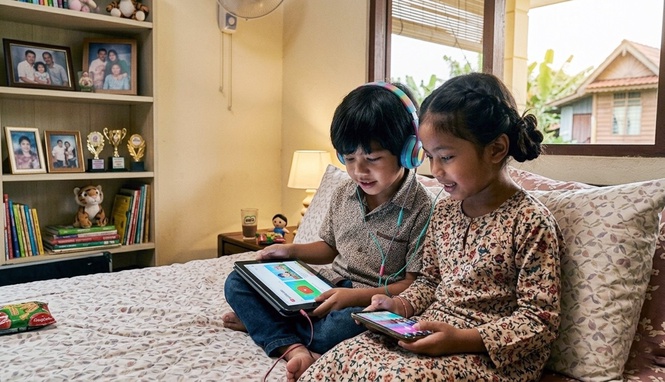
FROM hide-and-seek to online gaming, childhood has changed.
Today, it is just as common to see babies watching Cocomelon on tablets, toddlers holding smartphones and children spending hours on online games. But when are children old and responsible enough to have their own phone?
For many families, giving a child a smartphone or tablet is not simply about keeping them entertained. Gadgets can provide access to educational apps, videos and online learning platforms that allow children to explore new subjects and develop skills in an engaging way.
For younger children, interactive games and educational content can make learning feel more enjoyable and accessible.
Entertainment is another common reason parents introduce gadgets to their children. Cartoons, games and videos can keep children occupied, especially when parents are busy with work, household responsibilities or other commitments.
Gadgets can also be useful for communication and safety. As children grow older and become more independent, having a phone allows them to contact their parents when they need help or when their plans change.
Parents may also feel more comfortable knowing that they can reach their children when they are outside the home.
What are the concerns? Young children don’t learn language simply by hearing words from their surroundings. They learn through interaction with peers and adults on a daily basis.
Excessive or poorly managed screen exposure may reduce opportunities for the real-world interaction through which young children develop language.
Research has found associations between greater screen exposure and poorer language outcomes while educational content and co-viewing with caregivers appear more favourable than passive, solitary viewing.
Similarly, excessive screen time may also affect children’s ability to learn and maintain attention. Children who spend substantial amounts of time consuming fast-paced, highly stimulating content may become accustomed to constant changes in sound, movement and visual stimulation.
The concern is whether constant digital stimulation is displacing the slower, sustained activities through which children practise attention, problem-solving and persistence.
Can too much screen time be affecting children’s speech? A study had found that children exposed to screen time had more than twice the likelihood of experiencing language and speech delays compared with children with no screen exposure.
Researchers point to reduced opportunities for physical interaction and communication as one possible explanation.
How can families realistically create healthier boundaries around technology?
As children increasingly use gadgets in their daily lives, families can create healthier boundaries by setting clear rules while remaining actively involved in how technology is used.
Parents can arrange screen-free moments before meals, before bedtime and during family chats while choosing age-appropriate content and watching or engaging with younger children rather than leaving them to consume content alone.
They can also use co-viewing to keep an eye on things while still spending lots of time with their kids.
Higher screen time at age two was linked to worse executive function performance and lower receptive vocabulary at age four.
Most importantly, screen time should not replace conversation, play, reading, exercise and face-to-face interaction.
Parents can also teach children that boredom, patience and frustration are normal parts of life that do not always need to be solved with technology.
Learning to sit with boredom can encourage creativity, independence and the ability to find entertainment without a screen.
This approach is supported by the American Academy of Pediatrics, which describes parental mediation as how parents guide, set rules and monitor children’s media use.
If you decide to give your child a gadget, setting a few simple ground rules can help them develop healthier digital habits.
Here are some rules every parent can set:
0 Set daily limits for screen and phone use to help children develop healthy digital habits.
0 Use their gadgets responsibly, not only by respecting others online, but also by protecting their own personal information and following the rules agreed upon with their parents.
0 Lead by example. Parents should also be mindful of their own gadget use as children are more likely to follow healthy technology habits when they see their parents practising them.
0 Specify times of the day when using the phone is not allowed, such as late at night or during family activities, such as dinner.
0 When your kids start using social media, such as Instagram or Threads, monitor them and let them know that you are keeping an eye on their online interactions.
Ferhad Shah is a student at City University Malaysia. Comments: letters@thesundaily.com