
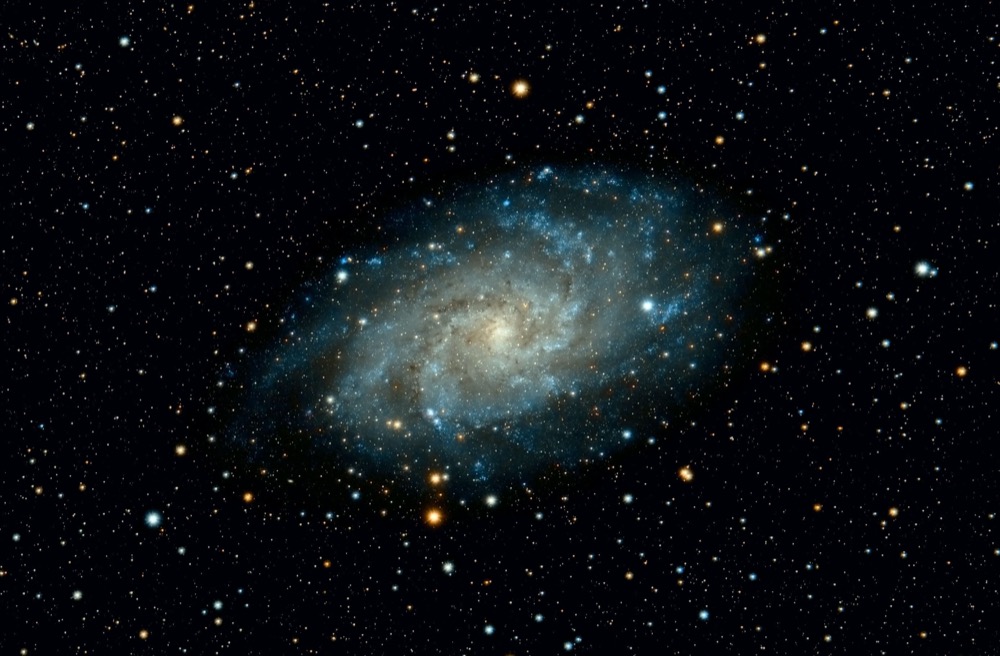
A galaxy just one-hundredth the size of the Milky Way has given astronomers one of their clearest views yet of one of the most transformative periods in cosmic history. Using observations from the Hubble Space Telescope, researchers detected escaping ultraviolet radiation from the distant galaxy MXDFz4.4, providing direct evidence of how the first generations of galaxies helped reshape the Universe only 1.4 billion years after the Big Bang. The findings, published in the Astrophysical Journal, offer an unprecedented glimpse into the process known as cosmic reionization.
A Tiny Galaxy With An Outsized Role In Cosmic History
For decades, astronomers have tried to understand how the Universe transitioned from a dark, opaque environment filled with neutral hydrogen into the transparent cosmos we observe today. This period, known as the Epoch of Reionization, unfolded during the first billion years after the Big Bang, when the earliest stars and galaxies began flooding space with energetic ultraviolet radiation. Until now, directly observing that escaping radiation from galaxies so far away has remained one of astronomy’s greatest challenges.
The newly studied galaxy, MXDFz4.4, existed roughly 1.4 billion years after the Big Bang, placing it near the closing stages of reionization. Despite being about 100 times smaller than the Milky Way, it is producing stars at a rate approximately ten times higher than our own galaxy. That intense burst of star formation packed an enormous number of young, massive stars into an exceptionally compact region, creating the conditions needed for ultraviolet photons to escape into intergalactic space. Those escaping photons are exactly the kind believed to have gradually ionized the neutral hydrogen that once blanketed the cosmos. The discovery gives scientists a rare opportunity to study the physical processes that likely occurred across countless early galaxies, but which have remained largely hidden from direct observation.
Hubble Captures What Scientists Once Believed Was Impossible
The observations relied on deep Hubble Space Telescope imaging collected across multiple long-duration surveys. Those exceptionally sensitive datasets allowed astronomers to detect ionizing ultraviolet light that would normally be absorbed before reaching Earth. Beyond detecting the escaping radiation itself, Hubble also resolved the galaxy’s internal structure, revealing clusters of newly formed stars responsible for generating the energetic photons.
“Observing a galaxy like this was thought to be impossible,” said Dr. Ilias Goovaerts, a postdoctoral fellow at the Space Telescope Science Institute.
“Researchers expected the ‘fog’ or neutral hydrogen that filled the early Universe would be too thick and obscure our view of its ionizing light.”
“Hubble not only spotted that light, but it also helped reveal incredible details about the galaxy’s characteristics.”
The research, published in the Astrophysical Journal, demonstrates how improvements in deep-space observations are allowing astronomers to test long-standing theories about the early Universe using direct evidence instead of indirect modeling. Rather than simply confirming that ionizing radiation existed, the observations reveal how the internal structure and star formation history of a young galaxy may have created channels through which ultraviolet light could escape into surrounding space.
Why MXDFz4.4 Stands Apart From Every Other Known Galaxy
Astronomers have identified many galaxies dating to the same era, but detecting escaping ionizing photons has proven extraordinarily difficult. Neutral hydrogen surrounding these ancient systems usually absorbs the radiation before it can be observed. That makes MXDFz4.4 an exceptional object whose properties may reveal why some galaxies contributed more effectively than others to reionizing the Universe.
“Astronomers have found many galaxies that existed at this point in the history of the Universe, but we haven’t detected ionizing photons from any of them, making MXDFz4.4 one of a kind,” said Dr. Marc Rafelski, also from the Space Telescope Science Institute.
The detailed Hubble images suggest that multiple recent bursts of star formation carved out pathways through the surrounding gas, allowing ultraviolet radiation to escape more efficiently. Instead of being distributed across a large galaxy, these hot, massive stars occupy an extremely compact region, dramatically increasing the intensity of radiation in a confined volume. That combination of size, density, and vigorous star formation may explain why MXDFz4.4 succeeded where similar galaxies have remained hidden from direct observation.
A Window Into How The Universe Became Transparent
The findings also strengthen the growing idea that numerous small, rapidly star-forming galaxies, not giant galaxies, played the dominant role in ending the cosmic dark ages. Although individually faint, these compact systems may collectively have generated enough ultraviolet radiation to gradually ionize the hydrogen filling intergalactic space. If similar galaxies were common throughout the young Universe, they could have driven one of the most significant transitions in cosmic evolution.
“A lot of young, hot, massive stars in a small space do a better job of blasting through opaque gas,” Dr. Goovaerts said.
Future observations with the James Webb Space Telescope and upcoming observatories are expected to search for additional galaxies like MXDFz4.4, allowing researchers to determine whether this object is a rare exception or represents a broader population that shaped the early Universe. Each new detection will help reconstruct how the first galaxies transformed a once-opaque cosmos into the transparent Universe that made the formation of stars, galaxies, and planetary systems, including our own, possible.