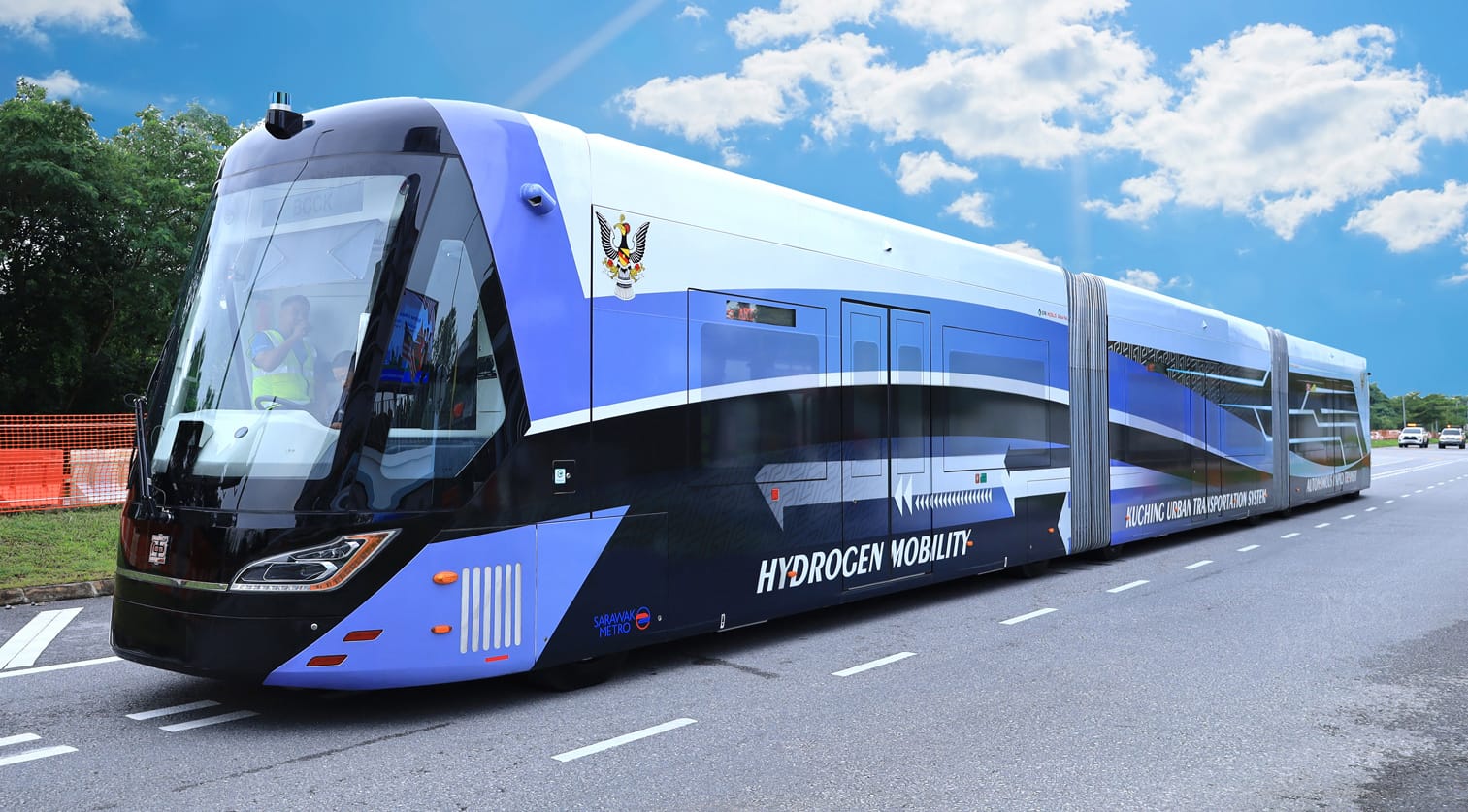
In my second article of the Sarawak series, I will analyse the Kuching Urban Transportation System (KUTS), an under-construction Autonomous Rapid Transit (ART) system network which will serve the Greater Kuching Area, including the Samarahan and Serian lines, with future expansion plans based on the existing transit routes, using two major metrics: Historical Precedent in Germany - specifically Thuringia - and the Political Cost, before concluding with my own personal thoughts and hopes for the rest of Malaysia.
What is KUTS?
The Kuching Urban Transportation System (KUTS) is Sarawak's plan to give Greater Kuching its first modern mass transit network. It isn't conventional light rail: the state dropped an earlier RM10.8 billion LRT plan for the ART, a rubber-tyred vehicle that follows a virtual track using sensors and road-embedded guidance. It looks like a tram but runs like a bus. Its vehicles are powered by hydrogen fuel cells, which means zero emissions at the point of use: no diesel exhaust, no carbon from the vehicles themselves, according to the Citizen's Journal.
Germany's Historical Precedent: Freistaat Thüringen & Lessons Learned
The best place to start the analysis of this article would be to have background on what other places have done, including findings and their successes/drawbacks - specifically in the German Free State of Thuringia [Freistaat Thüringen].
In 2019, the then-Thuringian Minister-President [Malay Equivalent: Menteri Besar] Bodo Ramelow and State Environment Minister Anja Siegesmund were presented with the results of a feasibility study at a test drive of the world's first hydrogen-powered commercial train, Coradia iLint, in the Thuringian forest. The result was the finding that operating a hydrogen-based railway line powered by 100 per cent renewable energy could save hundreds of tons of carbon emissions per year - in comparison to conventional diesel fleets, with the caveat that "green" hydrogen - hydrogen produced via renewable methods - is utilised rather than "grey" hydrogen - hydrogen produced via natural gas - which would significantly undercut climate benefits.
Since then, the state government approved funding for a joint research project between ThEEN [Thuringian Renewable Energy Network] and the HySON Institute for Applied Hydrogen Research in 2021, stretching until 2023, before the Federal Government decided to approve a maximum funding total of a whopping €15 million over the course of 4 years (September 2023 - September 2027) for a hydrogen filling station at the Erfurt freight transport centre - the most significant development for the expansion of hydrogen infrastructure in Thuringia while the Weimar Local Transport Initiative is a city-level initiative to replace fossil-fuelled buses with green-hydrogen fuel-cell buses, with the long-term aim of converting the whole Weimar bus fleet to support hydrogen, which had been supported and encouraged by the state with grants of approximately €3 million - with Environment Minister Anja Siegesmund going so far as to describe Weimar as the first place in Thuringia to run hydrogen buses in local public transportation.
However, there are drawbacks. One significant drawback, in my mind, is the reliance on external suppliers to ensure continuity of hydrogen supply - specifically from Tyczka Hydrogen. In an Instagram post by Stadtwirtschaft Weimar GmbH, the Weimar municipal company, they welcomed Tyczka Hydrogen - a supplier of hydrogen - as a partner to ensure that "hydrogen buses remain reliably in service". Regardless of how efficiently it works in Germany, it is clear that the prices, availability, and the "green" label depend on someone else's production and delivery. Still, above all, it depends on the availability of a company, which is very unstable in the current political and economic climate the whole world is facing. One must remember that this is a Public-Private Partnership (PPP) which might work well in Germany but fails when it comes to the Malaysian context due to either shady deals without accountability and oversight by the legislative branch of Government, or it is the companies themselves privatising profits while socialising losses in real time - look at the toll roads in West Malaysia. Another drawback is that Weimar is retrofitting its municipal vehicle depots and maintenance workshops to support a major green hydrogen transition, which might pose safety hazards. For starters, Hydrogen Gas is highly flammable - and it's this danger that makes retrofitting tricky, since specialised equipment has to be used for proper ventilation and active extraction systems, which is unfeasible or just downright expensive. Another is that hydrogen gas is odourless and colourless, which makes detection near impossible for human operators - meaning that any gas leak can rapidly replace oxygen and cause asphyxiation. Therefore, to prevent this and ensure the safety of the workers, retrofitted spaces require a costly network of dedicated electrochemical or fibre-optic hydrogen sensors linked to automatic emergency shut-off valves.
As Sarawak prepares to test and deploy its own hydrogen-powered ART network across Greater Kuching via KUTS, Thuringia's lessons in supply vulnerabilities and high infrastructure overheads serve as a critical cautionary tale - and it does seem that Sarawak is mostly avoiding these two major structural failures that were present during retrofitting and in the question of partnership. Sarawak's Economic Development Corporation (SEDC) energy subsidiary - which is a statutory body of the government of Sarawak - has stated in a Memorandum of Understanding that the supply of Hydrogen for the ART system will fall on its shoulders - which was reported by the Malay Mail two years ago, in 2024. Meanwhile, instead of retrofitting, they have built an entirely specialised, state-of-the-art workshop in Rembus to support the in-construction ART network, which drastically reduces the safety and feasibility concerns that may have arisen in the Malaysian context.
Political Costs & Debates
Unfortunately, the political cost cannot be exactly measured and is mostly speculation due to the lack of polling of public opinion on this project, and most sources are highly partisan - one way or another but there is strong evidence to suggest that this is politically contested.
The Government and Abang Johari, the State Premier, have hailed this ART project as Sarawak leading Southeast Asia with a hydrogen-powered ART system. In a source recorded in the Borneo Post, he mentioned that, and I quote: "Our policies are designed to ensure that Sarawak's development keeps pace with the new economy, where green and renewable energy will replace fossil fuels", and he put his own personality over the whole project when he doubled down on this project and said that Sarawak's own coffers would finance the whole thing when he could not secure certain Federal Government support in partially financing the project. He also claimed that Bintulu would be the site of the second ART system - which would include the area of Tanjung Kidurong, a very bold claim - that has received some structural setbacks. The initial phase of the KUTS experienced a minor delay of around 4%. Since the Bintulu Project is part of the 13th Malaysia Plan, which spans between 2026 and 2030, any subsequent regional expansions will naturally face an altered timeline since resources and structural validation are heavily tied to completing the initial Greater Kuching phases first.
The Opposition - particularly DAP's Violet Yong - has criticised the ART project, not for environmental reasons but on grounds related to expenses and instead diverting those funds to solving local needs first. She claims that "Sarawak is spending taxpayers' money to carry out the ART project to a tune of RM6 billion", which was reported in a press release. She has also, historically, criticised the project from a technological and maintenance perspective, as reported in 2020. One thing to note is that the State Opposition in Sarawak is politically very weak, as they only won two seats last time out, so the best thing for them to do as the Opposition is to criticise the Government from a financial hawkish approach while not falling out with the partnership they share in the Federal Government - so Sarawak DAP must walk a tightrope with their constitutional duty as "check and balance" against the Government; therefore, they choose to approach this from a neutral technocratic approach, whereby aggressive ideological or cultural attacks could destabilise the federal coalition at large.
Writer's Concluding Thoughts
Hydrogen methods can work - it just depends on the rollout timeline. Personally, I am in favour of any method that decreases carbon emissions while providing a cheap or even free alternative to transportation in order to foster a new environmentally conscious or "green" economy. With that said, since it is clearly in the experimental stage, I'd rather funds be used to develop for the long term - while addressing local issues like the cost of living and the long-term poverty that many Sarawakians face - which stands at 8.4% according to OpenDOSM Statistics, making it the 4th-highest poverty rate on a state-by-state basis.
However, in saying that, Sarawak must show the Federal Government that this project is worth investing in. This might give other areas which are not so developed a chance to improve their living standards by alleviating pressure on petrol by allowing cheap alternative public transportation that is environmentally friendly to foster a new Malaysia overall - with the strong caveat that it is driven by state-backed investment rather than the shambolic performances of public-private partnerships, to ensure that workers up and down the country get decently paid state-backed jobs and are emancipated from corporate oppression!
Germany walked, so that we could seize the opportunity - and run!
Timothy (timothytanyeantim@gmail.com) is a content creator under the Newswav Creator programme, where you get to express yourself, be a citizen journalist, and at the same time monetize your content & reach millions of users on Newswav. Log in to creator.newswav.com and become a Newswav Creator now!
The User Content (as defined on Newswav Terms of Use) above including the views expressed and media (pictures, videos, citations etc) were submitted & posted by the author. Newswav is solely an aggregation platform that hosts the User Content. If you have any questions about the content, copyright or other issues of the work, please contact creator@newswav.com.