
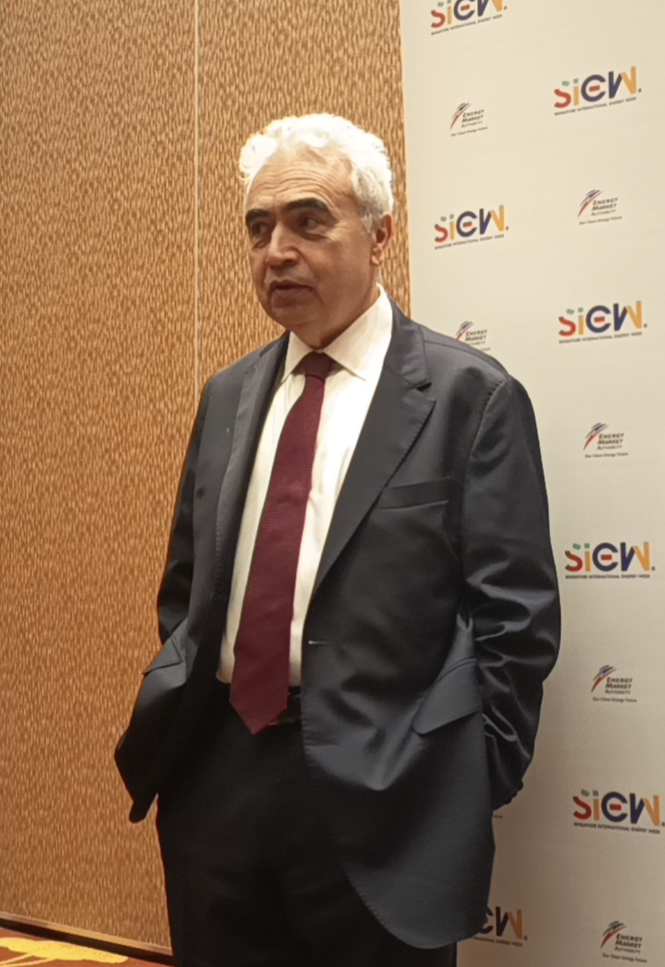
SINGAPORE — Global supply shocks and fossil fuel market volatility are driving an “unprecedented realignment of power engineering and energy architecture, accelerating deep structural transitions toward grid electrification, solar deployment, and nuclear generation,” according to International Energy Agency Executive Director Fatih Birol.
Delivering remarks at Singapore International Energy Week, Birol framed current market fractures not merely as short-term price spikes, but as structural catalysts forcing an overhaul of energy infrastructure. The sharpest real-world market countermeasure to soaring baseline fuel prices and supply interruptions has materialized as a surge in clean technology deployment, spearheaded by electrification across transport and industrial applications.
“Outside China, electric car sales in the last eight months increased by 60 percent compared to previous years,” Birol said, identifying the inflection in vehicle powertrain adoption as one of the most consequential technological shifts unfolding in international energy markets.
The acceleration in electric mobility arrives alongside a broader wave of system-wide electrification. Electricity consumption across Asia is expanding at twice the pace of total primary energy demand, propelled by industrial electrification, rising cooling loads, electric fleet conversions, and computing power requirements from expanding data centers.
Birol characterized current market conditions as “the largest energy security threat in history,” warning that international markets will not easily return to pre-war equilibrium by 2027. The instability has compelled governments to overhaul technological pathways, diversify supply chains, and deploy alternative generation sources at scale.
Soaring input costs have accelerated that economic calculation. Global natural gas prices have climbed by roughly 200 percent, while Asian regional coal indices surged 250 percent above pre-conflict baselines, stressing emerging power grids reliant on thermal imports.
Solar photovoltaic installations have surged, especially across Asian markets where panel import volumes jumped as network operators and distributed consumers seek domestic generation capacity to insulate against imported commodity spikes.
System efficiency and automated energy conservation measures have gained momentum across industrial and commercial footprints, though their long-term baseload impact remains subject to grid integration studies.
Concurrently, nuclear fission is undergoing a major renaissance. Around 90 gigawatts of nuclear generating capacity is under construction worldwide, marking the most active construction cycle the sector has seen in four decades.
“There is a lot of appetite for new nuclear energy,” Birol said, noting renewed investment across both gigawatt-scale conventional reactors and emerging small modular reactor technologies.
The systemic adoption of electric vehicles represents the fourth pillar, demonstrating how rapidly end-use consumer technologies and manufacturing lines adjust when relative fuel economics decouple from hydrocarbons.
Beyond generation assets, Birol underscored that the geopolitical resilience of technological systems hinges on supply chain integrity, pointing out that strategic trust among trade partners has eroded.
“If you ask me in today’s energy world, everything included, what is the most scarce commodity? Is it oil? No. Is it natural gas? No. The most scarce commodity today in the energy world is trust,” he said, warning that using energy flows as geopolitical leverage causes lasting institutional damage to export relationships while driving importers toward diversified and decentralized technologies.
Looking ahead, Birol said Asia is entering “the age of electricity,” wherein advanced transmission networks, storage capacity, and synchronized power systems will dictate industrial competitiveness. While thermal generation and natural gas remain embedded in transitional capacities, high-voltage networks and electrification will define primary energy flow.
To stabilize this regional architecture, Birol called for accelerated cross-border interconnection projects, specifically backing technical and physical integration through the Asean Power Grid.
“If this region wants to have an economy which is modern, clean and competitive, and if it wants a secure energy system, electricity is the future,” he said.
