First of a series
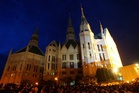
ON July 29, 2026, I witnessed the unveiling of the historical marker for the former central office of the Iglesia Ni Cristo (INC) in San Juan, led by National Historical Commission of the Philippines Chairman Regalado Jose and Executive Director Carminda Arevalo, together with Deputy Executive Minister Br. Angelo Eraño Manalo and General Secretary Br. Rene Panoncillo of the INC.
I was most interested in the part of the program where Br. Bienvenido Santiago, general evangelist of the INC, narrated the events that led to the construction of the central office in San Juan — finished in 1952 — where then-executive minister Br. Felix Manalo held office and residence until his death in 1963.
The INC was officially registered under the auspices of the Philippine government on July 27, 1914. By most accounts, it began as a modest religious group with its first local congregation established in Punta, Santa Ana, Manila. Many of its first converts belonged to the Filipino working class, and the INC itself was derided for many years as a cult by its detractors.
Under Spanish rule, the presence of religions other than Roman Catholicism in the Philippines was prohibited. From the start, Catholic religious missionaries served as a tool to advance colonialism under Spanish royal patronage (i.e., Patronato Real). Inevitably, the Catholic Church became the vehicle of racism that accompanied Western colonialism/imperialism, as experienced by San Juan de Dios donado (lay brother) Apolinario de la Cruz (Hermano Puli) and the native secular clergy immortalized by the martyrdom of GomBurZa, among others. Early in Spanish rule, native spiritual leaders (i.e., babaylan, etc.) were systematically persecuted and decimated by the colonial state and the Catholic Church in tandem.
In this context, the foundation of the upstart Iglesia Ni Cristo — together with the establishment of the Iglesia Filipina Independiente by Isabelo de los Reyes and Bishop Gregorio Aglipay in 1902, and a platoon of popular (messianic) movements tackled by historian Reynaldo Ileto in “Pasyon and Revolution” in the 19th and 20th centuries — served as a seismic challenge to the hegemony of the Roman Catholic Church. None of these religious groups would seriously threaten Catholic dominance in the Philippines, but it is no accident that most of them manifested various forms and levels of Filipino nationalism couched in religious language.
INC founder Br. Felix Manalo’s ardent nationalism is severely under-appreciated. Born in 1886, Br. Felix belonged to a generation of fiery nationalists heavily influenced by the towering figures of the 1896 Revolution including, among others, Rizal Law of 1956 sponsors Jose P. Laurel and Claro M. Recto.
The strong insistence of Br. Felix that Filipino/Tagalog be used as the main language of faith for the INC should not be trivialized. It is nothing short of revolutionary, both in terms of religious work and expression of intense nationalism, particularly if one fully appreciates Ileto’s monumental work in “Pasyon and Revolution.” The Roman Catholic Church eventually permitted the use of vernacular language in religious service after the Second Vatican Council of the 1960s upon realizing the immense power held by the native tongue in religious work. INC had a 50-year head start in this regard.
His successors, Brs. Eraño and Eduardo Manalo, have strongly continued Br. Felix’s legacy in the use of Filipino/Tagalog as the main language of faith in the INC so much so that I have seen clips of current executive minister Br. Eduardo Manalo still leading religious service overseas in the Filipino language.
Some insist that the use of Filipino for religious work by the INC was very practical as many of the early members belonged to the Tagalog-speaking working class and peasantry who were more conversant in that language compared to the colonial tongues that became the language of the postcolonial elite. There is no reason to contradict this. The practical vis-a-vis the nationalistic/revolutionary were inextricably woven together in the growth of the INC beginning with the stewardship of Br. Felix.
Br. Bienvenido Santiago recounted the odyssey of the INC institutional offices (and Br. Felix’s family residence) from 1915 onward owing to the shifting demands of the group’s steadily growing membership. The INC offices/Manalo residences were frequently moved all over Metro Manila before eventually settling down for two decades from 1948 to 1968 in Riverside (now F. Manalo) Street, San Juan.
The town of San Juan found itself being transformed by the tail end of Spanish colonial rule in the late 19th century due to developments in the country and the colonial capital, Manila. As the colonial capital, Manila served as the center of politics, society, religion, commerce and finance. Colonial policy practically barred Filipinos from entering that world. In fact, Jose Rizal and his generation of Filipino ilustrados — and even those who came before them — agitated the Spanish imperial center in Madrid to allow the natives to freely participate in colonial politics, society, religion, commerce and finance. To be sure, there was a very small opening for the natives in that regard, but in general, the highest levels of colonial politics, society, religion, commerce and finance were reserved for the ruling Spaniards, creating massive friction within the modernizing colony. Think of Spaniard Alfonso Linares’ sudden yet seamless entrance as Maria Clara’s fiancé vice Juan Crisostomo Ibarra in Rizal’s “Noli Me Tangere.” This rigid exclusivity stunted the growth of Intramuros at the start, but later incorporated the nearby arrabales or suburbs — as a bona fide national capital.
As colonial politics, society, religion, commerce and finance opened more and more, in conjunction with the transition from Spanish to American rule, Manila self-consciously found itself ill-equipped to meet the needs of a metropolitan national capital. Hence, nearby San Juan (and Mandaluyong) began to lighten Manila’s load by hosting a growing number of provincial-based national players: politicians, businessmen and religious leaders. Provincianos headlined by Senate President Manuel Quezon of Tayabas began calling San Juan home, preferring the more vibrant yet relaxed suburban space to the atrophy of Manila.
Inevitably, San Juan would also become home to a rapidly growing Iglesia Ni Cristo congregation.
To be continued