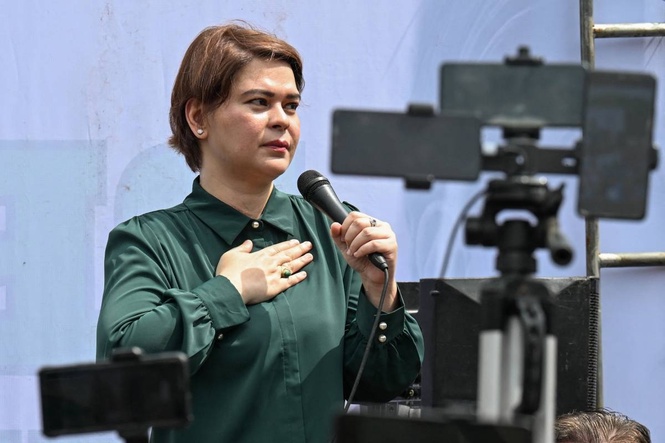
THE Senate impeachment court has admitted financial, corporate, property and tax documents as well as the statement of assets, liabilities and net worth of Vice President Sara Duterte from 2007 to 2021 introduced by the prosecution team.
The court also admitted records from the Anti-Money Laundering Council, Bureau of Internal Revenue, Securities and Exchange Commission, and bank records.
However, it said these documents are considered only as “starting financial baseline” and may only be used to evaluate assets existing before Duterte assumed the vice presidency.
Also allowed are land titles involving properties in Davao City and the Island Garden City of Samal, and insurance and investments documents.
The court, however, rejected documentary evidence relating to the withdrawn articles.
The court’s spokesman, Regie Tongol, said Presiding Officer Francis Escudero issued an order to resolve the prosecution’s offer of documentary evidence. However, he said that the admission of the documents does not mean that the prosecution’s allegations are true.
In evaluating the prosecution’s evidence, the court rejected the defense’s objection that subpoenaed documents constituted a “fishing expedition” by the prosecution.
However, the court also blocked efforts to introduce withdrawn charges or pre-incumbency offenses. Applying the Supreme Court’s landmark ruling in Duterte v. House of Representatives, it ruled that an official can only be impeached for acts committed during her current term. Duterte’s term as vice president started on June 30, 2022.
The court excluded all Commission on Audit disallowance records concerning the confidential funds of the Office of the Vice President and Department of Education. Because Article I was withdrawn on Oct. 13, it decreed that the records cannot be taken up under Article II.
All corporate records and forensic computations involving JTC Group of Companies Philippines Inc. and Pikimong Pikimong Philippines Corp. were also denied.
On Friday, private prosecutor Lorna Kapunan welcomed the impeachment court’s ruling rejecting the defense’s objections to evidence presented under Article II, saying it removed procedural obstacles ahead of the trial’s resumption.
“The good thing about the order on admissibility of our evidence is that the presiding officer admitted all the prosecution’s evidence. So, those are the two orders of the presiding officer, and there should no longer be any obstacle for the defense to present its case,” Kapunan said.
She said an impeachment complaint “only needs what are called ultimate facts — who, what, where, when and how. Those are the only things an impeachment complaint needs.” She cited the prosecution’s 52 boxes of evidence to illustrate why attaching every document to the complaint would be impractical.
As for the subpoenas, Kapunan said compelling the production of documents is part of court proceedings and falls within the impeachment court’s authority.
Kapunan agreed with the court that the documents be used only to establish a baseline for assessing Duterte’s income and net worth.
“Admissibility is different from probative value. Just because the presiding officer admitted the evidence does not mean it is true. They still have to weigh its probative value. What is the weight of this evidence? Does it merit an explanation of unexplained wealth?” Kapunan said.
The impeachment trial of Duterte will resume on Monday, Nov. 9.