
In northern Italy, a small town listed as a UNESCO World Heritage Site is home to one of the most fascinating theatres of the Renaissance. Behind a relatively understated façade lies an exceptional monument that has left a profound mark on the history of European architecture.
Located in Sabbioneta, in the Lombardy region, the Teatro all'Antica is often regarded as one of the first modern theatres in the Western world. With its frescoes, ingenious use of perspective and remarkable state of preservation, the Teatro all'Antica continues to astonish visitors more than four centuries after its construction. It is a visionary achievement that reflects the cultural ambition of a town conceived as an ideal city.
A theatre at the heart of the 'Little Rome'
To understand the significance of the Teatro all'Antica, it is first necessary to look at the town that houses it. In the sixteenth century, Sabbioneta was transformed by Duke Vespasiano Gonzaga Colonna, who dreamed of creating a perfect city inspired by the principles of ancient Rome.
Geometrically planned streets, harmonious fortifications and carefully arranged squares: every element was designed according to an exceptionally ambitious urban vision. The theatre occupied a central place within this project. Situated close to the ducal square and the town’s main thoroughfare, it quickly became one of the symbols of an Italian Renaissance deeply inspired by classical models.
To bring this vision to life, the Duke commissioned Vincenzo Scamozzi, one of the most renowned architects of his time. His objective was clear: to create a venue dedicated to performances that would be functional, elegant and innovative.
A spectacular interior where the art of perspective reaches its peak
From the moment visitors enter the Teatro all'Antica, their attention is immediately drawn to the richness of its decoration. Unlike the open-air theatres of antiquity, the building is entirely enclosed—a highly innovative feature at the end of the sixteenth century.
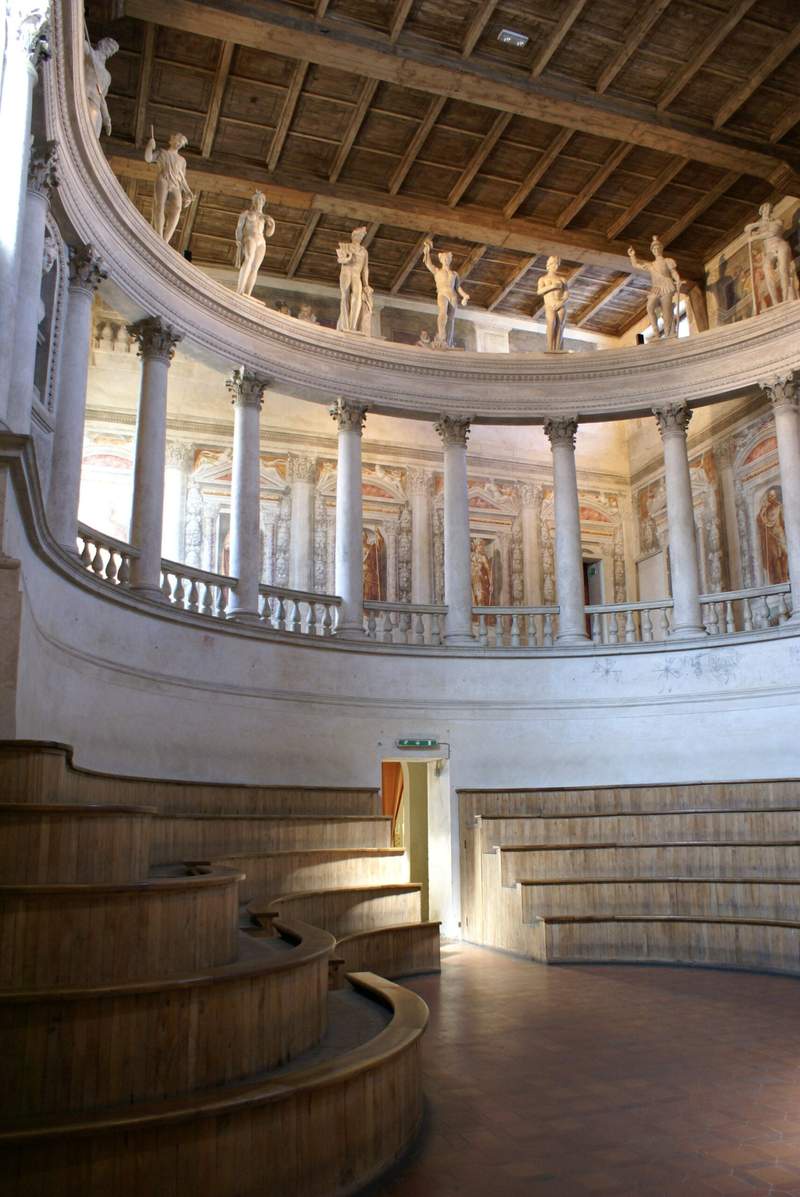
The auditorium is distinguished by its elegant amphitheatre, refined stage and impressive décor inspired by Roman architecture. On either side, frescoes depict some of Rome’s most iconic monuments, reinforcing the connection between Sabbioneta and the capital of the Empire.
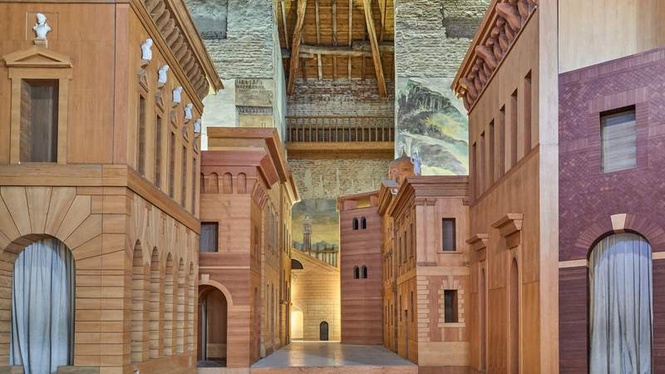
Yet it is the stage design above all that has made the theatre famous. The wooden structures installed on the stage create a striking sense of depth. Through a subtle arrangement of converging lines, the scenery gives the illusion of a city far larger than it actually is.
This mastery of perspective is one of Vincenzo Scamozzi’s defining hallmarks. Every element was carefully conceived to guide the spectator’s gaze and enhance the impression of grandeur.
Above the seating area, an elegant semi-circular peristyle houses a number of statues inspired by classical mythology. Hercules, Jupiter, Venus and Apollo stand watch over the auditorium, contributing to the theatre’s majestic atmosphere.
Even today, despite the many transformations it has undergone over the centuries, the Teatro all'Antica retains much of its original appearance. Having served at various times as a barracks, warehouse and even a cinema, the building has weathered the ages without losing its identity. This rarity allows visitors to discover one of the finest surviving examples of Renaissance theatre architecture in Italy.
https://www.youtube.com/watch?v=SgsdJFEkqWs
Are you planning a trip to Italy? Find out more in these articles: