
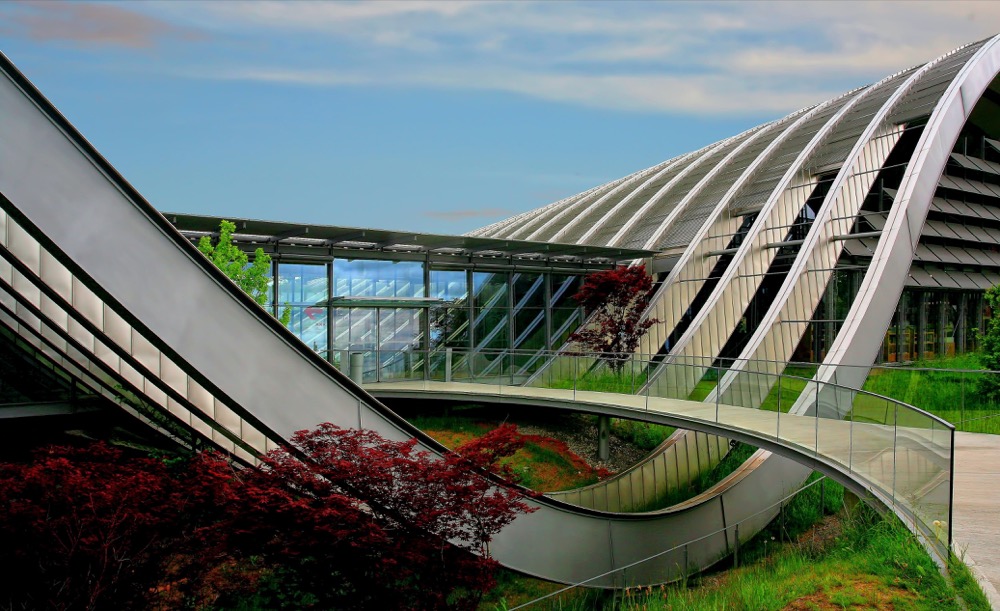
Nestled in the lush Ozark hills of Arkansas, Crystal Bridges Museum of American Art seamlessly pairs world-class masterpieces with a masterpiece of historic preservation. This stunning, free-admission cultural destination is home to an authentic Frank Lloyd Wright Usonian house, allowing visitors to step directly into a marvel of mid-century American architecture.
Calling all architecture lovers, hidden in the Ozark hills of Bentonville, Arkansas, discover the Crystal Bridges Museum of American Art, a place that effortlessly blends the boundaries between world-class art and American history. The museum is widely known for its sweeping Moshe Safdie-designed pavilions, its 134 acres of lush Ozark forest, and an extraordinary permanent collection spanning five centuries of American masterpieces.
But for those who love design and architecture, you’re in for a real treat. The museum is now home to a fully reconstructed, authentic Frank Lloyd Wright home nestled quietly along its wooded trails. The best part? The museum and the home are free to visit!
While general admission to the museum grounds and a self-guided audio tour of the Bachman-Wilson House are entirely free, timed entry tickets are strictly required due to the home's intimate size. If you want a deeper dive, the museum also offers excellent one-hour guided tours led by architecture docents for a small fee ($12).
A gem brought back to life
Originally built in 1954 along the Millstone River in New Jersey, the Bachman-Wilson House was commissioned by Gloria Bachman and Abraham Wilson. The home is a classic illustration of Wright’s Usonian architecture, a term he coined to describe a uniquely democratic, American style of residential design. These homes were designed during the Great Depression as a way to allow middle-class families to have access to beautiful, functional, and affordable housing that existed in harmony with nature.
Some decades later, the Bachman-Wilson House faced issues. Due to its location on a flood plain, it was subject to repeated and increasingly severe river overflows, which threatened the home’s mahogany wood and delicate structure. In 2013, the Bachman-Wilson House was purchased by Crystal Bridges when it understood the home’s historical importance.
Thanks to major preservation efforts, the house was carefully dismantled, piece by piece and was transported over 1,000 miles to Northwest Arkansas. Two years later, the home was reassembled on museum grounds and was placed to face a natural spring to keep the home’s original connection to water, but keeping it out of harm’s way.
Walk through the Usionian vision
To gain access to the Bachman-Wilson House, visitors walk through the museum's wooded trails, making it feel less like a regular gallery but more like finding a hidden gem. Right off the bat, the exterior of the house will grab your attention, with striking geometric lines, signature red-framed concrete blocks, and cantilevered rooflines.
Inside, you’ll discover the classic Wright tactic: 'compress and release'. The space dramatically opens up into a breathtaking, light-filled living area. Discover floor-to-ceiling windows that blur the boundary between the living space and the outdoors. Admire the Philippine mahogany that adds warmth and continuous lines, guiding you through the open floor plan. The home also has perforated wooden panels to create dramatic, ever-changing geometric shadows as the light changes throughout the day. Finally, the radiant concrete floors feature the architect’s signature Cherokee Red, heating the home efficiently from the ground up.
Every inch of the Bachman-Wilson House is intentional. Frank Lloyd Wright also designed the built-in furniture, shelves, and seating to maximise utility, making the compact footprint feel expansive.
https://www.youtube.com/watch?v=htwiuFWbDvM
Do you like museums? Find out more in these articles?
- 10 eagerly awaited exhibitions worth travelling to Paris for in 2026
- Brazilian architect Oscar Niemeyer’s 7 most stunning works to see around the world
- The 5 best exhibitions to see in New York in 2026 – from Italian Renaissance to an inaugural exhibition at the Met’s new space dedicated to fashion
- In Asia, this museum — opened just five months ago — has been named the most beautiful in the world