
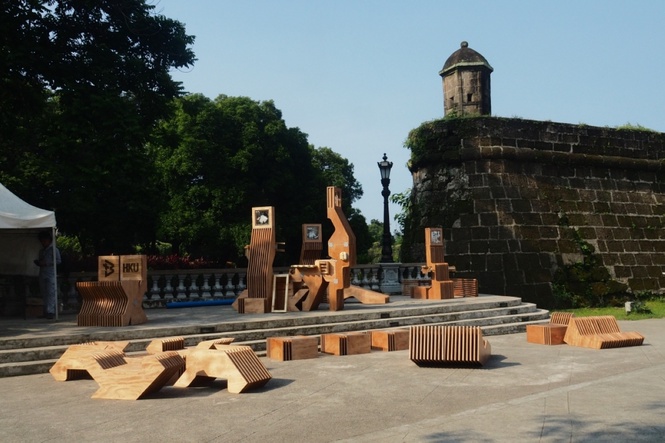
IN its first edition years ago, the Anthology Architecture Festival drew about 400 people. Today, the seventh version — the Anthology Asean Architecture Festival (AAAF) 2026 — has reportedly drawn in about 4,000, or ten times that number, during its three-day gathering at Intramuros on Oct. 2–4. While a majority of the attendees are the usual crowd of architects, designers, artists, and other professionals involved in the industry, the public has also been encouraged to attend. Hopefully, that is one indicator that the organizers have succeeded in achieving, or at least promoting one objective: to make architecture and design more inclusive and share more of its spaces with the greater community.
In a media interview on Oct. 3, Andy Locsin, administrator and design consultant at Leandro V. Locsin Partners, stated his wish that the “general public not be intimidated by the concepts ... It’s how we communicate and simplify things into words, ideas, and designs.”
Locsin is one of the more than 128 international resource persons who participated in the event’s panel discussions or dialogues. The Asean presence was stressed, with many of them coming from the Philippines, Singapore, Indonesia, Thailand, Vietnam, and Cambodia. Beyond the talks, which were mostly held at the Centro de Turismo, visitors could also browse or visit the various artworks and installations that were set up in various places in Intramuros.
Locsin spoke about “Shared Ground,” the festival’s principle that architecture deals with the shaping of public spaces, the response of communities to change, and the entrustment of culture and memory into the future. “Our contention is that social responsibility in a collective sense has always been there,” he said.
“When you start that project, Shared Ground means that any intervention you suggest is going to affect not only that thing, but everything else around it. What you do has an impact on the person next to you and the succeeding generation that uses the building.”
Although capital and the economics will remain primary drivers of building and construction, Locsin said that today’s architects and designers should also look at the affected communities in doing their craft. “The guys who work in the stores and the restaurants are absolutely critical to the lifeblood of that project. Your success about how you service that other side, that forgotten side, is equally as critical. We used to call it a ‘gillage’” — or what is beside (gilid) of a village.
To keep community in mind while designing a project, Locsin posed the following questions: “How do you build in structures when you conceive of a project? What care have you put in? What commitment have you put in to address the very things that make that development possible?”
Finally, his last advice on how to get a bigger picture that will move the designer to incorporate more people and communities outside their immediate milieu: “Know as much about the world. Not just about architecture, but about history, about art, about commerce, about anthropology, what makes people think, psychology. Bring it to bear on what you're doing as a designer.”
The AAAF 2026 was organized by WTA Architecture & Design Studio in partnership with the City of Manila, Intramuros Administration, and National Commission for Culture and the Arts (NCCA).