India and Pakistan have accused each other of violating a ceasefire after explosions were heard over two cities in India-administered Kashmir, just hours after a truce was reached between the two nuclear-armed countries.
Indian foreign secretary Vikram Misri blamed Pakistan for violating the truce after “huge” blasts were heard over Srinagar, a city to the north of Indian Kashmir, at around 9pm India time.
“For the last few hours, there have been repeated violations of the ceasefire reached earlier between India and Pakistan,” Mr Misri said. “The armed forces are giving an adequate and appropriate response to these violations.
In Islamabad, Pakistan's Foreign Ministry blamed India for initiating a ceasefire violation, claiming its own forces were handling “the situation with responsibility and restraint”.
Earlier, hours after the ceasefire was signed, The Independent’s producer Mohammad Dawood, who is in Srinagar, said it was “like the city was being bombed” with blasts did not stop for around an hour.
Witnesses also saw projectiles over Jammu, to the south, at around 7.45pm India time.. There were also reports of explosions over Gujarat, and Indian state further south.
Read More
Key Points
- Pakistan's PM Shehbaz Sharif says ceasefire response is in interest of peace
- India accuses Pakistan of violating ceasefire after explosions
- Watch: Explosions heard over Srinagar in Kashmir hours after ceasefire
- Trump announces India-Pakistan ceasefire after US-brokered talks
- India and Pakistan confirm truce after weeks of escalation
How did the US broker a truce between India and Pakistan
04:21
,
Namita Singh
A string of high-level calls led by Washington brought a temporary halt to the most serious flare-up between the nuclear-armed neighbours since the 1999 Kargil war.
A ceasefire agreement between India and Pakistan was clinched following intense behind-the-scenes mediation by the United States, ending four days of heavy cross-border hostilities that saw missile and drone attacks across several Indian and Pakistani cities, reported the Indian Express.
At the centre of this diplomatic push was a late-night call between US secretary of state and national security advisor Marco Rubio and Pakistan’s Chief of Army Staff General Asim Munir.
Mr Rubio said he had “offered US assistance in starting constructive talks in order to avoid future conflicts,” marking the first direct conversation between the US administration and General Munir, who is widely seen as the architect of Pakistan’s recent escalation.
The US State Department officially called the ceasefire a “US-brokered” understanding, although Indian officials continue to assert that the truce was a bilateral decision with “no third party involvement”.
As hostilities peaked, Mr Rubio, along with US vice president JD Vance, intensified diplomatic outreach, reported the Indian newspaper.
Mr Rubio spoke to India’s external affairs minister Subrahmanyam Jaishankar on 1 May and again on 8 May, urging “immediate de-escalation” and voicing “US support for direct dialogue between India and Pakistan".
In parallel, he was also in contact with Pakistani prime minister Shehbaz Sharif and eventually escalated talks to General Munir.
Mr Vance personally spoke to Indian prime minister Narendra Modi. “Great work from the President’s team, especially Secretary Rubio,” he posted on X, thanking both Indian and Pakistani leaders for engaging in the ceasefire efforts.
In a post on X, Mr Rubio summarised the whirlwind diplomacy, saying, “Over the past 48 hours, @VP Vance and I have engaged with senior Indian and Pakistani officials, including Prime Ministers Narendra Modi and Shehbaz Sharif, External Affairs Minister Subrahmanyam Jaishankar, Chief of Army Staff Asim Munir, and National Security Advisors Ajit Doval and Asim Malik.”
Pakistan, meanwhile, also gained strategic breathing room as it secured an IMF bailout package late Friday — despite India’s abstention — which some analysts believe provided Islamabad with an off-ramp to dial back its aggression without appearing to retreat.
From New Delhi’s standpoint, the current calm is contingent. Officials have said that “any terror attack in future will be deemed as an act of war,” signalling that the threshold for tolerating cross-border terrorism has fundamentally shifted. Diplomatic and economic retaliation remains on the table, including the ongoing suspension of the World Bank-mediated Indus Waters Treaty.
For Islamabad, General Munir was able to project to his domestic audience that Pakistan had responded robustly to Indian strikes, preserving a semblance of military parity.
India and Pakistan accuse each other of violating ceasefire hours after reaching deal
04:00
,
Namita Singh
India and Pakistan agreed to a ceasefire Saturday after US-led talks to end the most serious military confrontation between the nuclear-armed rivals in decades but accused each other of violating the deal just hours later.
The ceasefire had been expected to bring a swift end to weeks of escalating clashes, including missile and drone strikes, triggered by the mass shooting of tourists last month that India blames on Pakistan, which denies the charge.
But multiple explosions were heard in two large cities of Indian-controlled Kashmir hours after the countries agreed to the deal.
Indian foreign secretary Vikram Misri said late Saturday that "there had been repeated violations of the understanding arrived between the two countries" and accused Pakistan of breaching the agreement.
"We call upon Pakistan to take appropriate steps to address these violations and deal with the situation with seriousness and responsibility," he said at a news conference in New Delhi.
Misri said the Indian army was "retaliating" for what he called a "border intrusion".
In Islamabad, Pakistan's foreign ministry blamed Indian forces for initiating the ceasefire violation.
The ministry said Pakistan remains committed to the agreement and its forces were handling the situation with responsibility and restraint.
"We believe that any issues in the smooth implementation of the ceasefire should be addressed through communication at appropriate levels," the ministry said.
India accuses Pakistan of violating ceasefire after explosions over Kashmir
03:00
,
Alexander Butler
India has accused Pakistan of violating a ceasefire after explosions were heard over two cities in India-administered Kashmir just hours after a truce was reached between the two nuclear-armed countries.
Indian foreign secretary Vikram Misri blamed Pakistan for violating the truce after “huge” blasts were heard over Srinagar, a city to the north of Indian Kashmir, at around 9pm India time.
“For the last few hours, there have been repeated violations of the ceasefire reached earlier between India and Pakistan,” Mr Misri said. “The armed forces are giving an adequate and appropriate response to these violations.
The Independent’s producer Mohammed Dawood, who is on the ground in Srinagar, said it was “like the city was being bombed”.
Witnesses also saw projectiles over Jammu, to the south, at around 7.45pm India time, nearly three hours after the truce was agreed.
US Vice President JD Vance called Modi to encourage ceasefire talks - report
02:24
,
Rhian Lubin
US Vice President JD Vance was the one to call Indian Prime Minister Narendra Modi to encourage ceasefire talks over the escalating conflict with Pakistan, according to a report.
Earlier in the week, Vance said that the conflict “was none of [America’s] business.”
“What we can do is try to encourage these folks to de-escalate a little bit, but we’re not going to get involved in the middle of war that’s fundamentally none of our business and has nothing to do with America’s ability to control it,” Vance said in an interview with Fox News on Thursday.
According to CNN, the US received “alarming intelligence” about what was happening between India and Pakistan that pushed Vance, interim national security adviser Marco Rubio and White House chief of Susie Wiles into increasing U.S. involvement in peace talks.
“The vice president briefed President Donald Trump on the plan, then spoke with Modi at noon on Friday, making clear to the Indian prime minister that the White House believed there was a high probability for dramatic escalation as the conflict went into the weekend,” CNN reports.
Ceasefire violations between India and Pakistan signal deeper tensions beneath the surface of diplomacy
02:00
,
Namita Singh
Despite a US-brokered ceasefire between India and Pakistan after four days of intense military exchanges, renewed accusations of violations hours after the announcement underscore how fragile such agreements remain in the disputed territory of Kashmir.
Indian foreign secretary Vikram Misri in a press briefing late on Saturday said that Pakistan had breached the ceasefire understanding reached earlier that day.
“There had been repeated violations,” he said, adding that the Indian Army had retaliated against what it described as a “border intrusion”.
For a conflict long characterised by periodic flare-ups and swift escalations, the latest developments in Kashmir highlight how tenuous the peace can be – even with international intervention.
Pakistan's foreign minister denies country has broken truce
01:00
,
Alexander Butler
A spokesperson from Pakistan’s foreign minister has now issued a statement in response to India’s accusation it has broken ceasefire.
The country blamed India for breaking the truce, signed by both countries just hours ago.
The statement reads: “Pakistan remains committed to faithful implementation of ceasefire between Pakistan and India, announced earlier today.
"Notwithstanding the violations being committed by India in some areas, our forces are handling the situation with responsibility and restraint.
"We believe that any issues in smooth implementation of the ceasefire should be addressed through communication at appropriate levels.”
Watch: Explosions heard over Srinagar in Kashmir hours after ceasefire
Sunday 11 May 2025 00:01
,
Alexander Butler
'It's like we are being bombed', say witnesses
Saturday 10 May 2025 23:00
,
Alexander Butler
The Independent’s producer Mohammad Dawood, who is in Srinagar, has said it is like the city is “being bombed”.
He first heard explosions at around 9pm Indian time and said they have not stopped since. Footage showed projectiles flying across the night sky.
Chief minister of Jammu & Kashmir Omar Abdullah said on X: “What the hell just happened to the ceasefire? Explosions heard across Srinagar!!!”
How do India and Pakistan’s armies and nuclear arsenals compare to each other?
Saturday 10 May 2025 23:00
,
Alexander Butler
The dramatic flare-up of tensions and targeted cross-border strikes between India and Pakistan this week has raised the spectre of a first all-out war between the two nuclear-armed neighbours in decades.
The two countries have fought two wars since independence over the disputed region of Kashmir – and three in total – and the picturesque Himalayan valley is once again at the centre of their standoff. Already arguably the most highly militarised region in the world, with hundreds of thousands of troops and paramilitary forces deployed to maintain security in Indian-administered Kashmir at the best of times.
But taken together, the Indian and Pakistani militaries boast a total of around 2 million armed forces personnel. It means an all-out conflict would be one of the largest by number of combatants since the end of the Second World War.
The Independent’s Arpan Rai takes a closer look here:
Recap: Nuclear neighbours India and Pakistan step closer to war
Saturday 10 May 2025 22:30
,
Alexander Butler
A terror attack in Kashmir on 22 April has pushed India and Pakistan a step closer to war, marking the biggest breakdown in relations since 2019.
- 22 April: Gunmen shoot and kill 26 tourists at the tourist town of Pahalgam in Indian-administered Kashmir, a major shift in a regional conflict that has largely spared civilians. The unidentified gunmen also wound 17 people. A group called Kashmir Resistance, which India accuses Pakistan of backing, claims the attack.
- 23 April: India downgrades diplomatic ties, closes the only functional land border crossing, and suspends a crucial water-sharing treaty that has survived two wars and a major border skirmish between the two countries.
- India launches a manhunt for the Pahalgam assailants. Pakistan denies involvement in the attack.
- 24 April: India and Pakistan cancel visas for each other's nationals, setting a deadline for them to leave. In retaliation, Pakistan shuts its airspace for all Indian-owned or Indian-operated airlines, and suspends all trade with India, including to and from any third country. Government ministers on both sides hint the dispute could escalate to military action.
- 25 April: India says its troops exchanged fire with Pakistani soldiers at the Line of Control, the de facto border dividing the disputed Kashmir region. Pakistan warns it could suspend an agreement that established the Line of Control, in what would be a major and worrying step.
- 26 April: Pakistani prime minister Shehbaz Sharif vows his government will respond "with full force and might" to Indian attempts to stop or divert the flow of water.
- 30 April: Pakistan's information minister Attaullah Tarar says his government has "credible intelligence" that India intends to carry out military action against Pakistan in the next 24 to 36 hours.
- 3 May: Pakistan test-fires a ballistic missile with a range of 450km.
- 7 May: India fires missiles on Pakistan, which calls the strikes an "act of war" and vows to avenge those who died in the pre-dawn attack. The missiles kill 31 people, including women and children, in Pakistan-administered Kashmir and the country's Punjab province. The strikes target at least nine sites "where terrorist attacks against India have been planned", says India's defense ministry. Pakistan claims it downed several Indian fighter jets.
- 8 May: India fires attack drones into Pakistan, killing at least two civilians, the Pakistani military says. India, meanwhile, accuses its neighbour of attempting its own attack and acknowledges targeting its arch rival's air defence system.
- India evacuates thousands of people from villages near the highly militarised frontier in the Kashmir region. Flights remain suspended at over two dozen airports across northern and western regions of India.
- 9 May: India suspends its biggest domestic cricket tournament for a week following the escalating military tensions with Pakistan. Pakistan initially says it will move its own domestic T20 tournament to the United Arab Emirates because of the crisis, but then says it will only postpone matches. India's army says drones have been sighted in 26 locations across many areas in Indian states bordering Pakistan and Indian-controlled Kashmir, including the main city of Srinagar. The drones were tracked and engaged, it adds.
- 10 May. 5pm Indian time: US president Donald Trump announced a “full and immediate ceasefire” between India and Pakistan.
- 10 May, 7.45pm Indian time: Residents in Indian-controlled Kashmir report hearing loud explosions at multiple places in the region, including Srinagar, Jammu, and the garrison town of Udhampur.
- 10 May, 11pm Indian time: Indian accuses Pakistan of violating the ceasefire and warns that the military will respond “appropriately”.
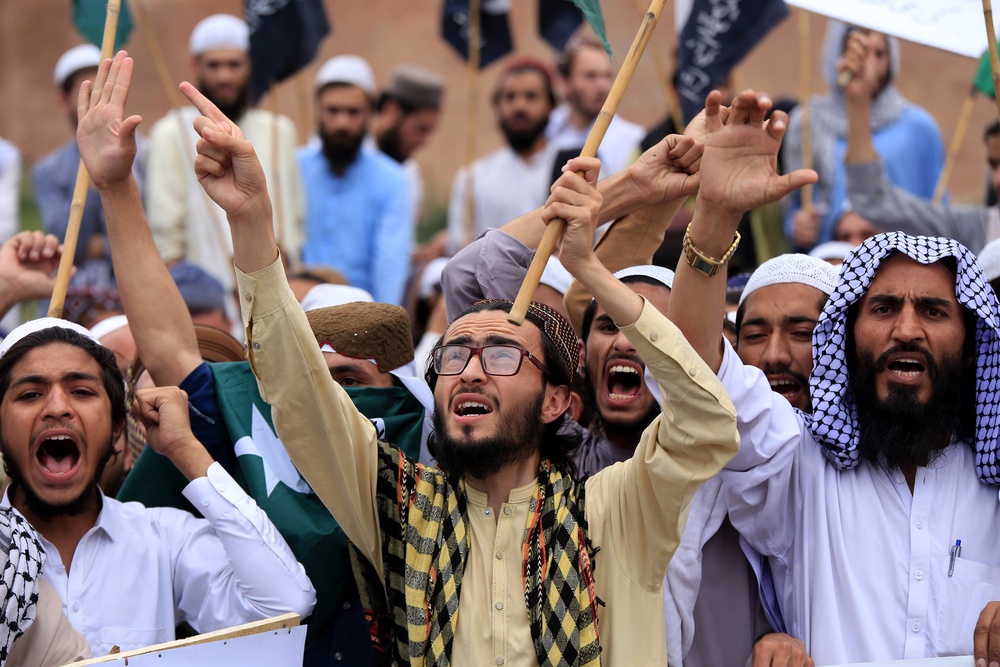
Pictured: Pakistanis celebrate ceasefire before breakdown
Saturday 10 May 2025 21:57
,
Alexander Butler
Watch: Explosions heard over Srinagar in Kashmir hours after ceasefire
Saturday 10 May 2025 21:37
,
Alexander Butler
Pakistan's foreign minister denies country has broken truce
Saturday 10 May 2025 20:52
A spokesperson from Pakistan’s foreign minister has now issued a statement in response to India’s accusation it has broken ceasefire.
The country blaming India for breaking the truce, signed by both countries just hours ago.
The statement reads: “Pakistan remains committed to faithful implementation of ceasefire between Pakistan and India, announced earlier today.
"Notwithstanding the violations being committed by India in some areas, our forces are handling the situation with responsibility and restraint.
"We believe that any issues in smooth implementation of the ceasefire should be addressed through communication at appropriate levels.”
Pakistan's PM Shehbaz Sharif did not address India's accusations
Saturday 10 May 2025 20:44
Mr Sharif spoke about the ceasefire deal, but did not respond to accusations from India’s foreign secretary, Vikram Misri, that Pakistan broke the cease-fire soon after it was announced.
He did say: “We are a very responsible country and we have displayed this. We want peace. We have made this agreement of ceasefire and we have been very positive about it.”
Pakistan's PM Shehbaz Sharif says ceasefire response is in the interest of peace
Saturday 10 May 2025 20:40
,
Alex Ross
As India accuses Pakistan of breaching the ceasefire agreed between the two countries, Pakistan’s prime minister Shehbaz Sharif has said his country has responded positively to the deal.
In a televised speech, he said he hoped all the outstanding issues with India, including the Kashmir dispute, would be resolved through peaceful dialogue.
Sharif thanked US President Donald Trump, China, and other friendly countries like Qatar, UAE, Saudi Arabia, and Turkey for their role in defusing tensions.
He praised the armed forces, saying Pakistan's military made a fitting response when India launched missile attacks overnight. "Our pilots silenced the Indian military's guns within hours," Sharif said.
Pakistan denies ceasefire violation allegations
Saturday 10 May 2025 19:39
,
Namita Singh
The apparent return to hostilities began shortly after the deal was struck, with fresh exchanges of fire reported along the Line of Control (LoC), and explosions heard in major cities such as Srinagar and Jammu.
Eyewitnesses in Indian-administer Kashmir reported blackouts and anti-aircraft activity, while visuals captured red projectiles streaking across the night sky.
Meanwhile, Pakistan has denied any ceasefire violations. Speaking to local media, the country’s Information Minister insisted that there had been no breach from their side.
Several social media users in India expressed their disappointment over the alleged violations. Chief minister of Jammu & Kashmir, expressed his exasperation over the late night attacks.
He shared a video of projectiles in Srinagar on X, and he wrote: “This is no ceasefire. The air defence units in the middle of Srinagar just opened up.”
Ceasefire violations between India and Pakistan signal deeper tensions beneath the surface of diplomacy
Saturday 10 May 2025 19:38
,
Namita Singh
Despite a US-brokered ceasefire between India and Pakistan after four days of intense military exchanges, renewed accusations of violations hours after the announcement underscore how fragile such agreements remain in the disputed territory of Kashmir.
Indian foreign secretary Vikram Misri in a press briefing late on Saturday said that Pakistan had breached the ceasefire understanding reached earlier that day.
“There had been repeated violations,” he said, adding that the Indian Army had retaliated against what it described as a “border intrusion”.
For a conflict long characterised by periodic flare-ups and swift escalations, the latest developments in Kashmir highlight how tenuous the peace can be – even with international intervention.
Recap: Nuclear neighbours India and Pakistan step closer to war
Saturday 10 May 2025 19:07
,
Alexander Butler
A terror attack in Kashmir on 22 April has pushed India and Pakistan a step closer to war, marking the biggest breakdown in relations since 2019.
- 22 April: Gunmen shoot and kill 26 tourists at the tourist town of Pahalgam in Indian-administered Kashmir, a major shift in a regional conflict that has largely spared civilians. The unidentified gunmen also wound 17 people. A group called Kashmir Resistance, which India accuses Pakistan of backing, claims the attack.
- 23 April: India downgrades diplomatic ties, closes the only functional land border crossing, and suspends a crucial water-sharing treaty that has survived two wars and a major border skirmish between the two countries.
- India launches a manhunt for the Pahalgam assailants. Pakistan denies involvement in the attack.
- 24 April: India and Pakistan cancel visas for each other's nationals, setting a deadline for them to leave. In retaliation, Pakistan shuts its airspace for all Indian-owned or Indian-operated airlines, and suspends all trade with India, including to and from any third country. Government ministers on both sides hint the dispute could escalate to military action.
- 25 April: India says its troops exchanged fire with Pakistani soldiers at the Line of Control, the de facto border dividing the disputed Kashmir region. Pakistan warns it could suspend an agreement that established the Line of Control, in what would be a major and worrying step.
- 26 April: Pakistani prime minister Shehbaz Sharif vows his government will respond "with full force and might" to Indian attempts to stop or divert the flow of water.
- 30 April: Pakistan's information minister Attaullah Tarar says his government has "credible intelligence" that India intends to carry out military action against Pakistan in the next 24 to 36 hours.
- 3 May: Pakistan test-fires a ballistic missile with a range of 450km.
- 7 May: India fires missiles on Pakistan, which calls the strikes an "act of war" and vows to avenge those who died in the pre-dawn attack. The missiles kill 31 people, including women and children, in Pakistan-administered Kashmir and the country's Punjab province. The strikes target at least nine sites "where terrorist attacks against India have been planned", says India's defense ministry. Pakistan claims it downed several Indian fighter jets.
- 8 May: India fires attack drones into Pakistan, killing at least two civilians, the Pakistani military says. India, meanwhile, accuses its neighbour of attempting its own attack and acknowledges targeting its arch rival's air defence system.
- India evacuates thousands of people from villages near the highly militarised frontier in the Kashmir region. Flights remain suspended at over two dozen airports across northern and western regions of India.
- 9 May: India suspends its biggest domestic cricket tournament for a week following the escalating military tensions with Pakistan. Pakistan initially says it will move its own domestic T20 tournament to the United Arab Emirates because of the crisis, but then says it will only postpone matches. India's army says drones have been sighted in 26 locations across many areas in Indian states bordering Pakistan and Indian-controlled Kashmir, including the main city of Srinagar. The drones were tracked and engaged, it adds.
- 10 May. 5pm Indian time: US president Donald Trump announced a “full and immediate ceasefire” between India and Pakistan.
- 10 May, 7.45pm Indian time: Residents in Indian-controlled Kashmir report hearing loud explosions at multiple places in the region, including Srinagar, Jammu, and the garrison town of Udhampur.
- 10 May, 11pm Indian time: Indian accuses Pakistan of violating the ceasefire and warns that the military will respond “appropriately”.
India accuses Pakistan of violating ceasefire after explosions over Kashmir
Saturday 10 May 2025 18:40
,
Alexander Butler
India has accused Pakistan of violating a ceasefire after explosions were heard over two cities in India-administered Kashmir just hours after a truce was reached between the two nuclear-armed countries.
Indian foreign secretary Vikram Misri blamed Pakistan for violating the truce after “huge” blasts were heard over Srinagar, a city to the north of Indian Kashmir, at around 9pm India time.
“For the last few hours, there have been repeated violations of the ceasefire reached earlier between India and Pakistan,” Mr Misri said. “The armed forces are giving an adequate and appropriate response to these violations.
The Independent’s producer Mohammed Dawood, who is on the ground in Srinagar, said it was “like the city was being bombed”.
Witnesses also saw projectiles over Jammu, to the south, at around 7.45pm India time, nearly three hours after the truce was agreed.
'It's like we are being bombed', say witnesses
Saturday 10 May 2025 18:06
,
Alexander Butler
The Independent’s producer Mohammad Dawood, who is in Srinagar, has said it is like the city is “being bombed”.
He first heard explosions at around 9pm Indian time and said they have not stopped since. Footage showed projectiles flying across the night sky.
Chief minister of Jammu & Kashmir Omar Abdullah said on X: “What the hell just happened to the ceasefire? Explosions heard across Srinagar!!!”
How do India and Pakistan’s armies and nuclear arsenals compare to each other?
Saturday 10 May 2025 17:53
,
Alexander Butler
The dramatic flare-up of tensions and targeted cross-border strikes between India and Pakistan this week has raised the spectre of a first all-out war between the two nuclear-armed neighbours in decades.
The two countries have fought two wars since independence over the disputed region of Kashmir – and three in total – and the picturesque Himalayan valley is once again at the centre of their standoff. Already arguably the most highly militarised region in the world, with hundreds of thousands of troops and paramilitary forces deployed to maintain security in Indian-administered Kashmir at the best of times.
But taken together, the Indian and Pakistani militaries boast a total of around 2 million armed forces personnel. It means an all-out conflict would be one of the largest by number of combatants since the end of the Second World War.
The Independent’s Arpan Rai takes a closer look here:
Watch: Explosions heard over Srinagar in Kashmir hours after ceasefire
Saturday 10 May 2025 17:14
,
Alexander Butler
'It's like we are being bombed', say witnesses
Saturday 10 May 2025 17:02
,
Alexander Butler
The Independent’s producer Mohammad Dawood, who is in Srinagar, has said it is like the city is “being bombed”.
He first heard explosions at around 9pm Indian time and said they have not stopped since. Footage showed projectiles flying across the night sky.
Chief minister of Jammu & Kashmir Omar Abdullah said on X: “What the hell just happened to the ceasefire? Explosions heard across Srinagar!!!”
Explosions heard over Kashmiri cities, say witnesses
Saturday 10 May 2025 16:25
,
Alexander Butler
Explosions were heard over Jammu and Srinagar in India-administered Kashmir just hours after a ceasefire between India and Pakistan was reached.
Witnesses saw projectiles over Jammu at around 7.45pm India time, nearly three hours after the truce was agreed, according to Reuters.
Chief minister of Jammu & Kashmir Omar Abdullah added: “What the hell just happened to the ceasefire? Explosions heard across Srinagar!!!”
It is unclear who was responsible for the explosions.
Watch: Trump announces India and Pakistan have agreed to a 'full and immediate' ceasefire
Saturday 10 May 2025 16:12
,
Alexander Butler
US officials conducted 'shuttle diplomacy' between India and Pakistan, reports say
Saturday 10 May 2025 15:49
,
Holly Bancroft
US secretary of state Marco Rubio spent the night working the phones and conducting “shuttle diplomacy” between Indian and Pakistani officials, according to the New York Times.
Vice president JD Vance also reportedly spoke with India’s prime minister Narendra Modi.
Announcing the truce on social media, president Donald Trump said that talks between the two countries had been mediated by the US.
UK foreign secretary urges India and Pakistan to sustain ceasefire
Saturday 10 May 2025 15:41
,
Holly Bancroft
Foreign Secretary David Lammy has described the ceasefire between India and Pakistan as "hugely welcome", in a post on social media adding: "I urge both parties to sustain this. De-escalation is in everybody's interest."
Indian military says it remains vigilant
Saturday 10 May 2025 15:30
,
Holly Bancroft
Indian armed forces remain “vigilant” and are ready to defend their sovereignty, defence officials say after ceasefire announcement.
Raghu R. Nair, an Indian navy commodore, told a news conference on Saturday that the Indian armed forces will adhere to the understanding reached on the ceasefire, but they "remain fully prepared, ever vigilant and committed to defending the sovereignty and integrity of the motherland."
"Every misadventure by Pakistan has been met with strength. And every future escalation will invite a decisive response. We remain fully operationally ready to launch whatever operations may be required in defence of the nation," said Mr Nair.
India and Pakistan 'worked directly on truce', source says
Saturday 10 May 2025 15:11
,
Holly Bancroft
India and Pakistan worked directly on the ceasefire agreement, a source on the Indian side has told CNN. The news comes after US president Donald Trump said that the truce was the result of a night of US mediation.
The source said: “The stoppage of firing and military action between India and Pakistan was worked out directly between the two countries”
Announcing the decision, the external affairs minister of India said that “India and Pakistan have today worked out an understanding on stoppage of firing and military action”.
In pictures: People celebrate ceasefire
Saturday 10 May 2025 15:01
,
Holly Bancroft
Indus Waters Treaty remains suspended, sources say
Saturday 10 May 2025 14:46
,
Holly Bancroft
The Indus Waters Treaty between India and Pakistan remains suspended, four government sources told Reuters news agency. This is despite the countries reaching a ceasefire agreement on Saturday after days of deadly fighting.
The 1960 treaty regulates the sharing of water from the Indus river and its tributaries between the South Asian nations. India pulled out of it last month after a deadly attack on tourists in Kashmir.
They cited national security concerns. The Indus basin supplies about 80 per cent of Pakistan’s irrigated agriculture.
India doesn’t have the power to limit water to Pakistan but it could choose to ignore restrictions on silt-flushing, releasing sediment into the water.
Many in Pakistan greet news of ceasefire with relief and joy
Saturday 10 May 2025 14:31
,
Namita Singh
Chanting slogans of "Long Live Pakistan", people in many cities welcomed the ceasefire with India, calling it a moment of national pride and relief after days of heightened tension.
"This is a big day for Pakistan," said Mohammad Fateh, a young man in the city of Lahore.
"Our forces responded with strength, and India had no choice but to agree to a ceasefire."
In Islamabad, Zubaida Bibi, a 45-year-old housewife, expressed joy at the restoration of peace with India, saying: "War brings nothing but suffering. We are happy that calm is returning. It feels like Eid to me. We have won."
In the northwest, in the city of Peshawar and tribal areas bordering Afghanistan, some people fired guns in the air to celebrate the ceasefire.
In Muzaffarabad, the capital of Pakistan-administered Kashmir, residents welcomed the ceasefire, hoping it would bring long-awaited relief to a region that has borne the brunt of recurring conflict.
"For us, peace means survival," said Zulfikar Ali, a resident. "We've suffered enough. I'm glad that both Pakistan and India have made a sensible decision."
Pakistan fully reopens airspace
Saturday 10 May 2025 14:23
,
Namita Singh
Pakistan has fully reopened its airspace for all types of flights, the country's airports authority said Saturday.
In a statement, it said: "All airports across the country are now available for regular flight operations."