
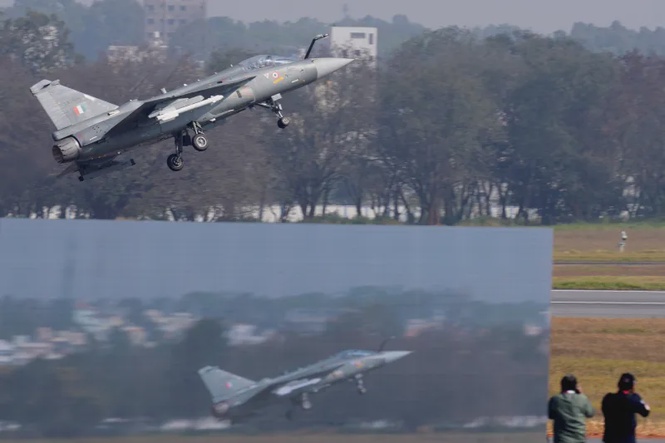
India's push to fill its thinning fighter fleet with homegrown Tejas jets is running into a hard limit: every one of them depends on an engine made in the United States, and GE Aerospace has struggled to ship them fast enough to keep production lines moving.
The bottleneck has pushed the upgraded Tejas Mark 1A more than two years behind schedule, according to Indian defense reporting, at a moment when the Indian Air Force (IAF) is retiring Cold War era aircraft faster than it can replace them.
Air Chief Warns India Needs Two New Squadrons A Year
Air Chief Marshal Amar Preet Singh, the IAF's chief of staff, made the stakes personal on October 11, when he flew a Tejas from an air base in Jodhpur on what was billed as his final fighter sortie. Singh, who retires on October 31 after roughly four decades in uniform, chose the Indian-built jet as a public show of faith in the country's defense industry, the South China Morning Post reported.
A week earlier, on October 3, he had delivered a blunt warning about the size of the force. "We need to induct two fighter squadrons every year," Singh said. Reaching the IAF's sanctioned strength of 42 squadrons, he explained, would require domestic production of 36 to 40 new fighters annually, and he added that the real requirement is far higher than that.
The IAF currently fields roughly 29 fighter squadrons, according to Indian media reports, well short of the 42 it is authorized to maintain. A standard IAF squadron operates 18 frontline aircraft, with three or four more held in reserve.
GE's F404 Engine Sets The Pace Of Tejas Production
The Tejas, a light combat aircraft program launched in the 1980s, has become the flagship of India's drive for defense self-reliance. Its first production Mark 1A flew in October 2025, while a more capable Mark 2 version remains in development.
State-owned manufacturer Hindustan Aeronautics Limited (HAL) aims to build 24 Tejas a year, and the IAF has 180 Mark 1A jets on order across two contracts: an initial batch of 83 and a follow-on order for 97. Including the Mark 2, India ultimately expects to build at least 350 Tejas fighters, making the type the backbone of its future tactical fleet.
But GE Aerospace is the program's sole engine supplier, and its F404-IN20 deliveries have dictated the pace. Under a 2021 contract worth 53.75 billion rupees, GE is to supply 99 of the engines for the Mark 1A fleet, India TV News reported. Shortfalls have left completed airframes waiting on the ground for powerplants, and HAL has imposed contractual penalties on GE for late deliveries, according to Defense Mirror. One engine received in May also needed rectification after a technical problem surfaced during post-delivery checks, the outlet said.
Shipments have picked up in recent months. GE delivered three engines in August and four more in September, bringing the total to 14, and the company expects to deliver 20 to 22 by the end of 2026. "GE Aerospace shipped four F404-IN20 engines in September 2026," the company said, adding that it remains "focused on delivering the engines needed to power India's Tejas indigenous fighter jets."
Air Marshal Ashutosh Dixit, the IAF's vice chief of staff, who has been named to succeed Singh as air chief on October 31, said the Mark 1A should be formally inducted within the next one to two months, following a lengthy development cycle and detailed operational evaluation of its avionics.
Engines were not the only holdup. Integrating the jet's radar, weapons, and flight control software also took longer than planned. "The successive delays in certification, weapons and radar integration, and engine supply show that indigenization needs more than declarations; it needs strong execution," said retired Air Marshal Gurcharan Singh Bedi. "Now that we have the capability to build fighters, the next thing we need to learn is how to scale up production."
Retirements Of MiG And Jaguar Fleets Widen The Gap
India's urgency comes from an aging fleet that is leaving service in waves. The IAF retired its last 36 Soviet-designed MiG-21 fighters in September 2025.
Next to go are the six squadrons of SEPECAT Jaguar ground attack aircraft, which are scheduled to retire between 2028 and 2031. To keep the remaining Jaguars flying, India even acquired nine airframes that Britain's Royal Air Force had retired in 2007, stripping them for spare parts.
Three MiG-29 squadrons and three Mirage 2000 squadrons are also slated to leave service by the middle to late 2030s, meaning new aircraft must arrive steadily for more than a decade just to keep the force from shrinking further.
Experts Urge India To Build Its Own Engines
New programs are in the pipeline. The Tejas Mark 2 is expected to make its first flight between June and September 2027 and, if testing goes smoothly, enter service in 2030 or 2031. India also hopes to fly a prototype of the Advanced Medium Combat Aircraft (AMCA), its planned fifth-generation stealth fighter, by September 2028.
Retired Brigadier Sanjay Iyer argued that the most effective fix for India's production crunch is to strengthen domestic engine manufacturing and give private companies a far bigger role. He noted that frequent design changes cost the Mark 1A program significant time, and suggested New Delhi allow some of the private firms that already build fuselages and wings for HAL to take part in final assembly.
On the reliance on GE, Iyer was blunt. "A single American supplier can decide when your fighter jets take off. Your production numbers are basically decided by them," he said. "Geopolitical considerations are critical. Once other U.S. interests are affected, they will not hesitate to use this to pressure or constrain India."
Stockpiling spare engines, he said, would be only an expensive stopgap. Only by bringing engine production under Indian control can the country guarantee its fighter output.
Why Taiwan Is Watching Engine Supply Chains
India's predicament echoes concerns in Taiwan, which also depends on U.S. manufacturers for its frontline fighters and the engines that power them. Taiwan waited years after placing its order for its first F-16 Block 70 jets, which arrived earlier this month. For both countries, the lesson is similar: owning an airframe is not the same as controlling the timetable for fielding it.
Original Article In Chinese: https://www.storm.mg/article/11174250