
JAKARTA - Indonesia’s Manpower Ministry is preparing a triple-skilling strategy to help young workers adapt as artificial intelligence changes workplace skill requirements.
Deputy Manpower Minister Afriansyah Noor outlined the 3S strategy announced on Aug. 29 at the Pink Model United Nations 2026 at Binus University in Jakarta.
The approach combines upskilling to deepen existing abilities, reskilling to help workers affected by technological disruption move into new roles, and cross-skilling to add competencies from other fields and increase career flexibility.
“The Ministry of Manpower views AI transformation not as a threat to be feared, but as a golden opportunity to accelerate the productivity and competitiveness of our national and global workforce,” Afriansyah said.
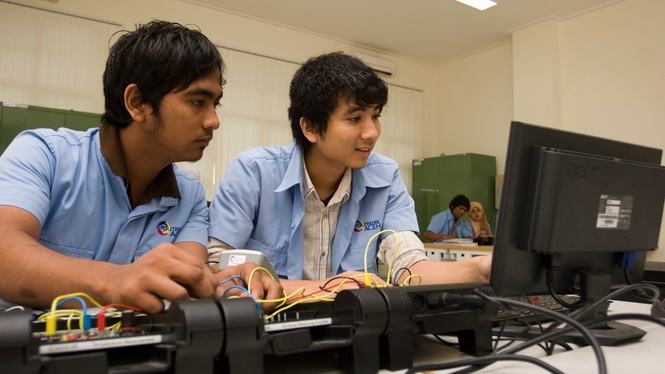
The ministry is also reorienting vocational curricula around AI literacy, data analysis and automation while retaining critical thinking, work ethics, adaptability and leadership.
Training centers are being modernized with technology-based facilities, instructors are being developed to keep pace with industry requirements, and participants are being directed toward national competency certification based on Indonesia’s work competency standards.
The policy comes amid substantial potential exposure to generative AI across Southeast Asian labor markets.
An International Labour Organization study released July 8 estimated that 21.7% of employment in Indonesia in 2025 was in occupations with more than minimal potential exposure to GenAI.
Across ASEAN, the share was 22.9%, or nearly 80 million workers. The ILO said there was no evidence to date of large-scale job losses from the technology.
Indonesia is also running state-funded vocational training programs. The first 2026 National Vocational Training batch enrolled 10,405 participants across 21 vocational training centers, 13 training units under the ministry’s vocational-training directorate and 46 regional centers.
Kemnaker has set a 2026 target of 70,000 APBN-funded participants, prioritizing senior and vocational high school graduates.
The broader employment push also includes the MagangHub national internship program, whose Angkatan II has a quota of 150,000 participants. The government has allocated Rp4.14 trillion for the six-month internship program for fresh higher-education graduates.
The government has also prepared Rp2.12 trillion for vocational and skills programs prioritizing 220,000 vocational-school graduates and skills support for 50,000 workers affected by layoffs.
Retraining for displaced workers forms part of the broader effort to help people acquire skills needed to return to employment as technology and industry requirements change.
Kemnaker also plans to widen access to vocational training by increasing women’s participation in STEM, providing disability-friendly facilities and extending opportunities to young people in underdeveloped, frontier and outermost regions.
Afriansyah said human capabilities would remain central as technology changes the workplace. “Skills such as critical thinking, work ethics, adaptability and leadership are human capabilities that can never be replaced by machines or algorithms.”