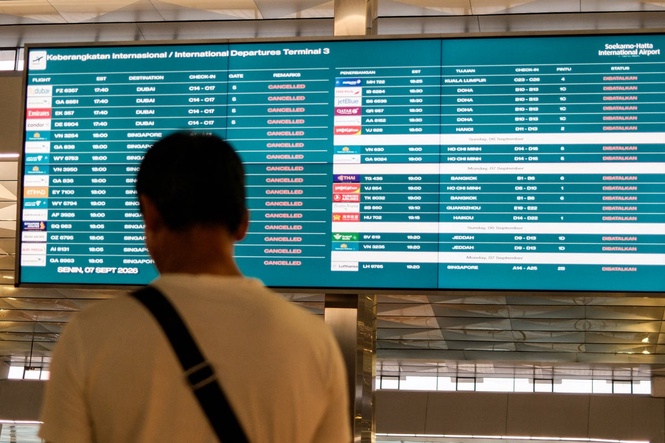
Indonesia’s main airport reopened after a two-day closure caused by volcanic ash from Mount Anak Krakatau, though fresh eruptions on Tuesday raised the risk of further disruption.
The Soekarno-Hatta and the Halim Perdanakusuma airports in the national capital Jakarta, the Husein Sastranegara airport in West Java’s Bandung, and a pair of small airports in Banten province, reopened just after midnight on Tuesday, transport minister Dudy Purwagandhi said.
Three other airports remained closed until 10am, including Radin Inten II in Lampung, on the southern tip of Sumatra. Another airport, the Atung Bungsu in Pagar Alam, South Sumatra, had already resumed normal operations on Monday morning.
The closures, which began on Sunday, disrupted 2,961 flights, including 622 international services, and affected more than 341,000 passengers, infrastructure minister Agus Harimurti Yudhoyono said.
Mr Purwagandhi said authorities were taking a conservative approach in reopening services given how unpredictable wind direction had been.
“We’re taking a conservative approach because wind direction is highly dynamic," he said in a statement. "We want to ensure that volcanic ash has moved away from airports around Anak Krakatau."
He said that although tests at several airports had shown no trace of ash, the extended closures allowed time to inspect and clean runways, taxiways and aircraft.
Officials also said that they would check the airworthiness of 178 planes that had been grounded at the Soekarno-Hatta during the closure.

Anak Krakatau's continuous eruption, marked by lava fountains and loud booms, ended on Sunday, but the volcano was still active into Tuesday morning, with eruptions recorded at 5.08am and 5.34am local time, though the height of the resulting ash column could not be observed.
The volcano monitoring agency said three smaller eruptions on Tuesday still carried some potential to disrupt flights, depending on ash height and wind direction.
"So far the impact is not as big as the previous eruptions, but we'll continue to monitor," Lana Saria, the head of Indonesia's geological agency, told Reuters.
Passengers described days of uncertainty. A flyer identified as Finna, 46, who had been trying to fly home to Jakarta from Malang in East Java since Sunday morning, said the airport grew increasingly chaotic as flights were repeatedly rescheduled.
"It was very crowded because passengers from the morning flights had piled up, while those scheduled for later departures still didn't know what would happen," she told BBC Indonesian. "We were all glued to the flight information screens."
She eventually gave up waiting and spent the night on two intercity trains, arriving in Jakarta at 3am on Monday.
"What can you do? It's nature. It is dangerous for the plane if you force it," said Alvin Pratama Putra, 31, who had been due to travel to South Korea for work from the Soekarno-Hatta on Sunday and had been sleeping on an airport bench since his flight was rescheduled to Thursday.
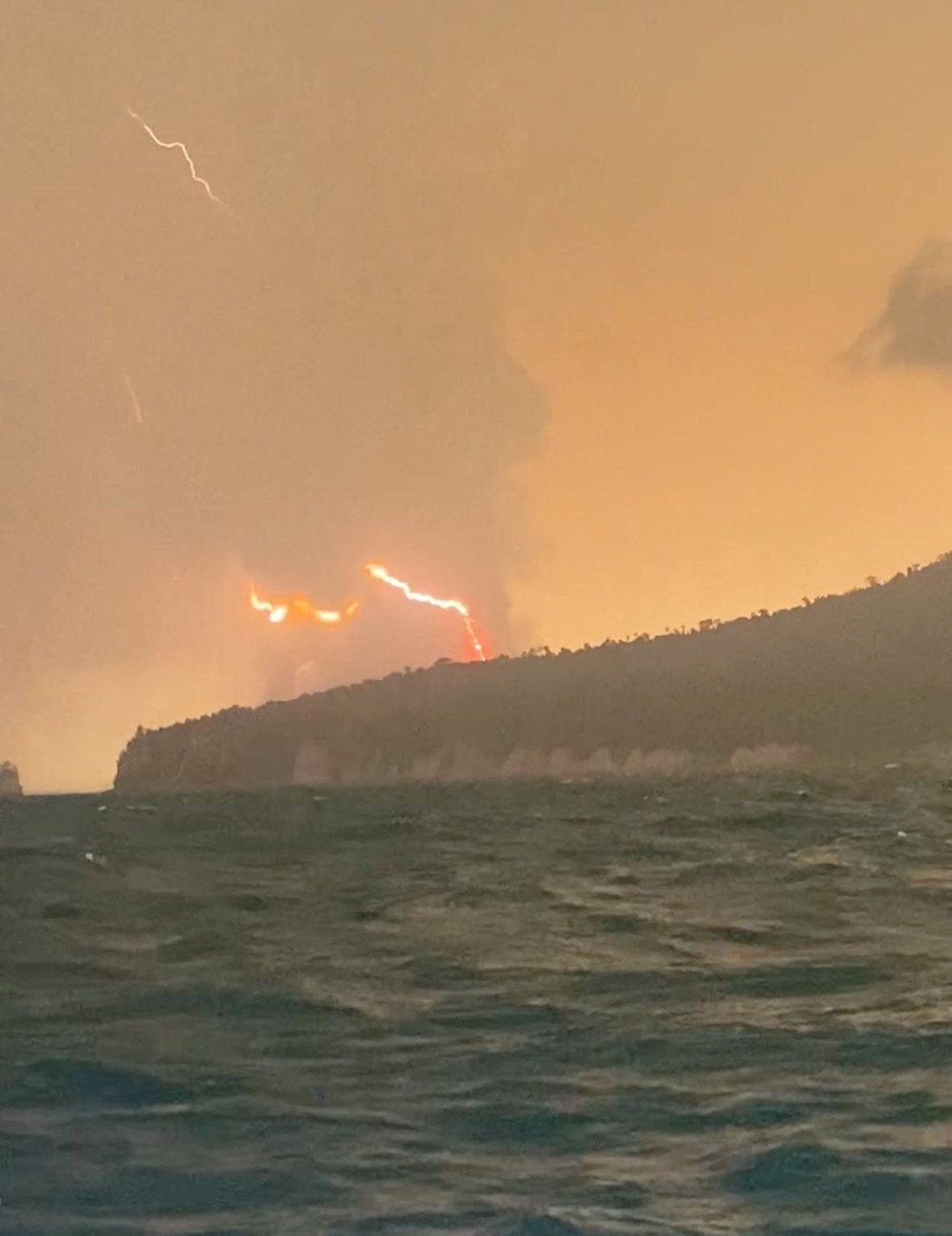
Anak Krakatau sits in the Sunda Strait, roughly midway between the islands of Java and Sumatra. It has been at Indonesia's second-highest alert level since July, and authorities have advised local residents, tourists and fishermen to stay 3km away from the active crater. Ships passing through the strait have been barred from entering the same exclusion zone.
The volcano – whose name means "child of Krakatau" – emerged from the sea about a century ago in the caldera left by the 1883 eruption of Krakatau, then known as Krakatoa, which killed some 36,000 people in a series of tsunamis.
A collapse of a section of Anak Krakatau in December 2018 triggered a tsunami that killed more than 430 people and displaced and injured thousands along the coastlines of Sumatra and Java. At the time, researchers suspected an underwater landslide caused the collapse, displacing a large volume of water. They have since discovered that some of the rock chunks that slid from the volcano were 70-90m high.
Indonesia has more than 120 active volcanoes. The Southeast Asian nation sits on the Pacific "Ring of Fire", a seismic belt stretching some 40,000km from the tip of South America to New Zealand, where roughly 90 per cent of the world's earthquakes occur.
Huge volcano eruption disrupts flights for 270,000 passengers across Indonesia
Indonesia’s Mount Anak Krakatau volcano eruption sends ash cloud 15km into the sky
Nearly 2,000 have suspected food poisoning linked to Indonesia’s free school meals
Thousands of students ill after eating free school meals in Indonesia
US aircraft carrier Abraham Lincoln leaves Thailand after five-day port visit
Sara Duterte posts bail after arrest for alleged threats against Ferdinand Marcos Jr


.jpg)