

Failure was affordable in Anastasha’s family.
Anastasha, 24, is a site engineer at a publicly listed construction company in South Jakarta.
She grew up in a wealthy family, with a helper at home, though her mother still taught her to cook and clean. She was sometimes paid for doing chores. Swimming, tennis, golf, horse riding and archery came with coaches. School subjects also came with tutors.
“My parents didn’t just give me things,” Anastasha said. “They gave me access. Certain schools, rooms, people, conversations.”
She said people sometimes took her seriously simply because they knew who her parents were. Meeting someone through family could be called networking, she said, and somebody without those connections might be accused of social climbing.
“I still work for what I have now, but I can’t pretend I built the starting point myself,” Anastasha said. “Some doors were already open before I was even old enough to understand.”
The cost of a wrong turn
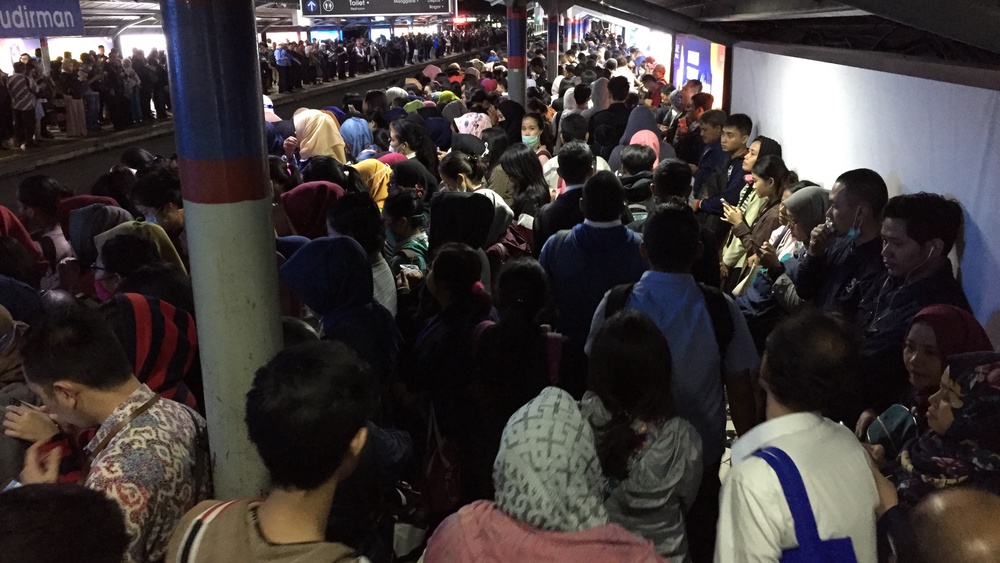
Commuters at Sudirman Station in Jakarta after office peak hours in a 2017 photo file. Photo: Netaholic13/Wikimedia Commons, CC BY-SA 4.0.
For Anastasha, that head start also changed the consequences of getting things wrong. “I can afford to be curious, to try things, to meet people, to fail, and try something else without the consequences being as serious.”
The same setback does not carry the same consequences for everyone. Reaching Indonesia’s middle class does not necessarily mean having enough security to stay there.
Statistics Indonesia defines the middle class through household expenditure relative to the poverty line. In September 2024, it classified 48.41 million people — about one in six Indonesians — as middle class, with per-capita household spending between 3.5 and 17 times the poverty line. Far more people sat immediately below them. Nearly half of Indonesians — 138.31 million people — were classified as “aspiring middle class.”
A separate World Bank measure asks whether workers earn enough to support a middle-class family of four, assuming one full-time worker and the equivalent of a second adult working part-time. The share meeting that standard fell by more than half, from 14.5% in 2018 to 7.1% in 2025.
Those near the bottom of the middle class were particularly vulnerable. A December 2025 working paper by economist Florischa Ayu Tresnatri and her co-authors found that the middle class had been shrinking since 2019, with households near its lower edge slipping back into the aspiring middle class.
Real net income per worker fell from around Rp1.8 million a month in 2019 to roughly Rp1.5 million in 2024. Middle-class workers remained concentrated in lower-paying sectors, while higher-value services absorbed relatively few of them.
Keeping track of where people sit as their circumstances change presents another problem.
A database briefly put a pedicab driver near the top of Indonesia’s welfare ranking. Timbul, a becak driver in Kulon Progo, Yogyakarta, went from the lowest welfare decile to the second-highest on paper.
Statistics Indonesia then checked his home and found that the information recorded in the National Socio-Economic Single Data, or DTSEN, did not reflect his current circumstances. After his information was updated, his ranking changed again, this time to the third decile.
DTSEN groups families into ten deciles according to their relative welfare position. BPS stresses that the ranking is not an absolute measure of a family’s income, wealth or poverty, and the database is updated as households’ circumstances change.
Asep Suryahadi, a senior research fellow at the SMERU Research Institute, said welfare positions can shift as households encounter shocks, particularly in countries with large informal sectors. For a targeting database to keep up, he told Migrant Times, it has to capture those changes as they happen.
“We have to remember that poverty, or welfare, is dynamic,” Suryahadi said.
A job, but not always a ladder
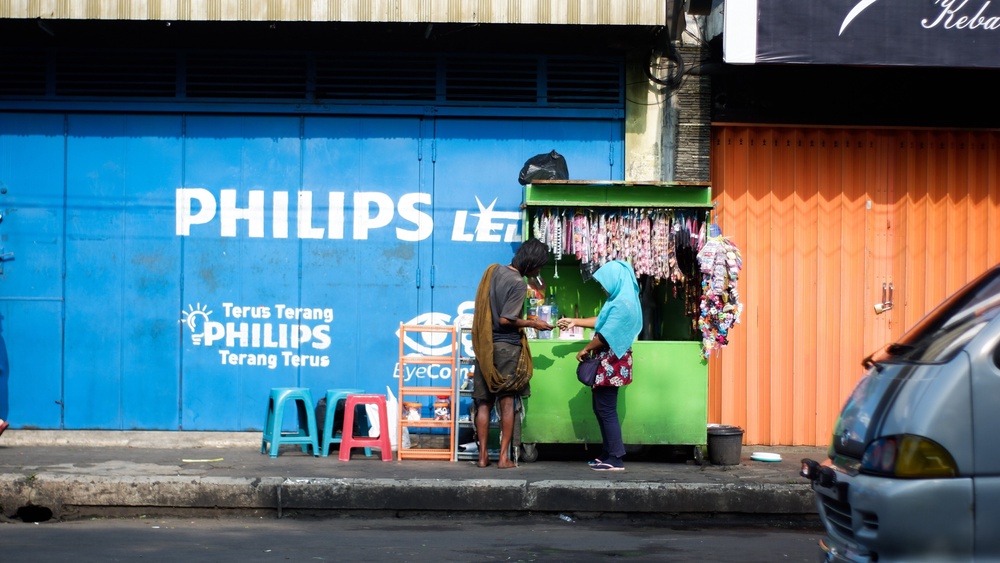
A street vendor serves a customer in Indonesia in April 2021. Photo: Nizarwibawa/Wikimedia Commons, CC BY-SA 4.0.
Employment was still growing. Indonesia had nearly two million more people in work in August 2025 than a year earlier. But nearly three in five were working informally.
Even higher education offered less protection than it once had. Among tertiary-educated workers, fewer than seven in ten were in formal wage employment by 2025, down from nearly three-quarters in 2018. Real wages declined by about 1% a year in medium-skilled occupations and around 2% annually in high-skilled work over the same period.
Where those workers landed increasingly mattered.
In a March 2026 ISEAS analysis, Maria Monica Wihardja and Sherry Tao Kong found that labour had continued moving away from agriculture, but was being absorbed largely by low-end services. Job creation was increasingly concentrated in low-productivity services and informal work. Real wages had also stagnated since around 2017.
Moving into another sector, then, does not necessarily mean moving very far up. Leaving agriculture for services can still raise productivity and incomes, but Indonesia has created too few higher-productivity jobs that can pull workers securely into the middle class.
Teguh Dartanto, a senior researcher at the Institute for Economic and Social Research at Universitas Indonesia, said education and formal employment remain the main routes into Indonesia’s middle class. In research he co-authored, however, graduates earned less when their qualifications exceeded what their jobs required or when they worked outside their field of study.
“Education and formal jobs remain the main routes into the middle class, but a degree alone no longer guarantees good returns,” Dartanto told Migrant Times.
That poses a problem for a country trying to reach high-income status by 2045. Bappenas wants the country to escape the middle-income trap before then, and has put productivity-led growth at the centre of that ambition.
Moving up and carrying more

The interior of Plaza Indonesia in Central Jakarta in March 2024. Photo: VulcanSphere/Wikimedia Commons, CC BY 4.0.
Nduk, kapan ngirim uang ke kampung?
For some Indonesians from poorer backgrounds, earning more can also mean being expected to “send money home.” Indonesia has long celebrated migrant workers — many of whom come from lower-income families — as pahlawan devisa, or “foreign-exchange heroes,” for the money they remit.
In 2025, Indonesian migrant workers sent US$17.3 billion home, according to Bank Indonesia. That was equivalent to roughly 1.2% of Indonesia’s GDP.
The same expectation to support family can follow people moving up at home.
Using 2014 data from the Indonesian Family Life Survey, one study found that roughly three in ten households qualified as part of the sandwich generation once support for elderly parents living elsewhere was counted. Those supporting parents outside their own household sent more than half again as much money as households living with the parents they supported.
Shary has made the kind of upward move those numbers struggle to show. She described herself as poor growing up. Today, she has steady work, savings and a home for her own family. She has money set aside for her daughter’s schooling.
Earning more also changed what her income was expected to do.
She bought each of her parents a home, bought them vehicles and paid off their debts. She also gives them money every month. At first, she said, the help was voluntary. Over time, it became an obligation. More financial requests followed; saying no could bring reminders of what her parents had sacrificed for her.
“When you have money, you want to ‘help’ other people as if you are helping your past self,” she said. “There is this thought that, ‘God gave me money so I could help other people too.’”
Her childhood also shaped what she wanted to do with the money left for herself and her daughter.
For Shary, toys make that most visible. She grew up poor as the only girl among several boys in her family. Toys had to be shared, she said, so the family bought things everyone could play with: helicopters, toy cars and swords. She remembers having few of the things other girls played with.
Her daughter is now three. “I get her dollhouses, girls’ toys, princess shoes, pretty clothes. I buy it all for her,” Shary said. “Because all I had growing up were boys’ things.”
Growing up poor also shaped what Shary refuses to spend. She keeps part of her savings effectively untouchable. “I learned how miserable it is to have no money at all.”
Shary said she already feels she has enough. She has savings, steady work and a home for her family. Being able to eat properly every day matters to her too. She does not particularly want to move into the upper class. “I’m already satisfied with my life now,” she said.
For Shary, moving up has not meant an endless climb through income groups. It has meant reaching a point where her daughter has things she did not, her parents are housed and there is still money she can refuse to touch.
Staying middle class
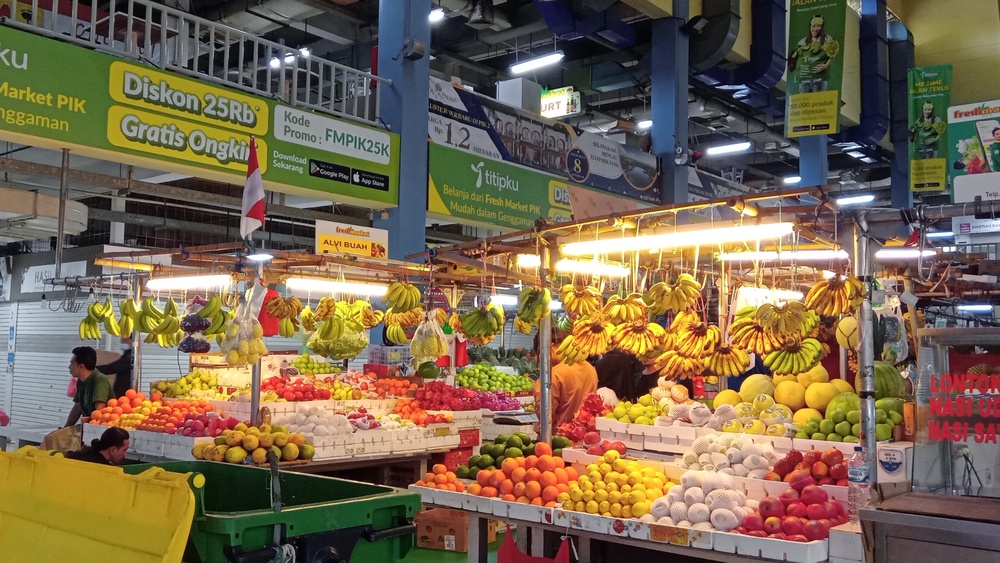
PIK Fresh Market in North Jakarta in May 2023. Photo: Cun Cun/Wikimedia Commons, CC BY-SA 4.0.
For Fred, 25, that sense of security remains harder to reach. He comes from Bogor and works in Central Jakarta. His family had a house, personal transport and a few small luxuries here and there. That comfort also depended heavily on his parents continuing to earn.
If either died, he believed, “we could literally [fall into a] lower class.” Financial security still felt like a “dream,” Fred said — mathematically out of reach despite what the family had.
By Jakarta standards, his family’s income could look comfortable. Fred said it still barely covered the bills. Even with his own income now, Fred said middle-class life still did not feel particularly “middle” enough. He worries that government decisions or economic shocks could erode savings built over years.
Tresnatri and her co-authors found that moving up through work has become harder.
Among middle-class workers who changed jobs, fewer moved into better-paying work than into worse-paying work in 2024. Workers on lower salaries were also the most likely to change jobs, often only to end up in similarly low-paid work.
Building a financial cushion was difficult too. World Bank survey data found that in 2025, households in the middle 40% of the income distribution saved two cents or less from each additional rupiah of income.
For newly middle-class families, Dartanto said, that can leave little protection when something goes wrong. “Newly middle-class families have few assets and are vulnerable to health and job shocks, so just staying in the middle class is already hard,” he told Migrant Times.
Dartanto cautioned against concluding that moving up within one generation had become impossible. “Still, the evidence does not show that one-generation mobility is closing,” he said. “Upward mobility is becoming less automatic and more uneven, rather than strictly multigenerational.”
So what would it take to make Indonesia’s middle class stick?