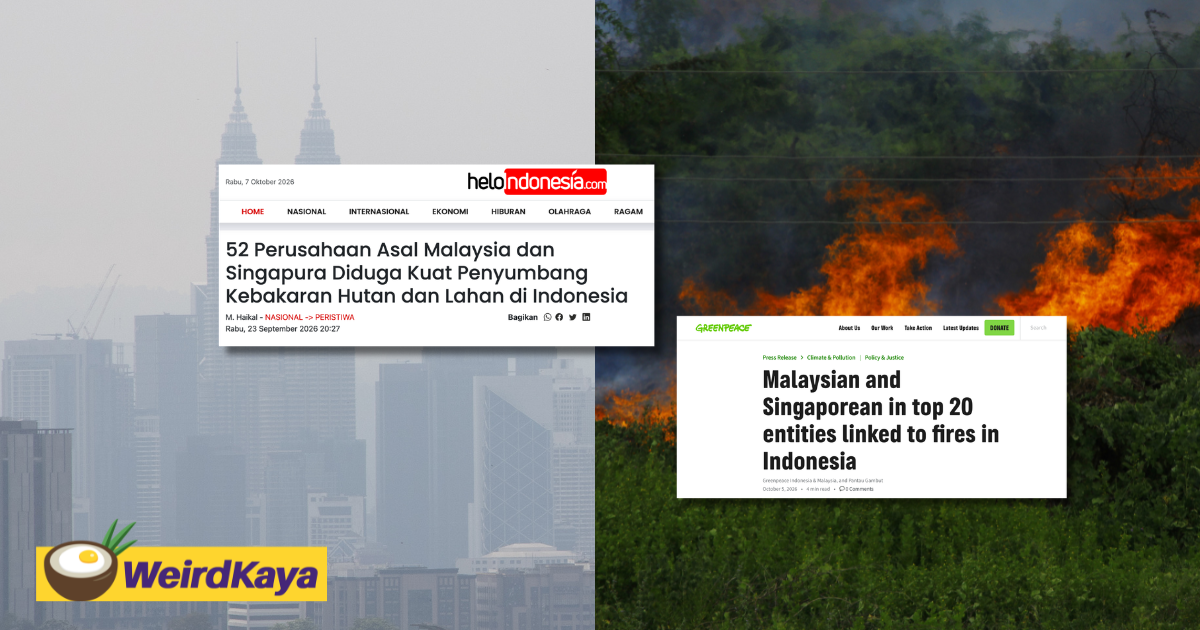
As haze continues to affect Malaysia and neighbouring countries, fresh scrutiny has fallen on companies allegedly linked to forest and peatland fires in Indonesia.
An Indonesian report recently claimed that dozens of companies linked to Malaysia and Singapore had fire hotspots detected within their concession areas, based on analysis by environmental groups.

Helo Indonesia reported that environmental group WALHI’s analysis identified around 26 Malaysian-linked companies and 26 Singapore-linked entities among those whose concession areas recorded hotspots this year.
Malaysian-linked KLK among entities highlighted
Separately, a new analysis by Greenpeace Indonesia, Greenpeace Malaysia and Pantau Gambut placed an Indonesian company linked to Malaysian plantation group Kuala Lumpur Kepong Berhad (KLK) among its “Top 20” entities connected to fire findings in Indonesia in 2026.

The company, PT Menteng Jaya Sawit Perdana (PT MJSP), was identified using haze-source data collected from August to Oct 1.
Greenpeace said the same entity had also appeared in a 2019 report involving fires detected on its land.
However, being linked to a concession where hotspots or fires were detected does not by itself establish that the company deliberately started the fires.
Singapore-linked concessions also named
The Greenpeace and Pantau Gambut analysis also identified at least four concessions with links to Singapore-based business groups where haze-source points were detected.
They included PT Damai Agro Sejahtera, linked to Singapore-headquartered Bumitama Agri; PT Kayung Agro Lestari; PT Mitra; and PT Arjuna Utama Sawit.
Helo Indonesia similarly reported WALHI’s claim that Singapore- and Malaysia-linked corporate groups were among hundreds of companies connected to hotspots detected on Indonesian concessions this year.
Thousands of smoke-source points detected
Greenpeace said its analysis identified 5,540 smoke-source points across Indonesia between Aug 8 and Sept 20.
Of these, 859 were found within 115 forestry concessions, while another 774 were located inside 210 oil-palm plantation concessions.

It also said 2,211 points were located in areas that had previously burned between 2015 and 2023, raising concerns about recurring fires in the same landscapes. Greenpeace
The groups argued that the findings showed a need for stronger corporate accountability and enforcement, particularly as smoke from the fires has crossed borders into Malaysia, Singapore, Brunei and other parts of Southeast Asia. Greenpeace
KLK says fires came from outside its concession
KLK has since responded to reports linking PT MJSP to the fires.
In a statement reported by Indonesian industry publication Sawit Indonesia, KLK said the fires originated outside PT MJSP’s concession area before spreading in, and stressed that all incidents had already been extinguished.
KLK also said the subsidiary’s concession is already fully mature and is not undergoing replanting, while reiterating that the group maintains a zero-burning policy in line with Roundtable on Sustainable Palm Oil standards.
The company said open burning is not permitted for land preparation or any other purpose across its operations.
Calls for companies to be named publicly
The issue has already become a point of debate between Malaysia and Indonesia.
In September, Malaysian civil society groups called on Indonesian authorities to publicly disclose companies being investigated over forest fires, after Indonesian officials said dozens of concession holders were under scrutiny without initially naming them.
Greenpeace Malaysia argued that transparency was necessary because Indonesian officials had previously pointed to Malaysian and Singaporean interests, while some companies maintained they followed sustainable practices.
For now, the latest reports and environmental-group analyses point to corporate links and hotspots within or around concession areas, but they should not be read as proof that every company named intentionally started fires.
As the haze continues, the calls for clearer evidence, public disclosure and cross-border accountability are only likely to grow.
Khairy: If true, Indonesia should punish them
Former health minister Khairy Jamaluddin also reacted to the Greenpeace report after it was shared on Instagram.
In an Instagram Story, Khairy said that if the allegations were true, Indonesian authorities should take firm action against the companies involved, regardless of whether they are Malaysian-owned.
It doesn’t matter if they are a Malaysian company.”
He also argued that Malaysia should have laws that would allow action to be taken locally against Malaysian companies found to be involved in such activities overseas.
Khairy further suggested that enforcement could potentially be more effective if Malaysia had the legal mechanism to pursue the companies here.