PETALING JAYA: Industries must play a greater role in shaping Malaysia’s talent pipeline as the country works towards training and upskilling 60,000 highly skilled Malaysian engineers by 2030, said Prime Minister Datuk Seri Anwar Ibrahim.
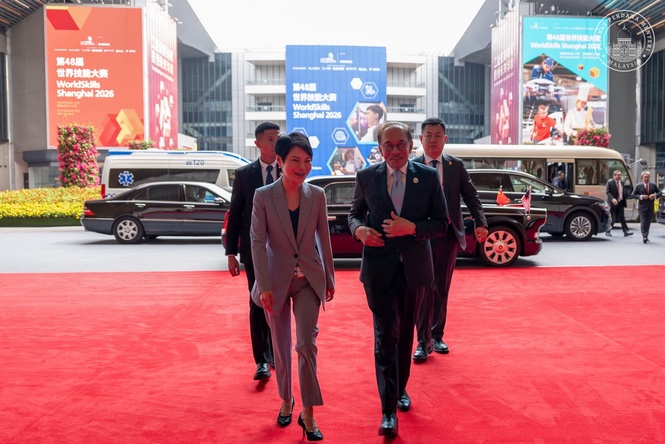
Speaking at the opening plenary of the WorldSkills Shanghai 2026 Conference and Expo at the National Exhibition and Convention Centre today, he said companies understood their equipment, technologies and evolving workforce needs best and should therefore work closely with training institutions from the outset to ensure talent development kept pace with industry demands.
“Companies, of course, know what equipment they use and how quickly their needs change.
READ MORE: TVET takes flight as drone, AI skills open new pathways for Malaysian youth
READ MORE: TVET students to undergo training in emerging fields at govt institutions – Anwar
“They should be partners in shaping talent from the outset and ensure they are ahead of the curve,” he said.
Anwar said Malaysia’s next phase of reform, dubbed TVET 2.0, would bring industry closer to technical and vocational education and training (TVET), while accelerating the adoption of artificial intelligence (AI), semiconductors and renewable energy.
He said the initiative was aligned with Malaysia’s National Semiconductor Strategy, which has set a target of RM500 billion in semiconductor investments and the development of 60,000 highly skilled Malaysian engineers by 2030.
Anwar also stressed that skilled careers must offer clear career progression and good incomes to attract young people to the sector.
“Young people will choose this work when they can see where it leads. Our task is to make sure that it leads somewhere worth going to, skilled work and good incomes,” he said.
He said modern economies could not function without technicians capable of operating, maintaining and troubleshooting increasingly sophisticated machinery and technology.
“The machinery may become more sophisticated; the software may become more intelligent. But somebody still has to understand how it works and know what to do when it does not,” he said.
Anwar also expressed appreciation to China for its role in providing skills training and opportunities for young people from developing economies.
He said China had demonstrated strong capabilities in advanced manufacturing, AI, robotics, industrial automation, electric vehicles, semiconductors and digital technologies.
“I am not aware of any country in the world that has given so much hope and support for our youth through its skills training centres as China. I salute and thank you,” he said.
He said Malaysia’s comprehensive strategic partnership with China had included cooperation in TVET since 2013, including the Malaysia-China TVET Youth Training programme.
He also congratulated WorldSkills International on 75 years of work in raising the standing of skilled work, noting that Malaysia had participated in the competition since 1995.
Anwar said Malaysia had sent 22 young competitors to Shanghai this year to compete across 21 skills areas.