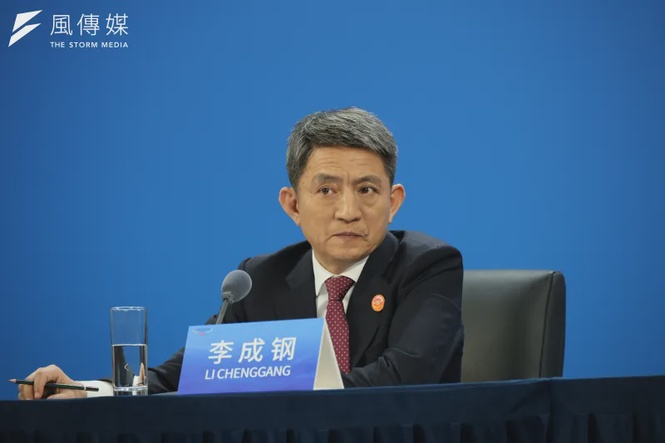
China's top trade negotiator said on November 16 that Asia-Pacific Economic Cooperation (APEC) governments are negotiating a standalone statement on a Free Trade Area of the Asia-Pacific (FTAAP) that could be adopted when leaders meet in Shenzhen this week, as security around the summit venues tightened sharply ahead of Xi Jinping's arrival.
Li Chenggang, China's international trade representative and a vice minister of commerce, told an evening briefing at the summit's media center that the FTAAP outcome document, which China proposed, was still under negotiation and was expected to be concluded at the leaders' meeting. A cooperation framework on digital and intelligent trade that China launched this year had won broad support and was in the final stage of talks, he said.
The APEC Economic Leaders' Meeting opens with a welcome dinner on the evening of November 18, and the summit itself takes place on November 19. Taiwan takes part in APEC as a full member under the name "Chinese Taipei."
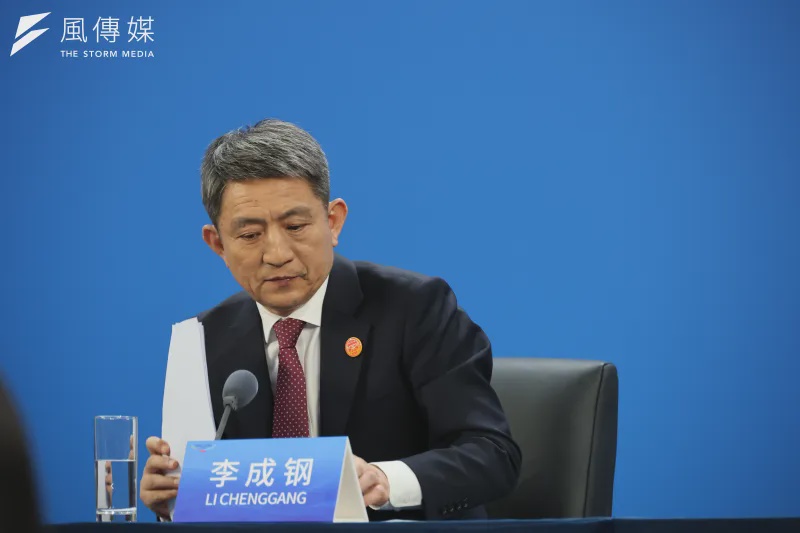
Xi Will Host Trump And Putin On Summit Day
APEC Economic Leaders' Week opened in Shenzhen on November 13 with a session to draft the summit's outcome documents. The two-day Concluding Senior Officials' Meeting (CSOM) and the three-day fourth meeting of the APEC Business Advisory Council (ABAC) have since wrapped up, and the APEC CEO Summit runs on November 17 and 18, with Xi and leaders of 11 other member economies expected to attend.
China's foreign ministry has said Xi will open the CEO Summit with a keynote speech on November 17 and chair the leaders' meetings on November 18 and 19. On November 16, it announced that Xi will also hold a China, US, and Russia leaders' meeting with US President Donald Trump and Russian President Vladimir Putin in Shenzhen on November 19, the same day as the summit.
The foreign ministry said on November 13 that China had held more than 300 meetings and events and 10 sectoral ministerial meetings since taking on the APEC host role this year, laying "a solid foundation" for the summit. It said Beijing hopes members will reach a "Shenzhen Declaration" with practical results on trade, connectivity, the digital economy, and artificial intelligence (AI).
Senior Officials Became The Real Battleground
Reaching that declaration has followed an unusual path this year. Normally, senior officials build an initial consensus, ministers take it further, and leaders sign off at the summit. This year, China moved the annual joint meeting of foreign and trade ministers, usually held during Leaders' Week, forward to November 3 and held it by video, angering several members.
Taiwan joined like-minded economies in protest and sent only deputy ministers to the meeting, which was chaired by Chinese Foreign Minister Wang Yi and Commerce Minister Wang Wentao. No joint statement followed, breaking with usual practice. With the ministers' annual meeting already over, the work of forging consensus on the Shenzhen Declaration shifted to the senior officials' meeting, where Taiwan's two senior officials took their seats on November 14.
Beijing Claims Nearly 50 Trade Outcomes This Year
Li said China's APEC year had focused on four tracks: regional economic integration, support for the World Trade Organization (WTO), deeper digital and intelligent cooperation, and sustainable development. Together they had produced nearly 50 practical outcomes, he said, and ministers took stock of the year's trade results at their November 3 video meeting.
Digital trade cooperation, Li said, is the area where APEC members share the firmest consensus and the strongest will to work together. Members tabled initiatives and documents this year on trade digitalization, AI, digital services, and cross-border e-commerce. On sustainability, he pointed to progress on environmental services, sustainable energy, and new energy vehicles.
Asked by China's state news agency Xinhua whether there had been any new progress on the FTAAP, given that this year marks 20 years since APEC leaders set out the vision and 12 years since China launched a Beijing Roadmap for it when it hosted APEC in 2014, Li answered with a laugh. "Whether it is 20 years or 12 years, it passes in the snap of a finger," he said.
RCEP And CPTPP Shape The Free Trade Push
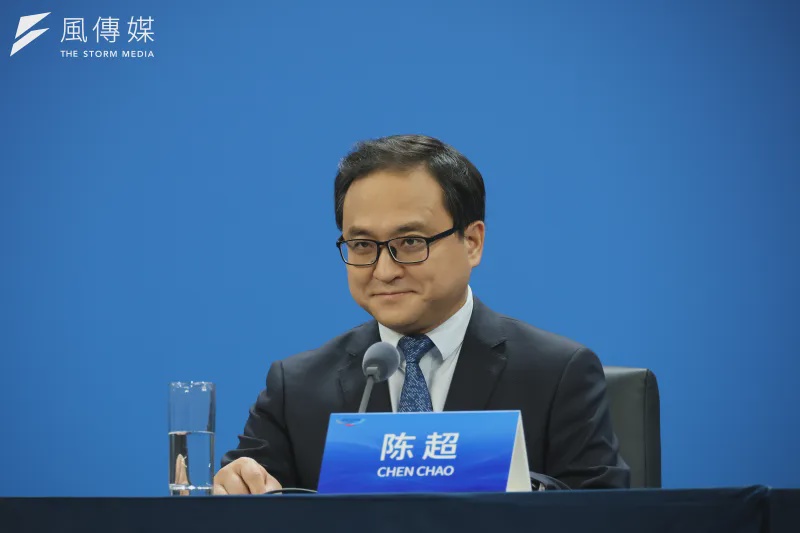
Chen Chao, director-general of the Commerce Ministry's international department, said Asia-Pacific economic integration had made "positive and major" progress in recent years. He noted that the Regional Comprehensive Economic Partnership (RCEP), the world's largest free trade area, is in force and taking in new members, while the Comprehensive and Progressive Agreement for Trans-Pacific Partnership (CPTPP) is also expanding and being upgraded. Both China and Taiwan have applied to join the CPTPP.
Alongside a growing web of bilateral, regional, and subregional deals, those pacts form a diverse network of trade rules across the Asia-Pacific, Chen said, which raises the bar for coordinating rules and aligning policies.
China's FTAAP work this year had two parts, he said. The first was promoting dialogue and links between the region's trade arrangements in a gradual, flexible, and pragmatic way, including by sharing the latest progress in RCEP and the CPTPP. The second was using APEC as an "incubator," opening policy dialogues in emerging fields and helping developing members build the capacity to take part in high-standard trade cooperation.
Digital Trade And AI Account For Half Of The Deals
Asked by Singapore broadcaster CNA about digital trade and new AI cooperation, Chen said China and other APEC economies had reached 25 cooperation outcomes this year on trade digitalization, AI, and cross-border e-commerce, accounting for "half" of the trade results from the APEC meetings China hosted. Besides China's digital trade framework, he said, an APEC Digital Trade Center of Excellence was formally launched this year to focus on capacity building and the sharing of experience and practice.
A Tough Negotiator Fronts Beijing's Trade Agenda
Li's role at the briefing reflects his rising profile. China's State Council formally named him international trade representative with full ministerial rank in October. He became China's permanent representative to the WTO at the end of 2020 and returned to Beijing in 2025 to take up the Commerce Ministry's trade negotiator post, just as Trump began his second term.
Foreign media have described Li as a tough but pragmatic technocrat at the negotiating table, and as one of China's "wolf warrior" diplomats who are willing to draw their swords and go on the offensive.
Phones Taped Shut At The Leaders' Venue
Earlier on November 16, Storm Media joined a Taiwanese press group led by Taiwan's foreign ministry as it visited the Shenzhen International Communication Center, the main venue for the leaders' meeting. The group cleared a security checkpoint at about 10 a.m. and spent roughly an hour inside the controlled zone.
After the initial screening, however, the Taiwanese journalists were held inside a security tent for several tens of minutes. They were allowed in only after foreign ministry staff negotiated with the site's command center, and only on condition that they leave camera equipment behind and cover the front and rear cameras of their phones with red "No Photographing" stickers.
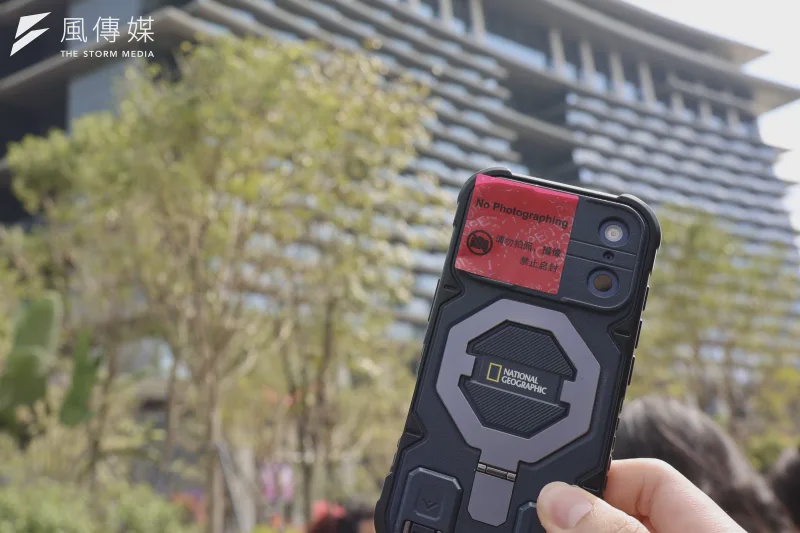
Inside, a different security unit moved in or out of the building about every half hour. Officers in light-colored shirts carrying camouflage water bottles came and went, as did another team in dark uniform jackets. Staff repeatedly checked whether anyone in the Taiwanese group was taking pictures, and asked the group to leave little more than 10 minutes after letting it into the venue.
The complex covers 200,000 square meters and cost nearly 10 billion yuan (about US$1.4 billion) to build, according to Shenzhen and Hong Kong media. It is divided into an international conference area and a garden conference area, includes a dedicated round-table hall for heads of state, and has about 60 meeting rooms and banquet halls seating a total of 15,000 people. Completed in May, it hosted the APEC Ministerial Meeting on Forestry in July, making the leaders' summit its second APEC event.
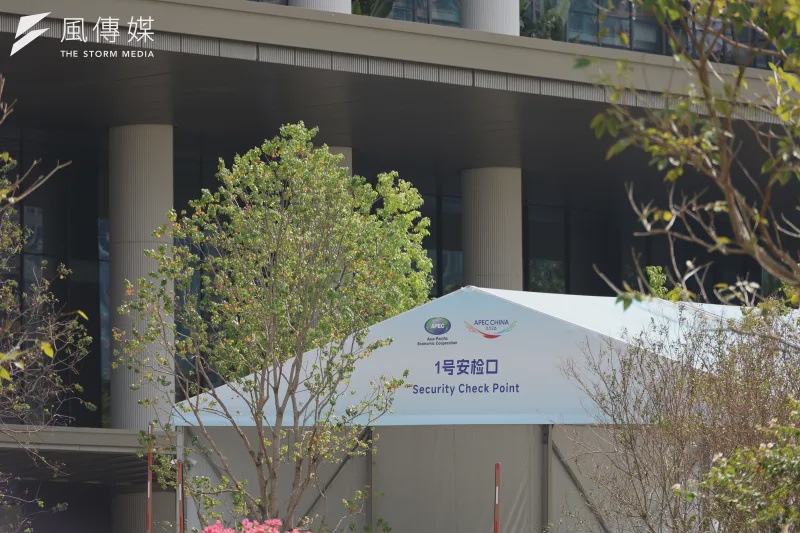
Plainclothes Guards Watch The CEO Summit Perimeter
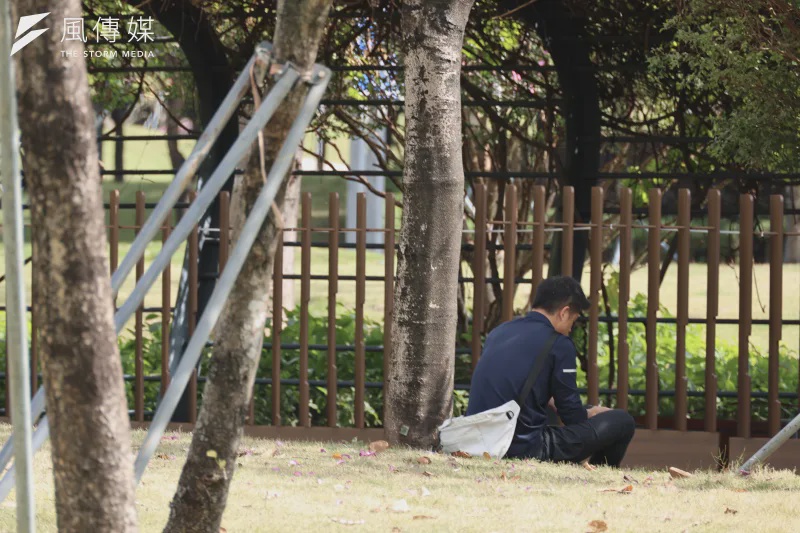
Security was tighter still at the Qianhai International Conference Center, the venue of the APEC CEO Summit, which Xi was due to enter the next day. Residents were still relaxing and playing on the lawns outside, but guards stood at fixed posts throughout the controlled zone, and plainclothes officers were stationed every few meters along the fence.
Those officers looked like people sitting on the grass to enjoy the shade. But as soon as they spotted anyone filming or taking photos, they called out to stop them, and showing a press card made no difference.
Original Article In Chinese (1)
Original Article In Chinese (2)
You've read it. Now join the conversation — follow us on X, Facebook and IG. Editor: Penny Wang