Most diets work in the short term. The problem is that the weight tends to come back once people stop following the plan. So when a study shows that the benefits of a dietary approach persist well beyond the intervention period, it deserves a closer look.
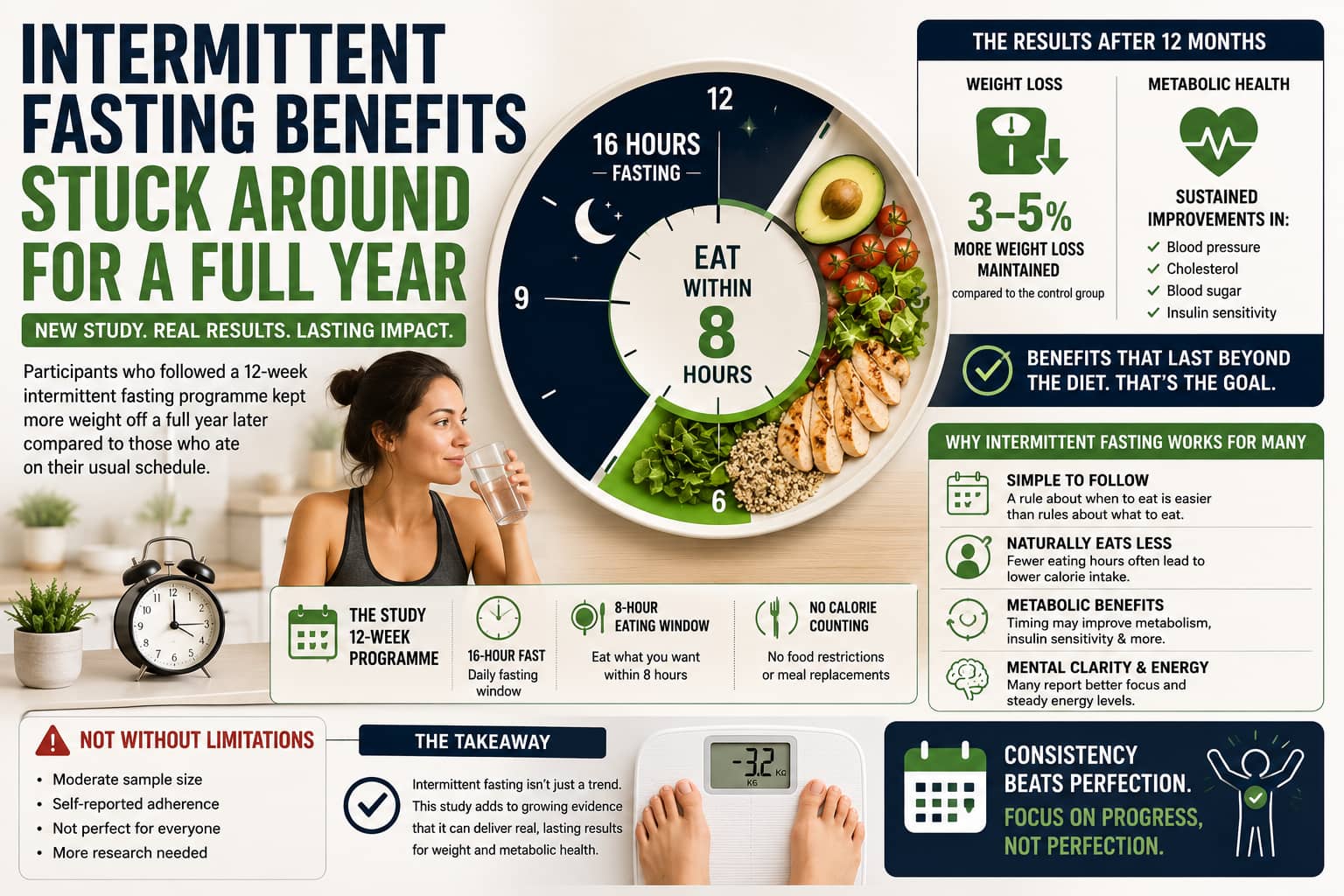
A new study found that participants who followed a 12-week intermittent fasting programme maintained more weight loss a full year later compared to a control group that ate on their usual schedule. The fasting protocol was straightforward: participants restricted their eating to an eight-hour window each day, with no specific rules about what they ate during that window.
What makes this study noteworthy is the follow-up period. Many intermittent fasting studies measure results at the end of the programme and stop there. This one checked back at the 12-month mark. The fasting group had not only kept more weight off but showed sustained improvements in metabolic markers compared to those who ate without time restrictions.
The eight-hour eating window is one of the most common forms of intermittent fasting, often called 16:8 because you fast for 16 hours and eat during 8. It has gained popularity because it is relatively easy to follow. Most people simply skip breakfast or stop eating after an early dinner. There is no calorie counting, no food restrictions, and no meal replacements.
Critics of intermittent fasting have long argued that any weight loss it produces is simply due to eating fewer calories overall, not anything special about the timing. That critique has merit. When you compress your eating into a shorter window, most people naturally eat less. But the sustained results in this study suggest that the timing component may have independent metabolic effects, though more research is needed to separate those factors cleanly.
One practical advantage of intermittent fasting over traditional diets is adherence. People find it easier to follow a rule about when to eat than to follow detailed rules about what to eat. The simplicity makes it more sustainable, which might partly explain why the benefits lasted.
The study was not without limitations. The sample size was moderate, and the participants were not randomly assigned in a way that eliminates all confounders. Self-reported adherence is always tricky, and there is no guarantee that participants stuck to the fasting protocol consistently for the entire year.
Still, the one-year follow-up showing durable weight maintenance adds to a growing body of evidence that intermittent fasting is more than a trend. For people looking for a sustainable approach to weight management that does not require overhauling their entire diet, it remains one of the simpler options on the table.
My Opinion
I find intermittent fasting appealing precisely because it does not tell you what to eat. Most diets fail because they demand too much cognitive effort. Counting macros, eliminating food groups, tracking points. The 16:8 approach just asks you to look at the clock. That is a much lower bar, and for most people, a lower bar is the one they actually clear.
Ronny M (ronny76netstuff@gmail.com) is a content creator under the Newswav Creator programme, where you get to express yourself, be a citizen journalist, and at the same time monetize your content & reach millions of users on Newswav. Log in to creator.newswav.com and become a Newswav Creator now!
The User Content (as defined on Newswav Terms of Use) above including the views expressed and media (pictures, videos, citations etc) were submitted & posted by the author. Newswav is solely an aggregation platform that hosts the User Content. If you have any questions about the content, copyright or other issues of the work, please contact creator@newswav.com.