
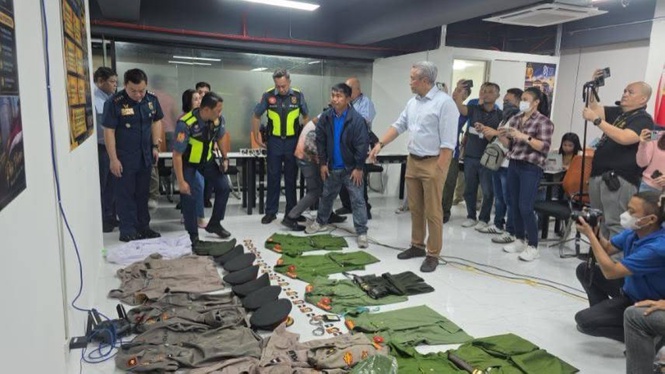
MANILA, Philippines — At least 159 foreigners, mostly Indonesians, Malaysians, Vietnamese and Chinese were rescued during a police operation at a scam hub in Pasay City on November 3.
Three masterminds of the parcel scam were arrested.
Philippine National Police chief Gen. Jose Melencio Nartatez Jr. and Interior Secretary Jonvic Remulla led the raid.
Operatives of the Criminal Investigation and Detection Group (CIDG) saw make-believe law enforcement offices of China, Malaysia, Vietnam and Indonesia, and workers disguised as law enforcers, along with their accomplices.
Philippine authorities were informed of the scam when three Indonesian workers escaped.
“We are now studying the pieces of evidence. The laptops, cellphones and ipads that they used and we will see there the people who were victimized,” Nartatez told reporters in an interview on the site after the raid.
“And now with the help of Indonesian police and others, we will prosecute them and we will share the necessary pieces of evidence to pursue cases against these personalities especially the masterminds,” he said.
Modus
Various law enforcement uniforms were found in the scam site during the raid. According to Col. John Guiagui, CIDG-National Capital Region chief, the modus is done in four stages.
The scammers choose their victims from their voluminous database and inform them of a parcel delivery which was already paid to lure the targets. However, they will then be told that the parcel contained contraband, particularly illegal drugs.
Scripts are prepared in the four Asia languages, which showed that there was no intent to victimize Filipinos since the actors do not know Tagalog.
This is where the characters will come in. Lower ranked officers will threaten the target that they will be investigated and their money and assets will be frozen.
Higher ranking officers would then come in and offer a way out for the victim by giving them an account number, supposedly secured and guaranteed, where they can send money.
Once the money is deposited, the scammers disappear.
The group lures workers online through social media and messaging apps like Telegram, offering them virtual assistant work but upon arrival in the Philippines, they will be locked in the building and forced to work.
Guiagui said the workers also endured physical abuse.