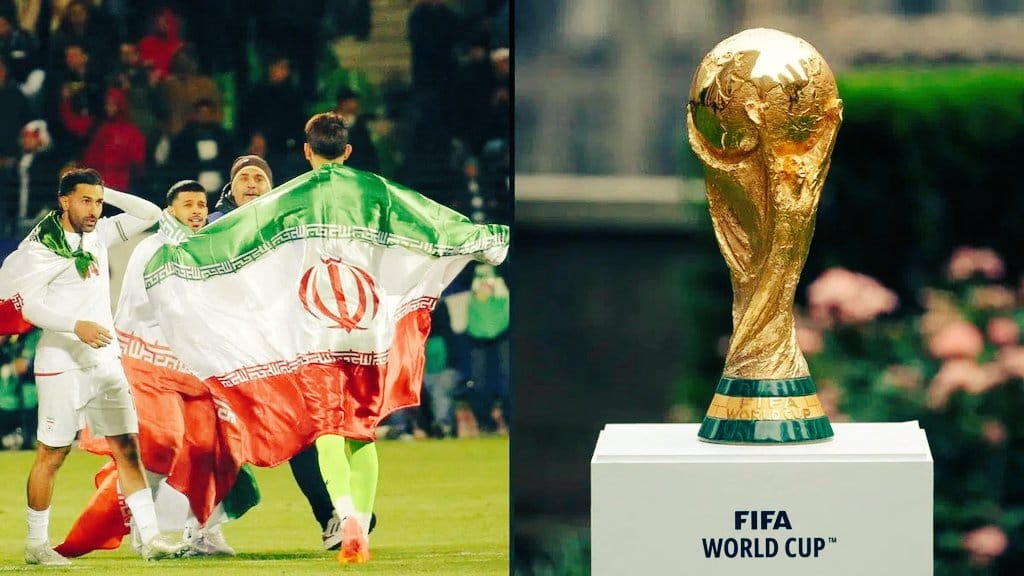
Just outside the bustling borders of San Diego, in the Mexican border city of Tijuana, a professional football squad trains under conditions that feel more like an espionage thriller than a World Cup campaign. The Iranian national football team affectionately known to millions of fans as Team Melli runs drills on unfamiliar turf, isolated from the luxurious, high-tech training compounds typical of a modern World Cup. This sudden, frantic relocation of their training base from Arizona to Mexico was not a tactical choice by head coach Amir Ghalenoei. It was an act of forced survival.
For football enthusiasts watching the spectacle unfold across North America, the beautiful game has collided head-first with an uncompromising geopolitical wall. Under draconian mandates enforced by the United States government, the Iranian national team is subject to an extraordinary, highly controversial same-day entry and exit restriction for their matches played on American soil. According to reported accounts by Goal.com, the team is only permitted to cross the US border on the morning of their fixtures and must depart immediately after the final whistle. The logistical nightmare this creates cannot be overstated, yet it points to a much deeper, darker fracture in international sports. For Malaysian observers, who have witnessed their own nation navigate complex international relations and hosting rowes, this unprecedented diplomatic exile feels remarkably close to home, prompting a profound examination of how global institutions yield to Western hegemony.
When Sportsmanship Yields to the Border Guard
To understand the sheer institutional asymmetry of this decision, one must look at the strict administrative protocols that govern international football. Under standard FIFA regulations, every qualifying nation is guaranteed an equal playing field, which inherently includes the right to arrive at least the day before a match to conduct standard pitch inspections, host mandatory pre-match press conferences, and adjust to local climates. This baseline equality has been thoroughly shattered. According to an investigative piece by The Independent, Coach Ghalenoei expressed deep distress over the sanctions, noting that such targeted obstruction has simply never occurred in the history of the modern tournament.
The institutional justification from Washington has been swift and unyielding. The U.S. State Department publicly defended its aggressive border enforcement, asserting that while necessary athletic visas were granted, the United States will not allow foreign delegations to abuse the immigration system under false pretenses. The political theater intensified further when U.S. lawmakers openly targeted specific individuals within the Iranian sporting structure. As reported by CNBC TV18, government officials emphasized that any individuals suspected of holding ideological or institutional ties to Iran's Islamic Revolutionary Guard Corps (IRGC) would be explicitly barred from entering the country, transforming a sports delegation into a litigation battleground. The operational toll on Team Melli is severe; as highlighted by The Star Malaysia, fifteen integral squad officials and administrative staff members, including team supervisor Mahdi Mohammad Nabi, were outright denied visas, leaving the players structurally adrift.
The Logistical Cage and the Illusion of Fair Play
Analysis of the situation reveals a staggering double standard in how the phrase "sporting integrity" is defined on the global stage. Consider the physical reality of an elite athlete under these parameters: waking up before dawn to undergo aggressive security clearances at a heavily fortified port of entry, commuting directly across a tense border, playing 90 minutes of high-intensity football against top-tier global opponents, and being immediately ushered back to a bus destined for the border before the sweat has even dried on their jerseys. This is not sport; it is an administrative extraction.
The stark contrast between the host nation’s privileges and the visitors’ restrictions makes a mockery of FIFA’s foundational fair-play doctrines. The geopolitical shadow over the group stage is impossible to ignore. Iran must navigate this logistical gauntlet during their critical fixtures, including high-stakes matches against New Zealand in Los Angeles and Egypt in Seattle. According to historical tracking from Google Sports Data, Iran has a proud history of fierce competitive spirit on the World Cup stage, including an unforgettable, emotionally charged Group B clash against the United States in Qatar 2022. By shifting the battleground from a neutral pitch to a weaponized immigration checkpoint, the host nation effectively compromises the biological readiness and psychological stability of its opponents long before the opening whistle blows.
A Hostile Architecture: The Suppression of the Diaspora
The exclusionary policies of the host administration do not stop at the touchline; they extend deep into the stands, silencing the cultural heartbeat of the sport. In an extraordinary move that surprised human rights observers globally, the Iranian Football Federation revealed that the ticket allocations specifically reserved for Iranian supporters had been abruptly withdrawn. As detailed by the American Immigration Council, this sudden revocation means Team Melli is forced to compete in echoing American stadiums completely devoid of their passionate, flag-waving diaspora.
This total atmospheric isolation forms a hostile architecture designed to systematically disadvantage nations deemed geopolitical adversaries. For a Malaysian audience, this hyper-politicization of stadium seating evokes deep cultural anxieties about inclusivity and fair representation in international forums. The beautiful game is celebrated precisely because a stadium is supposed to function as a temporary sanctuary a sovereign space where a flag represents athletic merit rather than state policy. By systematically barring both the administrative brain trust of the team and the fans who sing them forward, the tournament loses its claim to universal brotherhood, transforming instead into an exclusive western showcase where selected global south participants are tolerated only as transient, silent entertainment.
The Sound of Silence from Zurich
Where, one might ask, is FIFA in this escalating crisis? The governing body’s silence has been deafening, signaling a profound institutional retreat. When confronted with the reality of visa denials and same-day expulsions, FIFA’s official stance has been an exercise in bureaucratic buck-passing, stating coolly that the organization remains entirely uninvolved in host-country immigration processes and that sovereign governments ultimately dictate border entry.
This passivity stands in direct, hypocritical contrast to FIFA’s historical track record. When nations in the Global South deviate from FIFA’s stringent hosting requirements or express political objections on home soil, the executive response is usually swift, punitive, and absolute. The institutional memory of football fans remains sharp: FIFA previously stripped hosting rights from nations that let domestic political sentiments interfere with the tournament’s absolute inclusivity. Yet, when the United States implements sweeping, unilateral border restrictions that directly sabotage a participant's ability to compete fairly, the hierarchy in Zurich stands idly by. This selective enforcement of rules exposes a deeply entrenched institutional hierarchy, proving that the multi-billion-dollar commercial allure of the North American market far outweighs any abstract commitment to global equity.
Echoes in the Global South: A Shared Malady
This systematic exclusion of Iranian players and fans is not an isolated incident; it is part of a broader, systemic pattern of border weaponization that disproportionately targets developing nations. Human rights organizations have issued urgent travel warnings ahead of the tournament, noting that the host administration has aggressively doubled down on a draconian immigration agenda. The casualties of this border war span continents: citizens from Haiti face absolute entry bans, while nations like Senegal and Ivory Coast are choked by severe travel restrictions. Furthermore, processing data reveals that ordinary football fans from countries like Uzbekistan and Ecuador face staggering visa rejection rates approaching 40 percent.
This reality resonates powerfully with the Malaysian public, a society that fundamentally values international law, state sovereignty, and multilateral fairness. Watching a proud Asian powerhouse like Iran treated as a security threat rather than an elite sporting contemporary serves as a stark reminder of the invisible, yet impenetrable, visa walls that continuously divide the global populace. It forces an uncomfortable realization: despite the poetic rhetoric of global unity, our access to international cultural spaces remains strictly dictated by the arbitrary geometric lines of Western foreign policy.
The Broken Promise of the Beautiful Game
When the whistle blows and the ball rolls across the pristine grass of Los Angeles or Seattle, the television cameras will capture a familiar, beautiful spectacle. But beneath the flashing lights and corporate sponsorships, the soul of the tournament feels fundamentally compromised. A World Cup where an entire team must train in exile across a national border, enter under armed scrutiny, and flee into the night immediately after competing is not a festival of human unity. It is a dystopian manifestation of political containment.
Football has long derived its magic from its status as the great equalizer a sport where a kid from the streets of Tehran can stand eye-to-eye with a superstar from Western Europe, judged solely by their skill, endurance, and heart. When we allow the border guard to dictate the terms of the match, we lose the very essence of what makes the game beautiful. We are left with a corporate shell, an athletic theater where the rules of engagement are rigged by the powerful, and where the transient guest is reminded of their subjugation at every turn.
What do you think? I’d love to hear your opinion in the comments section.
As this tournament progresses, the images of empty Iranian fan sections and exhausting border crossings will linger long after the final scores are recorded. This structural isolation forces us to look in the mirror and ask hard questions about the future of international sport. Are we moving toward an era where international tournaments are no longer safe havens of global community, but rather highly selective showcases governed by geopolitical vetting? If the hosting of a truly global event requires the systematic humiliation and exclusion of an entire qualifying nation, then perhaps the very framework of choosing hosts must be radically reimagined.
The struggle of Team Melli is a sobering reminder that for much of the world, the pitch is never truly level. It is a story of resilience against systemic adversity, a narrative of athletes carrying the hopes of a silenced nation while navigating an invisible maze of state-sanctioned hostility. We are left to ponder the true cost of this compromise, and whether the beautiful game can ever truly recover its lost innocence.
AM World (tameer.work88@gmail.com) is a content creator under the Newswav Creator programme, where you get to express yourself, be a citizen journalist, and at the same time monetize your content & reach millions of users on Newswav. Log in to creator.newswav.com and become a Newswav Creator now!
The User Content (as defined on Newswav Terms of Use) above including the views expressed and media (pictures, videos, citations etc) were submitted & posted by the author. Newswav is solely an aggregation platform that hosts the User Content. If you have any questions about the content, copyright or other issues of the work, please contact creator@newswav.com.