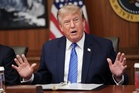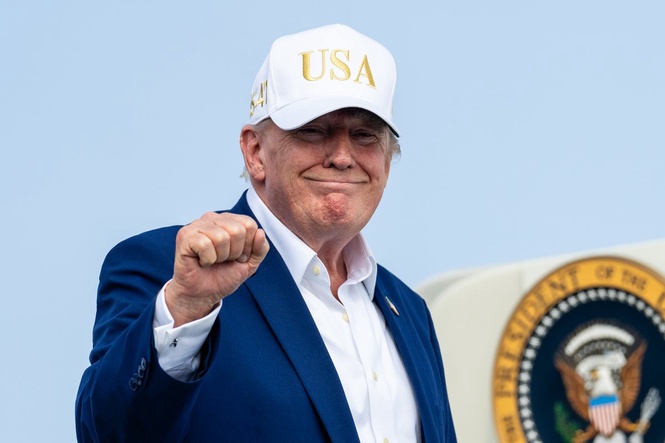
Donald Trump has declared that it “always works out” as he said the US will scale down the intensity of its efforts to reopen shipping through the Strait of Hormuz.
Talks to end their war and reopen shipping through the Strait of Hormuz appeared to have stalled, after Tehran demanded a series of conditions, including the payment of compensation, before it reopens the waterway.
"We are only semi-negotiating with them. We are just watching Iran with its huge inflation and the fact they have no money," he told Axios. "It will work out. It always works out. It's like a chess game.”
Tehran is in negotiations with Oman to partially open up the Strait, but set out six conditions the US must meet, including a permanent end to the war and aggression against Iran and its allies in Lebanon, Palestine, Yemen, and Iraq.
Stalling negotiations have seen the price of Brent crude ticked up for the fourth trading day in a row, now sitting at $84.
Meanwhile, the US is pushing for defence companies to “dramatically” accelerate weapons production as the Iran war drains through their missile supplies, according to a memo obtained by The Washington Post.
Read MoreTrump claims he’s ‘low-keying it’ with Iran after report he could walk away without nuclear deal
Trump foe vows he’s ‘prepared to support a bad deal’ to end war in Iran
The forgotten Iranians caught in the deadly stalemate of Trump’s war
Iran says Strait of Hormuz will remain closed until US meets six demands
Key Points
- 'We're low-keying it on Iran', says Trump
- Iran says Oman deal on strait is near but sets US conditions
- Netanyahu says Trump's new Gaza plan is unacceptable
- UAE oil tanker attacked by missile in Strait of Hormuz
- What compensation does Iran want from the US to reopen the Strait of Hormuz
What are Iran's six demands of the US to reopen the Strait of Hormuz?
21:00 , James ReynoldsIran’s top security official has said the Strait of Hormuz will remain shut until the US meets six demands, including compensation for the war.
Mohammad Bagher Zolghadr, secretary of the Supreme National Security Council, laid out Iran’s terms in a statement on Saturday.
In his words, these were:
1. Never, and in no language, threaten Iran or insult the sanctities of this nation.
2. Permanently end the war and aggression against Iran and Iran’s allies in Lebanon, Palestine, Yemen and Iraq.
3. Lift the naval blockade and withdraw its military forces (naval and air) from around Iran.
4. Pay in full, without any reduction, the damages caused to Iran by the two wars of aggression and imposition.
5. Lift the unjust and illegal sanctions against the Iranian nation.
6. Unconditionally release the blocked and stolen assets of the Iranian people.
Trump says US has cleared Strait of Hormuz of mines
20:41 , James ReynoldsDonald Trump now claims the US has already mineswept the entire Strait of Hormuz.
Iran has maintained a grip on traffic passing between the Arabian Sea and the Persian Gulf while insisting the narrow channel remains shut.
Intertanko, the tanker owners association, relayed estimates in June there were around 80 mines still in the strait hindering navigation and keeping ships to agreed Iranian routes.
Watch: Trump says voters are angry with Republicans – but not him
20:00 , James ReynoldsRecap: Trump’s ‘roadmap’ for peace in Gaza in full as Israel rejects plan
19:00 , James ReynoldsBenjamin Netanyahu has rejected Donald Trump’s 15-point peace plan for Gaza, saying Israel will not withdraw from the enclave until Hamas fully disarms.
At a cabinet meeting on Sunday, Israel’s president said it "will not carry out any withdrawal until Hamas is genuinely disarmed and will continue to thwart threats against our forces and our citizens”.
He insisted that any disarmament by the militant group, which ran Gaza for nearly two decades before carrying out the October 7, 2023 attack on Israel that triggered the Gaza war, must not be a “fictitious” one.

Trump’s ‘roadmap’ for peace in Gaza in full as Netanyahu rejects plan
Markets appear unconvinced by talks of Hormuz deal
18:00 , James ReynoldsEuropean shares and major Wall Street indexes were lower on Monday as hopes faded over a potential deal between the US and Iran to reopen the Strait of Hormuz.
Oil prices jumped after Iran insisted that the United States must satisfy several demands before the Strait can reopen.
On Wall Street, the Dow Jones Industrial Average fell 0.12% and the Nasdaq Composite lost 0.17%.
The S&P 500 bucked the trend, edging 0.02% higher. Europe’s STOXX 600 index fell 0.16% on Monday.
That came after Iran said on Sunday that a deal with Oman about transit through the Strait of Hormuz was in its final stages, but reiterated that the waterway would only reopen once the United States met other conditions.
Those include compensation and an end to sanctions and military threats.
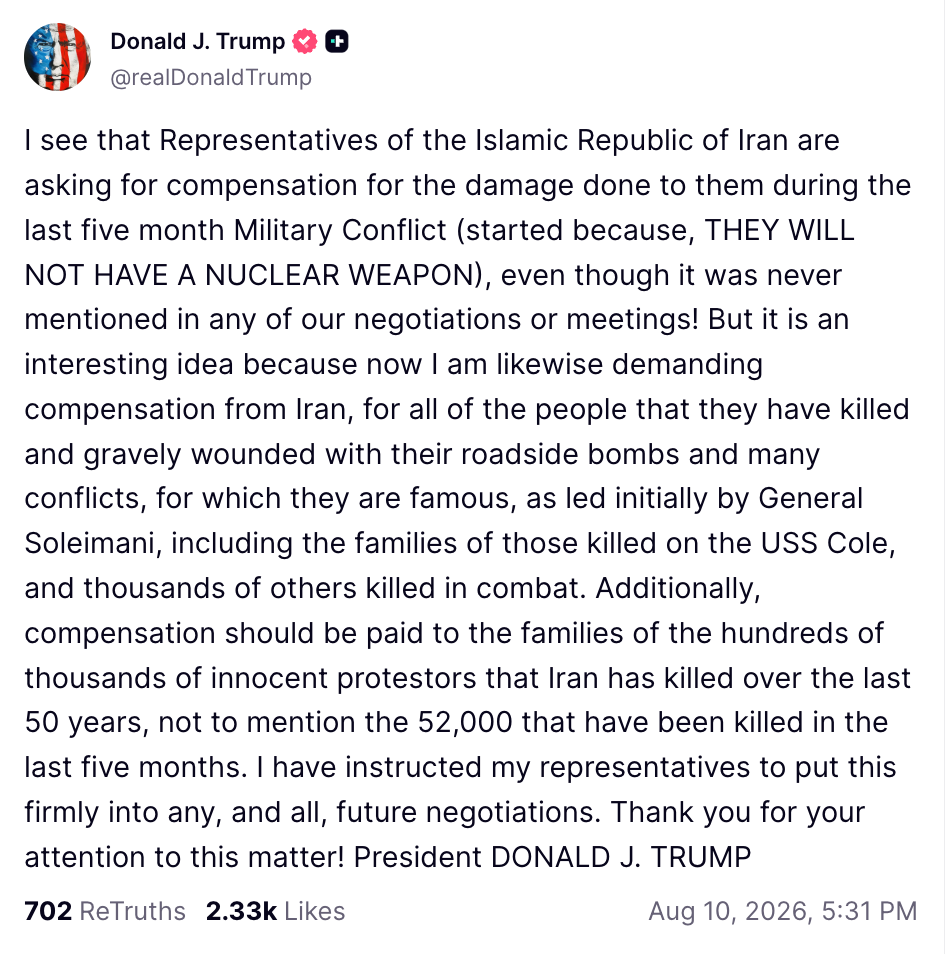
Trump demands compensation from Iran in snub to latest demands
17:51 , James ReynoldsAfter Iran on Saturday demanded the US meet six new conditions, including compensation for the war, before they reopen the Strait of Hormuz, Donald Trump on Monday indicated he was surprised by the terms - and demanded compensation from Iran.
“I see that Representatives of the Islamic Republic of Iran are asking for compensation for the damage done to them during the last five month Military Conflict ... even though it was never mentioned in any of our negotiations or meetings!” he wrote on Truth Social.
“But it is an interesting idea because now I am likewise demanding compensation from Iran ...”
He concluded: “I have instructed my representatives to put this firmly into any, and all, future negotiations.”
Hopes of reopening the Strait appeared less likely in light of the post.
Recap: UAE oil tanker attacked by missile in Strait of Hormuz
17:30 , Alex CroftAs we reported last night, the United Arab Emirates condemned an Iranian missile attack on its carrier as it passed through the Strait of Hormuz, accusing Tehran of "acts of piracy".
State news agency WAM initially reported ADNOC as saying one of its vessels had been targeted by a missile early on Saturday and that the situation was under control.
The UAE Foreign Ministry later condemned what it called "the hostile Iranian attack" on an ADNOC vessel.
Neither statement gave details on the tanker, its cargo or possible damage. No injuries were reported.
The ministry said the attack violated a UN Security Council resolution on freedom of navigation and accused Iran's Revolutionary Guards of "acts of piracy" by targeting commercial shipping and using the waterway as a tool of economic pressure.
Iran appoints new chief of staff and head of IRGC
16:58 , James ReynoldsIran’s Supreme Leader Mojtaba Khamenei has made six new appointments to the Revolutionary Guards and armed forces, according to his social channels.
Those include:
- Major General Pilot Ali Abdollahi as chief of staff of the armed forces;
- Brigadier General Ahmad Vahidi as commander-in-chief of the IRGC.
Recap: Iran says deal in 'final stages' - but reiterates conditions before opening Hormuz
16:29 , Alex CroftTehran said on Sunday that a new deal with Oman defining new shipping lanes in the Strait of Hormuz was in its final stages - but reiterated that the waterway would only reopen if the US meets several conditions.
Agreement between Iran and Oman over the strait, which separates the two countries, is seen as vital to a wider deal to end the war.
One of the conditions being demanded by Tehran is compensation from the US following the launch of its war, alongside Israel, on 28 February.
The secretary of Iran's top national security body, Mohammad Baqer Zolqadr, listed other demands including ending US threats against Iran, stopping aggression against Iran and its Lebanese, Palestinian, Yemeni and Iraqi allies, lifting a blockade and sanctions on Iran and freeing Iranian assets.
Watch: Houthis release video claiming ballistic missile and drone attack on Saudi Arabia
15:30 , Alex CroftYemen's Houthis attack Saudi refinery
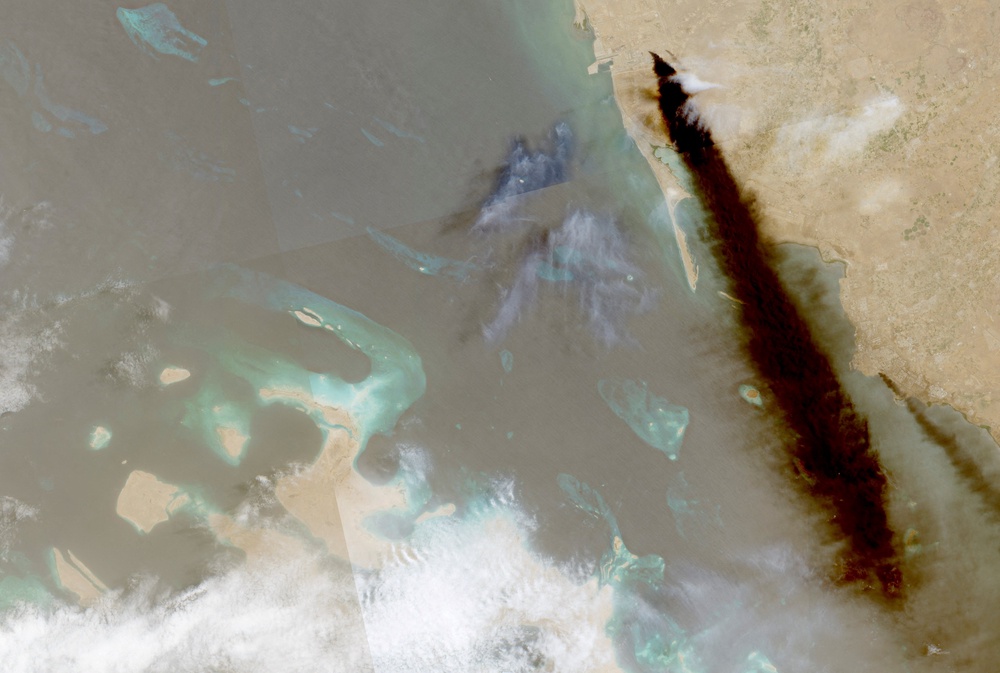
14:27 , Alex CroftYemen's Iran-aligned Houthis say they have struck the Jazan refinery in Saudi Arabia.
The Saudi energy ministry said a fire had broken out at the refinery but was later extinguished with no injuries and authorities were dealing with the incident, without giving a cause.
The Houthis used a drone to target the refinery, military spokesperson Yahya Saree posted on X. They had struck Aramco sites before in Jazan, which processes 400,000 barrels of crude oil per day in southwestern Saudi Arabia. They had also hit Yanbu on the Red Sea.
The Houthis declared a naval blockade against Saudi Arabia in the Red Sea last month, citing what they said was a Saudi siege on them, an allegation Riyadh denies.
In a separate statement, Saree said the Houthis carried out missile and drone strikes on the Yemeni Red Sea port city of Mocha.
The port, controlled by the Aden-based government, is close to the strategic Bab el-Mandeb strait, which links the southern Red Sea with the Gulf of Aden and the Indian Ocean. Should it be closed, Saudi Arabia would be deprived of an alternative to the Strait of Hormuz.
The forgotten Iranians caught in the deadly stalemate of Trump’s war
13:31 , Alex CroftThis article first appeared on our partner site, Independent Persian
“We’re constantly terrified by the sound of explosions. The electricity and water keep being cut off. We are without jobs and have no food. It feels like no one is coming to help the people of southern Iran. We don’t want war.”
These remarks reflect dozens of messages and firsthand accounts received by Independent Persian from residents of the southern provinces of Hormozgan, Bushehr, Khuzestan and Sistan and Baluchestan.
With intermittent US military strikes on southern Iran in recent weeks under a very precarious ceasefire, residents say they are now grappling not only with the threat of explosions but also prolonged power outages, water cuts, internet disruptions, shuttered businesses and a complete lack of meaningful government support.
Read more here:

The forgotten Iranians caught in the deadly stalemate of Trump’s war
Trump has lost his war on geography in the Strait of Hormuz. What now?
12:59 , Alex CroftTrump has committed many diplomatic faux pas, insulted allies and embraced dictators, but he may have dug himself into a hole by attacking Iran and believing it would end just as swiftly as his special operation in Venezuela.
He cannot win without deploying troops on the ground and trying to decisively defeat Iran. He won't concede whatever the costs.
Many governments in the world are livid at Iran for blackmailing them into paying for safe passage, but if anything they are even angrier at Trump for creating the conditions that made it possible. They can't tell him off and risk higher tariffs or withdrawal of security assurances, so they have decided to mull their options.
Solving the Hormuz issue without creating a dangerous precedent has become an impossible task. If Iran can blackmail the global community into paying for safe passage, what's stopping the Houthis from blocking Bab al-Mandab, the vital 20-mile-wide“Gate of Tears" located between Yemen and the Horn of Africa, or anyone else?
Trump might still sing his own praises, but diplomats across the world are holding their heads in their hands, waiting for him to leave the White House and hoping for someone reasonable to come to power.
"He offered a better deal with Iran. Where is it?" a diplomatic source asked me. Trump picked a fight with geography, and he lost. Even if others foot the bill, the Iranian fee may yet become known as Trump’s toll.
Read the full comment piece by Anchal Vohra.
Recap: Netanyahu says Trump's new Gaza plan is unacceptable
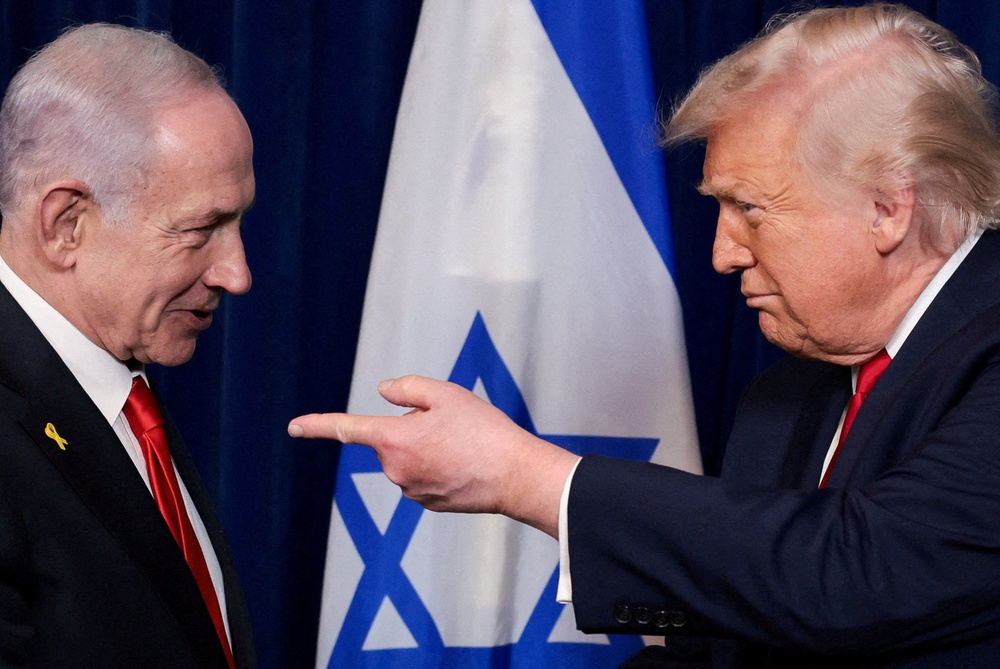
12:28 , Alex CroftIsraeli prime minister Benjamin Netanyahu restated his rejection of Donald Trump's latest Gaza plan in televised remarks to his right-wing government on Sunday, even as Israel's military has effectively halted attacks in the territory under pressure from the US president.
Netanyahu is struggling in the polls as he seeks re-election at a vote due on 27 October but is caught between far-right ministers angered by concessions in Gaza and his key military backer, Trump, who wants progress toward ending the conflict there with a new 15-point roadmap.
Israel has scaled back attacks in Gaza since Monday, when Nikolay Mladenov, the Gaza envoy for Trump's Board of Peace that oversees the ceasefire, met with Netanyahu.
A source familiar with Israel's position said it had agreed that the military would only act against what it perceives as immediate threats in Gaza and no longer carry out targeted assassinations as it had been doing on a near-daily basis. Mladenov said on Sunday that discussions on the new roadmap were ongoing.
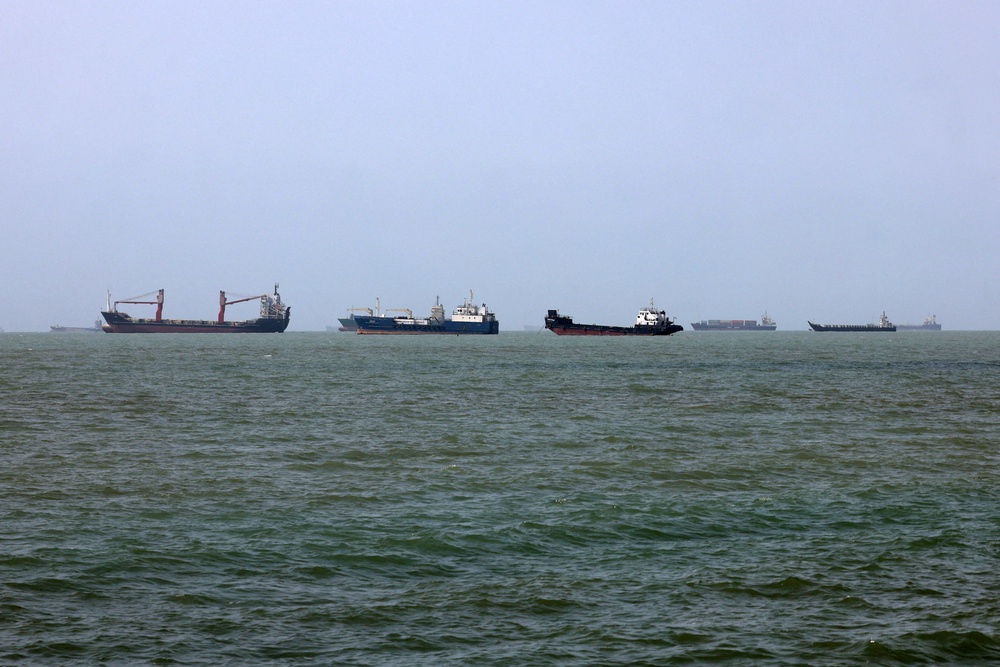
In pictures: Vessels transit Strait of Hormuz near southern Iran
11:56 , Alex Croft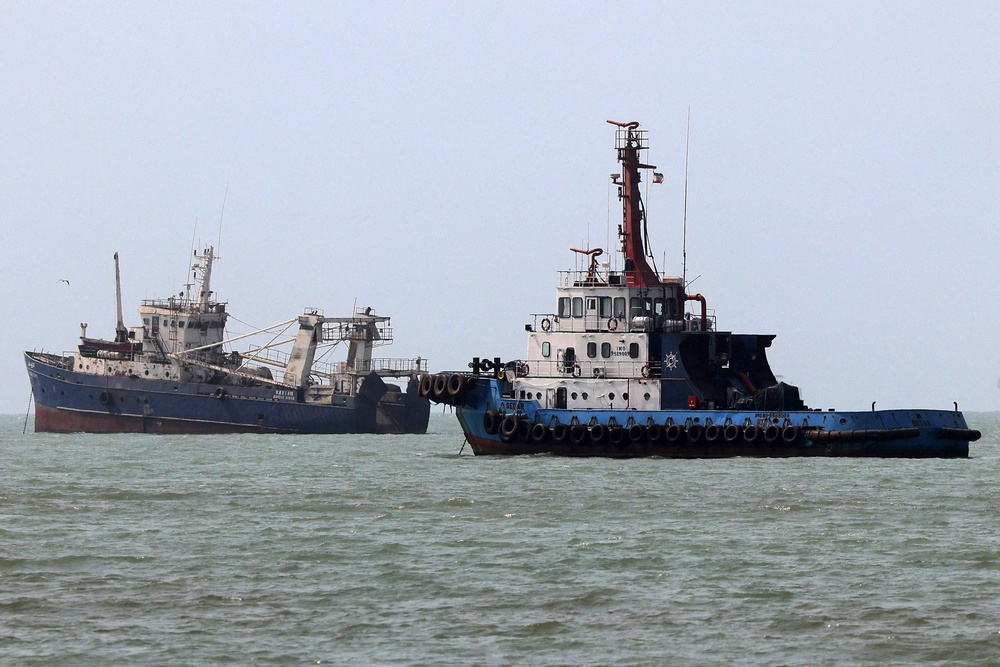
Iran's demands before it opens Strait of Hormuz
11:24 , Alex CroftAs we reported earlier, Mohammad Bagher Zolghadr has been replaced as the secretary of Iran’s Supreme National Security Council and replaced by Revolutionary Guards commander Mohsen Rezaei.
It is unclear whether the change in leadership will impact Iran’s approach to peace negotiations.
Just days before his departure, Zolqadr laid out the six terms Tehran has demanded from the US to reopen the Strait of Hormuz.
- Never, and in no language, threaten Iran or insult the sanctities of this nation.
- Permanently end the war and aggression against Iran and Iran’s allies in Lebanon, Palestine, Yemen and Iraq.
- Lift the naval blockade and withdraw its military forces (naval and air) from around Iran.
- Pay in full, without any reduction, the damages caused to Iran by the two wars of aggression and imposition.
- Lift the unjust and illegal sanctions against the Iranian nation.
- Unconditionally release the blocked and stolen assets of the Iranian people.
Trump foe vows he’s ‘prepared to support a bad deal’ to end war in Iran
10:52 , Alex CroftConnecticut Sen. Chris Murphy tore into Donald Trump’s ongoing inability to reach an agreement to permanently end the war with Iran on Sunday and said that it was increasingly obvious that Trump would be forced to take a “bad” deal to extract the U.S. from the conflict.
But Murphy, speaking on NBC’s Meet the Press on Sunday, told host Kristen Welker that he’d support any effort to end the war at this point — even a “terrible-bad deal” — as traffic continues to be heavily restricted through the Strait of Hormuz and the U.S. has so far been unable to pressure Iran to accept any deal reopening the strait and addressing its nuclear program.
His remarks come as the Wall Street Journal reported on Sunday that the president is considering what would be essentially a concession of defeat on one of his main military objectives — the securing of an agreement to destroy Iran’s remaining nuclear material and put legal restrictions on Iran’s enrichment and development abilities for years to come.
Read more here:

Trump foe vows he’s ‘prepared to support a bad deal’ to end war in Iran
Iran appoints new secretary of top security body
10:23 , Alex CroftIran now has a new secretary of the Supreme National Security Council, after former Revolutionary Guards commander Mohsen Rezaei was appointed as second-in-command on the body that coordinates Tehran’s security and foreign policy.
Rezaei is more of an outspoken public figure than his predecessor, Mohammad Baqer Zolqadr.
President Masoud Pezeshkian's deputy director of communications confirmed the appointment of Rezaei, who is more outspoken than his predecessor Mohammad Baqer Zolqadr, late on Sunday.
Zolqadr had only been appointed as SNSC secretary in late March, after his predecessor, Ali Larijani, was killed in an air strike during the war pitting Iran against the US and Israel.
It is still unclear why the change was made - and if it reflects any change in foreign policy.
Fallout from war in Iran is leaving millions vulnerable to hunger
10:01 , Alex CroftAs the US, Iran and Oman edge towards an interim agreement to reopen the Strait of Hormuz, months of insecurity and disruption are leaving millions more vulnerable to hunger in Yemen.
The economic fallout from the regional conflict has driven up food and fuel prices, while more than four months of conflict with Iran has driven renewed escalation in Yemen, compounding one of the world's worst humanitarian crises.
More than half the population were already facing hunger, but slow progress from world leaders to re-open the Strait has caused months of disruption to global food and energy supplies, disrupting humanitarian aid operations.

Fallout from war in Iran is leaving millions vulnerable to hunger
No concern over Pakistan-Turkey-Saudi pact, says Tehran
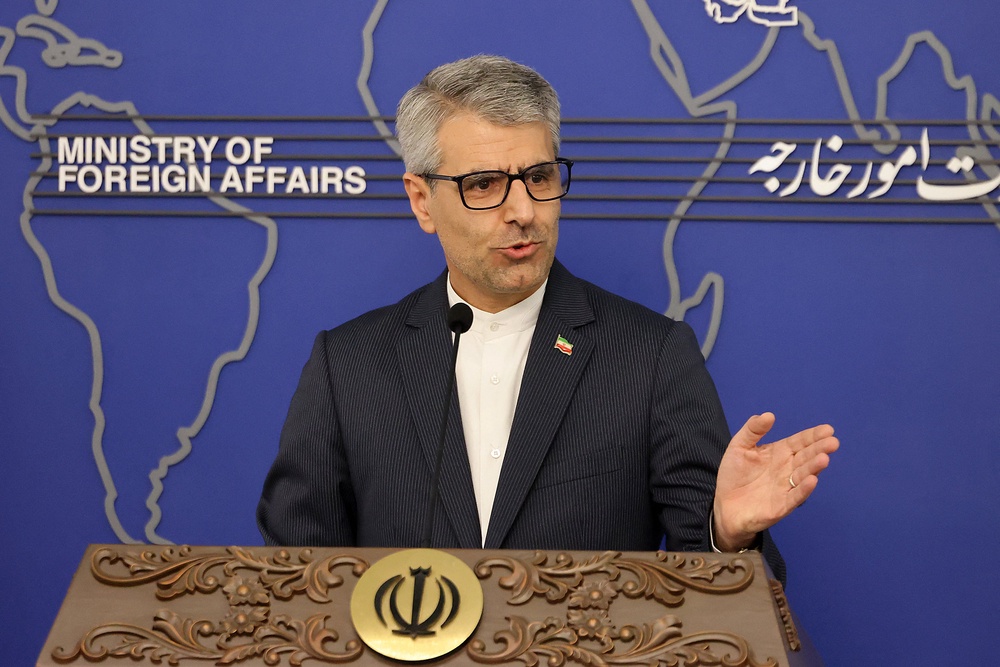
09:12 , Alex CroftWe’ve just heard from Iranian foreign ministry spokesperson Esmail Baghaei, who has been discussing the new security pact signed by Pakistan, Turkey and Saudi Arabia last week.
There is no concern that the pact is directed against Tehran, he said, adding that it shows a shift in approach to regional securities as countries rely more on their own capabilities than outside powers.
He said any plan which “correctly identifies the enemy and the threat” has a chance of helping strengthen regional security and preventing instability and abuses by Israel and its allies.
Watch: Houthis release video claiming ballistic missile and drone attack on Saudi Arabia
08:46 , Alex CroftIran says deal in 'final stages' - but reiterates conditions before opening Hormuz
08:27 , Alex CroftTehran said on Sunday that a new deal with Oman defining new shipping lanes in the Strait of Hormuz was in its final stages - but reiterated that the waterway would only reopen if the US meets several conditions.
Agreement between Iran and Oman over the strait, which separates the two countries, is seen as vital to a wider deal to end the war.
One of the conditions being demanded by Tehran is compensation from the US following the launch of its war, alongside Israel, on 28 February.
The secretary of Iran's top national security body, Mohammad Baqer Zolqadr, listed other demands including ending US threats against Iran, stopping aggression against Iran and its Lebanese, Palestinian, Yemeni and Iraqi allies, lifting a blockade and sanctions on Iran and freeing Iranian assets.
Bulletin | Trump says US is ‘only semi-negotiating’ as Iran talks stall
08:06 , Alex CroftHere’s everything you need to know in just five lines with The Independent’s Bulletin:
Trump says US is ‘only semi-negotiating’ as Iran talks stall
Recap: UAE oil tanker attacked by missile in Strait of Hormuz
07:45 , Alex CroftAs we reported last night, the United Arab Emirates condemned an Iranian missile attack on its carrier as it passed through the Strait of Hormuz, accusing Tehran of "acts of piracy".
State news agency WAM initially reported ADNOC as saying one of its vessels had been targeted by a missile early on Saturday and that the situation was under control.
The UAE Foreign Ministry later condemned what it called "the hostile Iranian attack" on an ADNOC vessel.
Neither statement gave details on the tanker, its cargo or possible damage. No injuries were reported.
The ministry said the attack violated a UN Security Council resolution on freedom of navigation and accused Iran's Revolutionary Guards of "acts of piracy" by targeting commercial shipping and using the waterway as a tool of economic pressure.
Yemen's Houthis attack Saudi refinery
07:26 , Namita SinghYemen's Iran-aligned Houthis say they have struck the Jazan refinery in Saudi Arabia.
The Saudi energy ministry said a fire had broken out at the refinery but was later extinguished with no injuries and authorities were dealing with the incident, without giving a cause.
The Houthis used a drone to target the refinery, military spokesperson Yahya Saree posted on X. They had struck Aramco sites before in Jazan, which processes 400,000 barrels of crude oil per day in southwestern Saudi Arabia. They had also hit Yanbu on the Red Sea.
The Houthis declared a naval blockade against Saudi Arabia in the Red Sea last month, citing what they said was a Saudi siege on them, an allegation Riyadh denies.
In a separate statement, Saree said the Houthis carried out missile and drone strikes on the Yemeni Red Sea port city of Mocha.
The port, controlled by the Aden-based government, is close to the strategic Bab el-Mandeb strait, which links the southern Red Sea with the Gulf of Aden and the Indian Ocean. Should it be closed, Saudi Arabia would be deprived of an alternative to the Strait of Hormuz.
Houthis strike ships at oil chokepoints
06:53 , Namita SinghIranian strikes on Strait of Hormuz shipping have been coupled with increased attacks by its Yemen-based allies, the Houthi rebels, who have targeted ships at another oil chokepoint on the other side of the Arabian Peninsula between the Red Sea and Gulf of Aden.
The Houthis also declared a naval blockade against Saudi Arabia in the Red Sea last month in response to what they said was a Saudi siege on them in Yemen, an allegation denied by Riyadh, which backs Yemen's internationally recognised government.
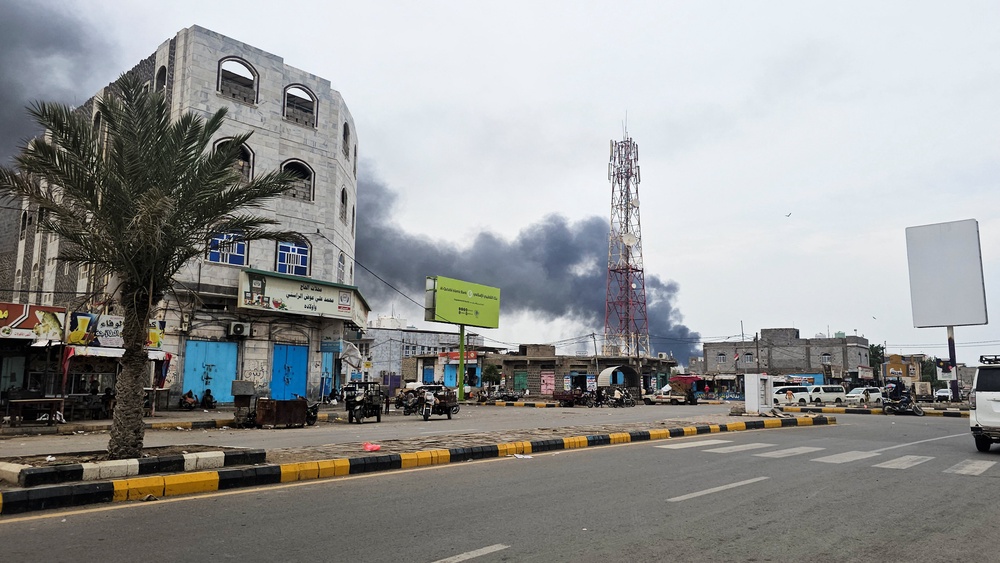
The Yemeni rebel group said they had attacked Saudi Aramco's Jazan refinery on Sunday, two days after the kingdom signed a defence pact with Sunni Muslim allies Turkey and Pakistan in response to growing regional instability from the US-Israeli war on Shi'ite Iran.
The Saudi energy ministry said a fire had broken out at the refinery but was later extinguished with no injuries, without giving a cause.
Turkish foreign minister Hakan Fidan said the new alliance was not directed against Iran or any other country, but rather served as a general pledge to support security.
Fighting has escalated between the Houthis and government forces in Yemen, with the Yemeni military on Monday saying seven people including military personnel and civilians were killed in a Houthi attack on the Red Sea port city of Mocha.
Air defences intercepted and shot down 11 Houthi drones that participated in the attack, the military said.
Yemeni military says Houthi attack on Mocha kills 7, wounds 30
06:17 , Namita SinghThe Yemeni military said seven people, including military personnel and civilians, were killed and 30 others wounded in a Houthi attack on the Red Sea port city of Mocha.
"Four members of the armed forces and three civilians have been killed, and 30 others injured," the Yemeni military said in a statement early on Monday. Air defences intercepted and shot down 11 Houthi drones that participated in the attack, the military said.
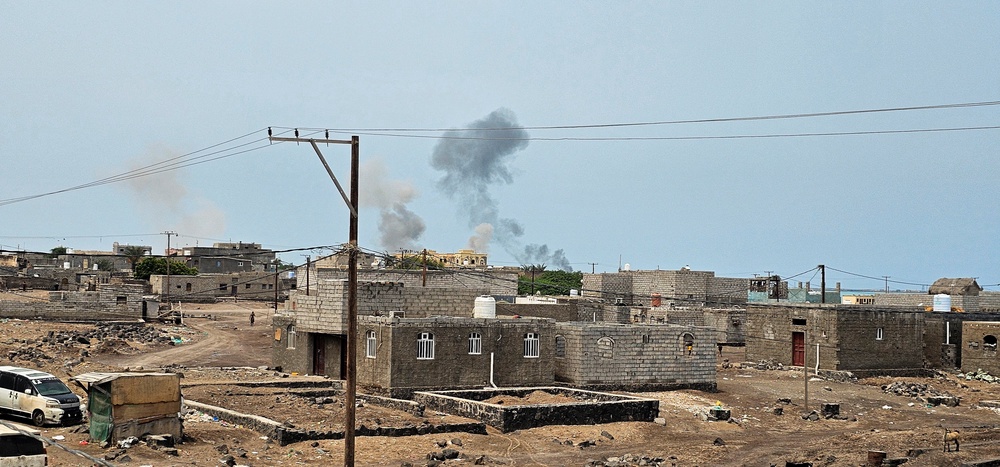
Footage shown by Houthi-affiliated Al Masirah TV showed the launch of several ballistic missiles and drones, which Houthi military spokesperson Yahya Saree said in a post on Telegram targeted Saudi troop concentrations and weapons depots.
The Yemeni military said the Houthi attacks had also targeted residential neighbourhoods in Mocha.
Iran replaces top security chief as Tehran denies direct US talks on ending war
06:08 , Namita SinghIran has appointed a senior commander from its powerful Islamic Revolutionary Guards Corps as its new top security official, in a major reshuffle that comes as Tehran denies holding direct negotiations with Washington to end the war and reopen the Strait of Hormuz.
Mohsen Rezaei, previously an adviser to supreme leader Ayatollah Mojtaba Khamenei, will take over as secretary of the Supreme National Security Council, a spokesperson for president Masoud Pezeshkian said late on Sunday.
He replaces Mohammad Bagher Zolghadr, who resigned from the post and will now serve as a political adviser to Khamenei.
Zolghadr had held the role since March, when his predecessor, Ali Larijani, was killed in an Israeli air strike.
The change at the heart of Iran's security establishment comes amid competing accounts over efforts to bring the conflict to an end.
Foreign minister Abbas Araghchi said Tehran was not engaged in direct talks with the United States over ending the war and reopening the Strait of Hormuz, despite US officials claiming that the two sides were close to reaching an agreement.
Israel and Hamas disagree over timings in Trump’s plan
05:30 , Namita SinghDonald Trump announced last month that there had been a breakthrough in his plan to end the war, to which both Israel and Hamas agreed, with Israeli forces withdrawing as Hamas disarms and an International Stabilisation Force working with a new Palestinian police force to secure the enclave.
But complications have swiftly emerged with questions over the plan's timeline."Israel does not accept the 15-point document," Israeli prime minister Benjamin Netanyahu said at the start of a meeting with cabinet ministers.
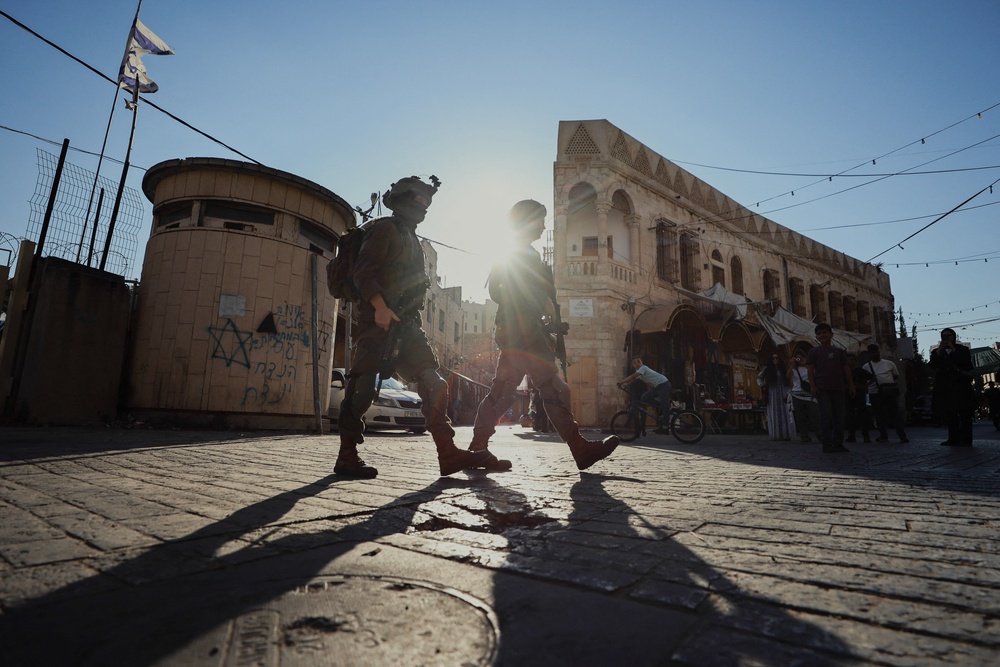
The military "will not carry out any withdrawal until Hamas is disarmed ... it means heavy weaponry, lighter weaponry, all weaponry", he said. Netanyahu made similar remarks in a social media post on Tuesday and Israeli officials have said reservations have been shared with Washington.
He added that Israel was in talks with the United States on the plan. "They (the US) have ideas, some of which are acceptable to us and some of which are unacceptable to us and we know how to stand firm against these things," Netanyahu said.
Basem Naim, a senior Hamas official, told Reuters on Sunday that the group remained committed to the roadmap agreed in Cairo 10 days ago.
"We expect the mediators and the US guarantor to press Netanyahu and his government to adhere to the roadmap and not obstruct the process for internal political and electoral reasons," he said.
Netanyahu says Trump's new Gaza plan is unacceptable
04:45 , Namita SinghIsraeli prime minister Benjamin Netanyahu restated his rejection of Donald Trump's latest Gaza plan in televised remarks to his right-wing government on Sunday, even as Israel's military has effectively halted attacks in the territory under pressure from the US president.
Netanyahu is struggling in the polls as he seeks re-election at a vote due on 27 October but is caught between far-right ministers angered by concessions in Gaza and his key military backer, Trump, who wants progress toward ending the conflict there with a new 15-point roadmap. Israel has scaled back attacks in Gaza since Monday, when Nikolay Mladenov, the Gaza envoy for Trump's Board of Peace that oversees the ceasefire, met with Netanyahu.
A source familiar with Israel's position said it had agreed that the military would only act against what it perceives as immediate threats in Gaza and no longer carry out targeted assassinations as it had been doing on a near-daily basis. Mladenov said on Sunday that discussions on the new roadmap were ongoing.
Houthis attack Saudi refinery
04:32 , Namita SinghIranian strikes on Strait of Hormuz shipping have been coupled with increased attacks by its Yemen-based allies, the Houthi rebels, who have targeted ships at another oil chokepoint on the other side of the Arabian Peninsula between the Red Sea and Gulf of Aden.
The Houthis also declared a naval blockade against Saudi Arabia in the Red Sea last month in response to what they said was a Saudi siege on them in Yemen, an allegation denied by Riyadh, which backs Yemen's internationally recognised government.
The Yemeni rebel group said they had attacked Saudi Aramco's Jazan refinery on Sunday, two days after the kingdom signed a defence pact with Sunni Muslim allies Turkey and Pakistan in response to growing regional instability from the US-Israeli war on Shi'ite Iran.
The Saudi energy ministry said a fire had broken out at the refinery but was later extinguished with no injuries and authorities were dealing with the incident, without giving a cause.
Turkish foreign minister Hakan Fidan said the new alliance was not directed against Iran or any other country, but rather served as a general pledge to support security.
US ‘low-keying’ talks with Iran
04:15 , Namita SinghUS president Donald Trump said in an interview with Axios that the US was "low-keying" it with Iran.
"We are only semi-negotiating with them. We are just watching Iran with its huge inflation and the fact they have no money."
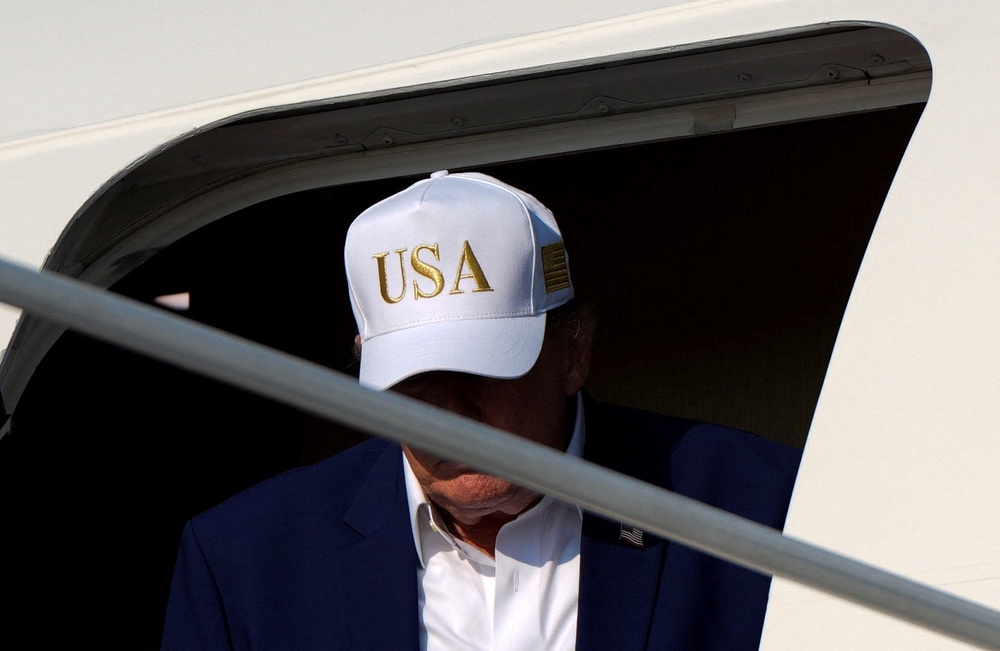
Washington and Tehran agreed to a ceasefire in June, but the US reimposed a blockade on Iranian shipping in the Gulf in July, a move that Tehran said violated the truce, which by then had already broken down.
"Once the deal is announced to restore commercial shipping without impediments, the United States will lift the blockade of Iranian ports," a US official told Reuters on condition of anonymity.
Fallout from war in Iran is leaving millions vulnerable to hunger
04:00 , Maryam Zakir-HussainAs the US, Iran and Oman edge towards an interim agreement to reopen the Strait of Hormuz, months of insecurity and disruption are leaving millions more vulnerable to hunger in Yemen.
The economic fallout from the regional conflict has driven up food and fuel prices, while more than four months of conflict with Iran has driven renewed escalation in Yemen, compounding one of the world's worst humanitarian crises.
More than half the population were already facing hunger, but slow progress from world leaders to re-open the Strait has caused months of disruption to global food and energy supplies, disrupting humanitarian aid operations.
Fallout from war in Iran is leaving millions vulnerable to hunger
Iran says Oman deal on strait is near but sets US conditions
03:52 , Namita SinghIran said it was nearing a final pact with Oman defining new shipping lanes between them through the Strait of Hormuz but repeated that the US must meet other conditions, including compensation and an end to sanctions and military threats, before the strategic waterway is reopened.
A US official told Reuters on Friday that Iran and Oman were close to a deal that could pave the way for restoring safe passage through the strait, a major conduit for oil and gas shipping before Iran blocked Hormuz in response to US and Israeli attacks on Tehran that began in late February.
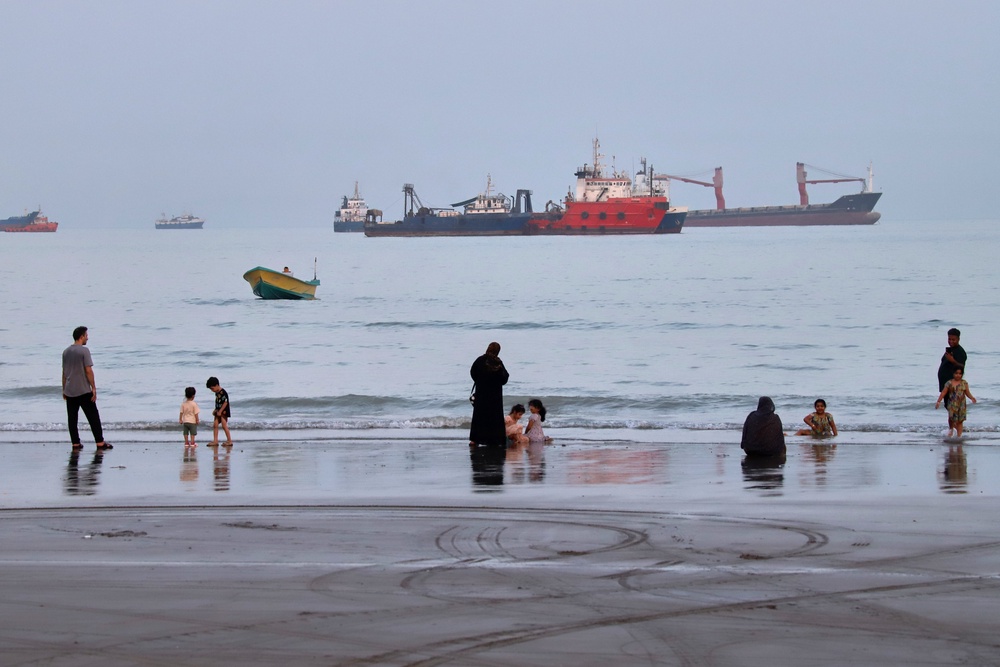
Iranian foreign minister Abbas Araqchi said on Sunday an agreement with Oman on the strait was in its "final stages" but reiterated comments made on Saturday that Tehran would not reopen the channel unless the US met certain demands made by Tehran.
Mr Araqchi said reopening the strait would depend in part on the US paying compensation for damage it caused in widespread attacks on Iran.
The secretary of Iran's top national security body, Mohammad Baqer Zolqadr, also listed ending further US threats against Iran; halting aggression toward Iran and its Lebanese, Palestinian, Yemeni and Iraqi allies; removing a US naval blockade in the Gulf; lifting sanctions on Iran; and releasing frozen Iranian assets.
'We're low-keying it on Iran', says Trump
03:00 , James ReynoldsDonald Trump told Axios on Sunday that he’s “low-keying it” on Iran with talks to end the war still on ice.
The US president signalled that he preferred to allow economic pressure on Iran to mount, as opposed to ordering a new military offensive, with both sides still held at an impasse.
Iran, aware of the impact of delaying the reopening of the Strait of Hormuz, has indicated it is also willing to maintain the status quo until the US concedes to its demands.
“We're only semi-negotiating with them. We're just watching Iran with its huge inflation & the fact they have no money,” Trump told Axios, adding: “It will work out. It always works out. It's like a chess game.”
Iranian foreign minister Abbas Araghchi earlier ruled out a resumption of negotiations with the US until Washington ends its violations of the so-called memorandum of understanding to end the war, according to Iranian media.
Trump foe vows he’s ‘prepared to support a bad deal’ to end war in Iran
02:00 , James ReynoldsConnecticut Sen. Chris Murphy tore into Donald Trump’s ongoing inability to reach an agreement to permanently end the war with Iran on Sunday and said that it was increasingly obvious that Trump would be forced to take a “bad” deal to extract the U.S. from the conflict.
But Murphy, speaking on NBC’s Meet the Press on Sunday, told host Kristen Welker that he’d support any effort to end the war at this point — even a “terrible-bad deal” — as traffic continues to be heavily restricted through the Strait of Hormuz and the U.S. has so far been unable to pressure Iran to accept any deal reopening the strait and addressing its nuclear program.
Read the full story:
Trump foe vows he’s ‘prepared to support a bad deal’ to end war in Iran
US military pushes companies to ‘dramatically accelerate’ weapons production as Iran war burns through supply, memo says
01:00 , Maryam Zakir-HussainThe US is pushing for defence companies to “dramatically” accelerate weapons production as the Iran war drains through their missile supplies, it is understood.
Deputy defence secretary Steve Feinberg gave companies three weeks to lay out how they would “drive significantly faster, more aggressive delivery schedules and/or increased production for critical capabilities.”
“Years-long development cycles are not acceptable,” Mr Feinberg added in the memo, which was obtained by The Washington Post.
“We must dramatically accelerate our program schedules and expand our production capacity now.”

Pentagon pushes to ‘dramatically’ speed production as Iran war burns through weapons