
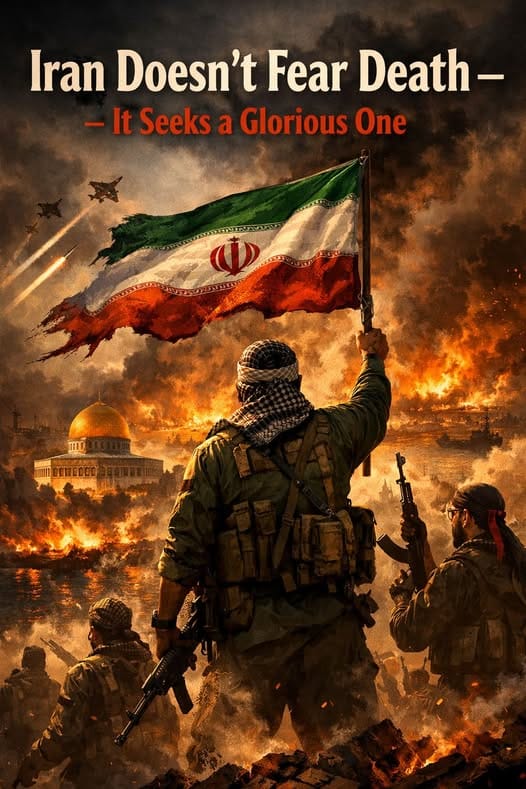
When reduced to its essence, I am entirely convinced that the war involving Iran will never truly end—because Iran, in some profound and unsettling sense, wants to die.
Why would a nation want such a fate?
Because sometimes, what applies to individuals applies equally to civilizations. Some people, and by extension some nations, reach a point where existence itself becomes an unbearable contradiction. They find it too difficult to remain who they are, yet impossible to become something else. Trapped between identity and reality, they begin to long not for survival, but for a meaningful end.
What they seek is not annihilation in the literal sense, but transcendence through destruction—an event, an opportunity, an occasion to go out with a bang, while remaining exactly as they have always been.
For Iran, a war with United States offers precisely that opportunity.
Iran understands the imbalance of power. It knows that in a direct confrontation, it is outmatched militarily, economically, and diplomatically. Yet that is precisely what gives the conflict its allure. In such a war, defeat is not disgrace—it is destiny. And more importantly, it is a destiny that can be framed as heroic.
In this imagined final act, Iran does not see itself as a reckless aggressor, but as a righteous defender. It envisions itself standing firm against a vastly superior adversary, fighting not merely for its own survival, but for a higher cause—for Islam, for the oppressed, for the Palestinians, and for the dignity of a civilization it believes has been humiliated and sidelined.
What more glorious way is there, in this narrative, to go out?
In this war, Iran will strive to do everything “right.” It will allow oil shipments to pass through the Strait of Hormuz for neutral or friendly nations. It will participate in negotiations. It will present itself as measured, rational, even restrained.
But it would be naïve to interpret these actions as genuine attempts at peace.
Rather, they are part of a deeper strategy—one not aimed at avoiding war, but at shaping its moral narrative. Iran does not want to be seen as the arsonist, but as the victim of a fire it could not prevent. When the world eventually looks for someone to blame, it wants the finger pointed squarely at Washington, not Tehran.
Because in the story Iran is telling itself—and hopes the world will one day accept—it is not the villain. It is the martyr.
Peace, in this context, is not a blessing for Iran. It is a burden.
Peace demands compromise, moderation, and ultimately, transformation. It requires Iran to exist within a global order largely defined by others, particularly by the West. It asks Iran to accept limits—to its influence, to its ambitions, to its identity.
And that is precisely what Iran cannot do.
Iran sees itself as something far greater than a mere nation-state. It views itself as an ancient civilization, a torchbearer of Islam, a defender of the Muslim world, and a natural leader in the Middle East. In its own self-image, it deserves not just respect, but reverence.
Yet reality tells a different story.
In the current international system, Iran is, at best, an ordinary power. At worst, it is treated as a pariah—isolated, sanctioned, and contained by Western powers and their allies.
For a civilization that thinks so highly of itself, such a status is intolerable. It is a humiliation that gnaws at the core of its identity.
And for some, humiliation is worse than death.
Faced with this stark choice—endure a diminished and constrained existence, or embrace a catastrophic but meaningful confrontation—Iran appears to lean toward the latter.
War, after all, offers something peace never can: the possibility of redemption.
Through war, Iran can reassert its identity. It can reclaim its narrative. It can transform weakness into moral strength, isolation into defiance, and eventual defeat into eternal glory.
It can die as it believes it was always meant to live—proud, unyielding, and righteous.
In this sense, Iran’s calculus is not entirely irrational. It is rooted in a different kind of logic—one that prioritizes honor over survival, legacy over longevity, and symbolism over pragmatism.
History, after all, is filled with figures and nations that chose destruction over submission. The story of Battle of Thermopylae and the legendary stand of Leonidas I continues to resonate not because it was a victory, but because it was a defiant and heroic defeat.
Iran may well see itself in a similar light.
It may believe that even in destruction, it can achieve a form of immortality—that its sacrifice will echo through history as a symbol of resistance against overwhelming power.
Whether this belief is justified, or whether it is a tragic delusion, is ultimately beside the point.
What matters is that it shapes behavior. It influences decisions. It sustains a trajectory that makes de-escalation increasingly difficult.
And that is why this conflict feels so intractable.
Because it is not merely a geopolitical struggle over territory, influence, or resources. It is, at a deeper level, a struggle over identity, dignity, and meaning.
As long as Iran sees itself as a civilization denied its rightful place, and as long as war offers a path—however destructive—to reclaim that place, the cycle is likely to continue.
Peace, in such a framework, is not an end goal. It is an obstacle.
And until that changes, the possibility of a blaze of glory will remain far more appealing than the quiet, unremarkable drift into the black.
P/S: There is, of course, another side to this equation—one involving the inability of the United States to accept strategic defeat. But that is a discussion for another day.
TheRealNehruism (nehru.sathiamoorthy@gmail.com) is a content creator under the Newswav Creator programme, where you get to express yourself, be a citizen journalist, and at the same time monetize your content & reach millions of users on Newswav. Log in to creator.newswav.com and become a Newswav Creator now!
The User Content (as defined on Newswav Terms of Use) above including the views expressed and media (pictures, videos, citations etc) were submitted & posted by the author. Newswav is solely an aggregation platform that hosts the User Content. If you have any questions about the content, copyright or other issues of the work, please contact creator@newswav.com.