
It is an image that routinely trends across Malaysian social media: the modern airport terminal as a temple of seamless, cosmopolitan freedom. For middle-class travelers flying from Kuala Lumpur to regional destinations, the post-pandemic promise of international travel is one of digital efficiency and borderless fluidness. We are told we live in a hyper-connected, globalized world where talent, culture, and sport rise above the petty squabbles of geography.
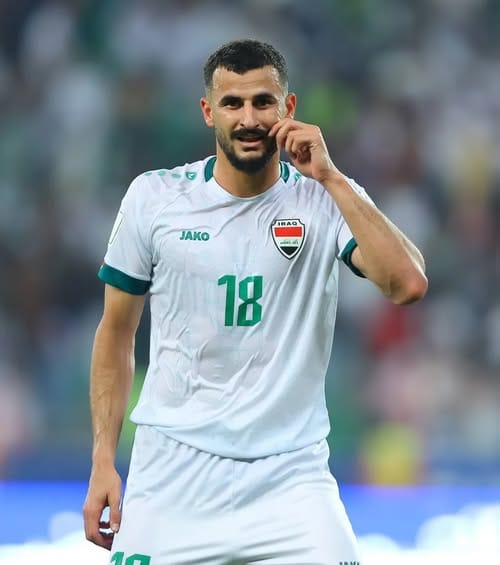
Yet, this veneer of universal accessibility is a fragile luxury, unevenly distributed and fiercely policed. We saw a chilling manifestation of this global truth when Iraqi World Cup striker Aymen Hussein was detained and interrogated for nearly seven hours upon his arrival at Chicago’s O'Hare International Airport. For seven exhausting hours, a national icon the talismanic forward whose historic goals broke a 40-year drought to secure Iraq's spot in the 2026 FIFA World Cup was isolated from his team, his mobile phone subjected to an invasive digital forensic audit.
To a casual observer, it might look like a standard administrative speedbump. But for global onlookers, and particularly for readers in nations that navigate the complex waters of post-colonial identity, Hussein’s grueling ordeal at the gateway of the "Land of the Free" exposes a much darker reality. It reveals how international borders remain deeply weaponized, operating on deep-seated biases that sport can mask, but never truly erase.
When the Beautiful Game Hits the Bureaucratic Wall
The setup was supposed to be a celebration of sporting triumph. The Iraqi national football team landed in Chicago to finalize their preparations for a tournament co-hosted by the United States, Canada, and Mexico. Fans had gathered in the early hours of the morning, waving flags and singing, desperate to catch a glimpse of the heroes who had defied decades of geopolitical strife to reach football's grandest stage.
Instead, as the rest of the squad cleared customs, Hussein was singled out for intensive secondary screening. According to local reports, the Iraqi delegation was forced to return to its base camp without their leading forward, leaving the 30-year-old athlete alone with immigration officials. Even more severe was the fate of national team photographer Talal Salah, who was interrogated for over 10 hours before being outright denied entry due to vague "vetting concerns."
From an analytical standpoint, this separation of elite athletes from their support staff looks less like a routine security check and more like a systematic exercise in institutional intimidation. A spokesperson for U.S. Customs and Border Protection later defended the actions as a “routine part of CBP’s inspection process to verify information and determine admissibility,” emphasizing that all travelers are vetted on a case-by-case basis. However, framing a seven-hour isolation and a total digital search of a high-profile, internationally vetted athlete as "routine" assumes a baseline of suspicion that is rarely applied to Western sports stars traveling under different passports.
The Digital Strip-Search and the Architecture of Suspicion
In the 21st century, a smartphone is no longer just a communication device; it is an externalized archive of the human soul. It holds our private conversations, our family photographs, our financial records, our political views, and our religious beliefs. To subject an individual to a comprehensive phone search at a border crossing is to perform a profound psychological and digital strip-search.
For someone like Aymen Hussein, whose life narrative is deeply scarred by the violent fallout of foreign intervention, this invasion carries an unbearable weight. Hussein is a man whose personal history mirrors the collective trauma of his homeland: his father was killed in an al-Qaeda attack, and his brother was kidnapped by the Islamic State during the chaos that followed the 2003 U.S.-led invasion of Iraq.
There is a cruel, tragic irony at play here. The very nation whose foreign policy decisions destabilized Hussein’s childhood home is the same nation that, decades later, detains him at its border, viewing his history not as a source of profound empathy, but as a checklist of national security red flags. This analysis suggests that within Western institutional frameworks, the victims of global instability are perpetually re-traumatized by the very systems that claim to police global safety.
A Pattern of Exclusion in the Shadow of the World Cup
Hussein’s experience is far from an isolated incident; rather, it represents the tip of a deeply entrenched iceberg of systemic exclusion plaguing this iteration of the World Cup. As the global tournament gets underway, the friction between FIFA’s idealized vision of unity and the harsh realities of Western immigration policy has erupted into open controversy.
The Iran Football Federation recently leveled accusations of “vindictive behavior” against the United States following targeted visa denials for managerial and administrative staff. The Iranian squad was hit with severe travel constraints, forcing them into a bizarre logistical nightmare where they are required to enter and leave the U.S. on the exact same day as their matches, effectively eliminating any hope of establishing a stable training camp on American soil. U.S. Secretary of State Marco Rubio openly noted that the Iranian delegation would be heavily monitored for any potential links to the Islamic Revolutionary Guard Corps, signaling that geopolitics will firmly dictate the boundaries of the playing field.
Furthermore, this institutional gatekeeping extends past the pitch to the media corps trying to document it. The International Sports Press Association issued an urgent, scathing letter to FIFA protesting the widespread denial of visas to accredited journalists from African and Middle Eastern nations. Association President Gianni Merlo condemned the "countless and unacceptable" cases of journalists receiving restrictive, single-entry visas. This creates a logistical trap: if a Global South journalist follows their national team across the border to matches in Canada or Mexico, they are effectively barred from returning to the United States to cover the rest of the tournament.
The Illusion of the Equal Playing Field
For Malaysian readers, these systemic hurdles resonate on a profound cultural level. We live in a society that prides itself on passport mobility, yet we remain acutely aware of how quickly international doors can slam shut based on religious, cultural, or national background. When a Western superpower hosts a truly global event like the World Cup, it enters into a tacit cultural contract with the international community: the promise to provide an open, fair, and non-discriminatory environment for all participants.
When immigration authorities use administrative vetting to systematically dismantle the support staff of Middle Eastern teams, disrupt their psychological preparation, and lock out their media representatives, the integrity of the tournament itself is compromised. It forces an uncomfortable assumption: is the World Cup truly a celebration of global humanity, or is it an elite Western showcase where teams from the Global South are merely tolerated guests, subjected to rigorous surveillance the moment they step off the aircraft?
The institutional defense will always rest on the absolute sovereignty of national borders. But when that sovereignty is enforced with an aggressive lack of empathy against athletes who have overcome insurmountable odds to represent their people, it exposes the deep hypocrisies of our modern global institutions. It tells us that despite our shared love for the game, some passports are still viewed with automatic dignity, while others are viewed as inherent threats.
What do you think? I’d love to hear your opinion in the comments section.
When Aymen Hussein finally walked out of that Chicago airport terminal after seven hours of intense isolation, he was greeted by the loud cheers of the Iraqi diaspora. They did not care about the institutional suspicions or the security profiles; they saw a young man who carried the hopes, the resilience, and the battered pride of a nation on his shoulders. He will lace up his boots and take the pitch against the world's best, battling through the exhaustion of administrative bias to do what he does best: score goals and unite his people.
Yet, the collective memory of that interrogation room will linger long after the final whistle blows. It serves as a stark, poetic reminder that the playing fields of our world are never truly level. The borders we cross do not just measure geographic distances; they measure the deep, unresolved cultural divides and structural inequalities that continue to split our global community apart. True global unity will not be achieved when we simply invite the world to play on our pitches; it will only be realized when we learn to respect their dignity at our gates.
AM World (tameer.work88@gmail.com) is a content creator under the Newswav Creator programme, where you get to express yourself, be a citizen journalist, and at the same time monetize your content & reach millions of users on Newswav. Log in to creator.newswav.com and become a Newswav Creator now!
The User Content (as defined on Newswav Terms of Use) above including the views expressed and media (pictures, videos, citations etc) were submitted & posted by the author. Newswav is solely an aggregation platform that hosts the User Content. If you have any questions about the content, copyright or other issues of the work, please contact creator@newswav.com.