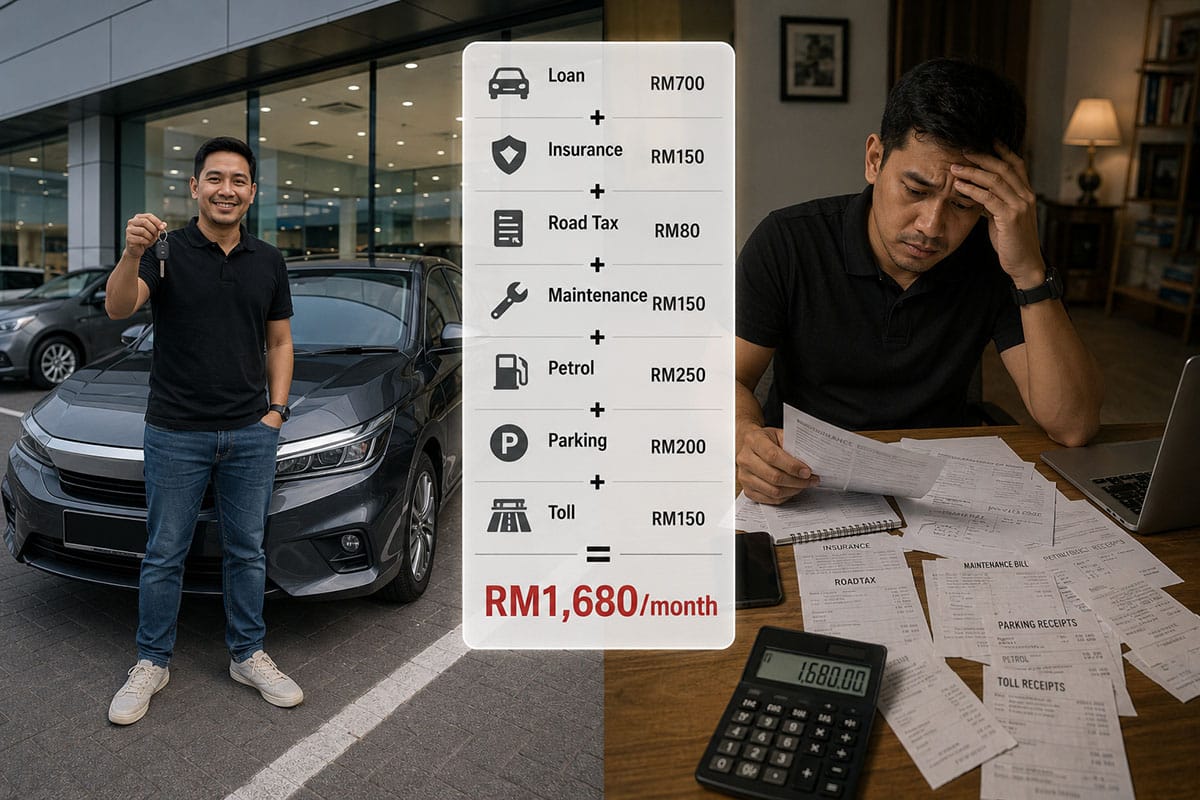
The monthly instalment is just the beginning. The real cost of a new car in Malaysia will surprise you.
Let me tell you about a friend of mine.
He was driving a Perodua Myvi. Reliable, fuel-efficient, easy to park, cheap to maintain. By every objective measure, it was doing everything a car is supposed to do. Getting him from home to the office and back, five days a week, without complaint.
Then he got promoted to manager.
Within a few months, the Myvi was gone. In its place sat a brand new sedan, financed over nine years, at a monthly instalment that would have made his previous self wince. His reason, stated plainly and without embarrassment: "I'm a manager now. I can't be seen driving a Myvi."
I genuinely did not know what to say to that. And I have thought about it many times since.
The Real Cost Nobody Adds Up Before Signing
Most Malaysians decide whether they can afford a car by looking at one number. The monthly instalment. If it fits inside the budget, the deal gets done.
What they rarely calculate is everything else.
Owning a car in Malaysia costs approximately RM13,000 to RM15,000 per year when you add up all the actual costs, not just the loan repayment. For a RM60,000 car on a seven-year loan, here is what the monthly picture actually looks like beyond the instalment:
Insurance runs between RM1,000 and RM2,500 per year depending on the car, your age, and your no-claim bonus. Road tax varies by engine size. Servicing and maintenance should be budgeted at RM100 to RM200 per month as a baseline. Parking fees in urban areas easily add RM150 to RM400 per month. Tolls for regular commuters run between RM100 and RM250 per month. And petrol, even with the Budi95 subsidy keeping eligible Malaysians at around RM2.05 per litre, adds another RM200 to RM350 monthly for a typical urban driver.
Add all of that to a monthly instalment of say RM700 and you are looking at total transportation costs of RM1,500 or more per month. On a median Malaysian salary of RM3,000. That is 50% of take-home pay spent on a depreciating asset that gets you from point A to point B.
The Depreciation Rate
Here is the part of the new car conversation that is almost never part of the conversation at the showroom.
A new car in Malaysia loses up to 20% of its value in the first year alone. A car that cost RM100,000 today is worth roughly RM80,000 by the time it has been on the road twelve months. And the drop continues every year after that. New cars can lose up to 50% of their value within three years, which means a RM100,000 car you are still paying a loan on could be worth RM50,000 while you still owe the bank significantly more.
Luxury brands depreciate fastest of all. BMW and Mercedes models can lose 25% or more in the first year. Ironically, the cars most associated with financial success are often the worst financial decisions in the Malaysian market.
The one national exception worth noting: the Perodua Myvi consistently has the best resale value retention among national cars. The very car my friend abandoned for status reasons.
The Nine-Year Loan Trap
A 9-year loan looks cheaper monthly but costs around RM6,480 more in interest compared to a 5-year loan. You also end up still paying for a car that has depreciated substantially by the time the loan is settled. In some cases, Malaysians find themselves in negative equity, owing more on the loan than the car is actually worth.
The Hire Purchase Amendment Act 2026, which took effect on June 1 this year, abolished the flat rate and Rule of 78 method that banks previously used to calculate early settlement penalties. This is genuinely good news for borrowers who want to pay off their car loans early. If you have an existing car loan, it is worth checking with your bank whether you can now settle early on more favourable terms.
The Secondhand Alternative That Most Malaysians Overlook
Here is where I will be transparent about my own thinking on this.
My 2013 Perodua Alza is fully paid and still running well. It does everything I need a car to do. It gets my family to where we are going. It carries groceries. It covers work trips. It is not flashy, and it is absolutely not a status symbol. It is a vehicle, which is what a car is supposed to be.
I do need a second car given my current work situation. But when that happens, it will be a secondhand purchase, fully paid in cash upfront. No new loan. No new monthly commitment. No new insurance premium at new-car rates. A reliable used car at two or three years old, where the first owner has already absorbed the steepest depreciation curve, bought at market rate with no bank involved.
Over 60% of Malaysian car buyers already opt for pre-owned vehicles due to affordability. Used cars depreciate at around 10% annually compared to 20% for new ones. Insurance premiums for used cars run 20 to 30% lower than for new cars of equivalent size. The financial case for buying used is not a compromise. It is often the smarter decision when the numbers are laid out honestly.
Platforms like Carsome and Carro have made the used car buying process significantly more transparent and trustworthy than it used to be, with inspections, certified conditions, and price comparisons that remove much of the historical anxiety around buying secondhand in Malaysia.
Public Transport: Better Than It Was, But Still Not Enough
For Malaysians living and working in the Klang Valley, the MRT, LRT and Rapid KL bus network has genuinely improved. For certain routes and certain lifestyles, it is possible to substantially reduce car dependency.
But the honest reality is that Malaysia is still fundamentally designed around car ownership. Most residential areas, particularly those built before 2010, are not walkable from transit stations. The last-mile connection between a station and your actual home or workplace often requires a car, a Grab, or a very long walk in very hot weather.
The practical compromise most urban Malaysians have landed on is a hybrid approach. Drive to the nearest LRT or MRT station, park, and take public transport for the urban portion of the journey. It is not car-free living. But it does reduce fuel costs, toll costs, and parking costs for the city centre segment of a daily commute. My own experience reflects this exactly.
What About Electric Vehicles?
Malaysia's EV infrastructure has expanded remarkably quickly. Charging stations are now genuinely accessible at shopping malls, office buildings, hotels, and highway rest stops in most urban and suburban areas. Proton and Perodua now both offer EV options at more accessible price points than the early wave of premium imports.
The kW-based road tax structure for EVs introduced in 2026 makes annual ownership costs significantly lower, typically 85% cheaper on road tax than an equivalent petrol car. The argument for EVs on a total-cost-of-ownership basis is getting stronger every year.
That said, for someone like me who drives an older Alza that runs perfectly well and carries no loan, the calculus for switching to an EV does not yet make financial sense. A new EV purchase, even a more affordable one, means taking on a new loan or a large cash outlay. For a family managing on unpredictable freelance income, that is not the right move right now regardless of how good the technology has become.
The EV conversation in Malaysia is genuinely exciting. But it should not be entered the same way many Malaysians enter the new car conversation: based on trend rather than honest financial assessment.
My Take
A car is a tool. Its job is to get you where you need to go safely and reliably. Beyond that, everything else is optional.
The manager who replaced his Myvi with a sedan to match his job title is now paying for a decision he made based on how he wanted to be perceived rather than what he could genuinely afford. I do not know the full details of his financial situation. But I know what a nine-year car loan at Malaysian interest rates costs over its lifetime, and I know what the Myvi he gave up would have been worth by now in terms of zero debt, low insurance, and the quiet financial freedom of owning your transport outright.
A car that impresses people at the traffic light while draining your bank account every month is not a status symbol. It is a very expensive version of caring what strangers think of you.
Get from A to B. Keep the money. That is the whole strategy.
Kamarul Azwan (k.azwan@gmail.com) is a content creator under the Newswav Creator programme, where you get to express yourself, be a citizen journalist, and at the same time monetize your content & reach millions of users on Newswav. Log in to creator.newswav.com and become a Newswav Creator now!
The User Content (as defined on Newswav Terms of Use) above including the views expressed and media (pictures, videos, citations etc) were submitted & posted by the author. Newswav is solely an aggregation platform that hosts the User Content. If you have any questions about the content, copyright or other issues of the work, please contact creator@newswav.com.