One in four Malaysians now freelances. But the income reality is far quieter than the freedom narrative.
Nobody plans to become a freelancer. They get pushed into it, pulled toward it, or slowly realise that the traditional career path they were on was not going where they thought it was.
The official numbers suggest this is happening at scale. Nearly one in four Malaysian workers has engaged in some form of gig or informal work, and 26% of the workforce is now engaged in freelancing or contract-based jobs. The Gig Workers Act 2025 extended protections to approximately 1.2 million freelancers, signalling that the government has officially acknowledged what the employment market already knew: freelancing is no longer a side arrangement for a few. It is a mainstream career reality for hundreds of thousands of Malaysians.
But official recognition and financial stability are two very different things. And the gap between them is where most freelancing stories get complicated.
How Most Malaysians Actually End Up Freelancing
There are two kinds of freelancers in Malaysia. The ones who planned it and the ones who were pushed into it.
The planned ones are the minority. They spent months building a client base before resigning, saved six months of expenses as a buffer, and made the leap with their eyes open and a spreadsheet ready.
The majority end up freelancing because something changed. A retrenchment. A company closure. A toxic workplace that made staying impossible. Or simply the realisation after enough years that the corporate path was leading somewhere they did not want to go.
I fall into the second category. I was retrenched in December 2025. And while I had always done freelance writing and marketing work on the side during my employment years, going fully independent was not the plan. It was the circumstance.
What followed was the very real experience of building something from scratch while simultaneously paying bills that do not pause for your business to figure itself out. The freedom is genuine. The financial instability is equally genuine. Both exist at the same time and you learn to hold them together without letting either one dominate your thinking for too long.
The Income Reality Nobody Talks About Honestly
Most conversations about freelancing in Malaysia focus on the upside. Set your own hours. Choose your clients. Work from anywhere. Be your own boss. All of that is true.
What gets less airtime is the part where the client who owes you three months of retainer fees sends another email asking to push the timeline. Or the month where two projects fall through simultaneously and you are doing the mental maths on which bill to prioritise. Or the quiet anxiety of a Sunday evening when Monday brings no office to go to, no meeting to attend, and no external structure to tell you what to do with your time.
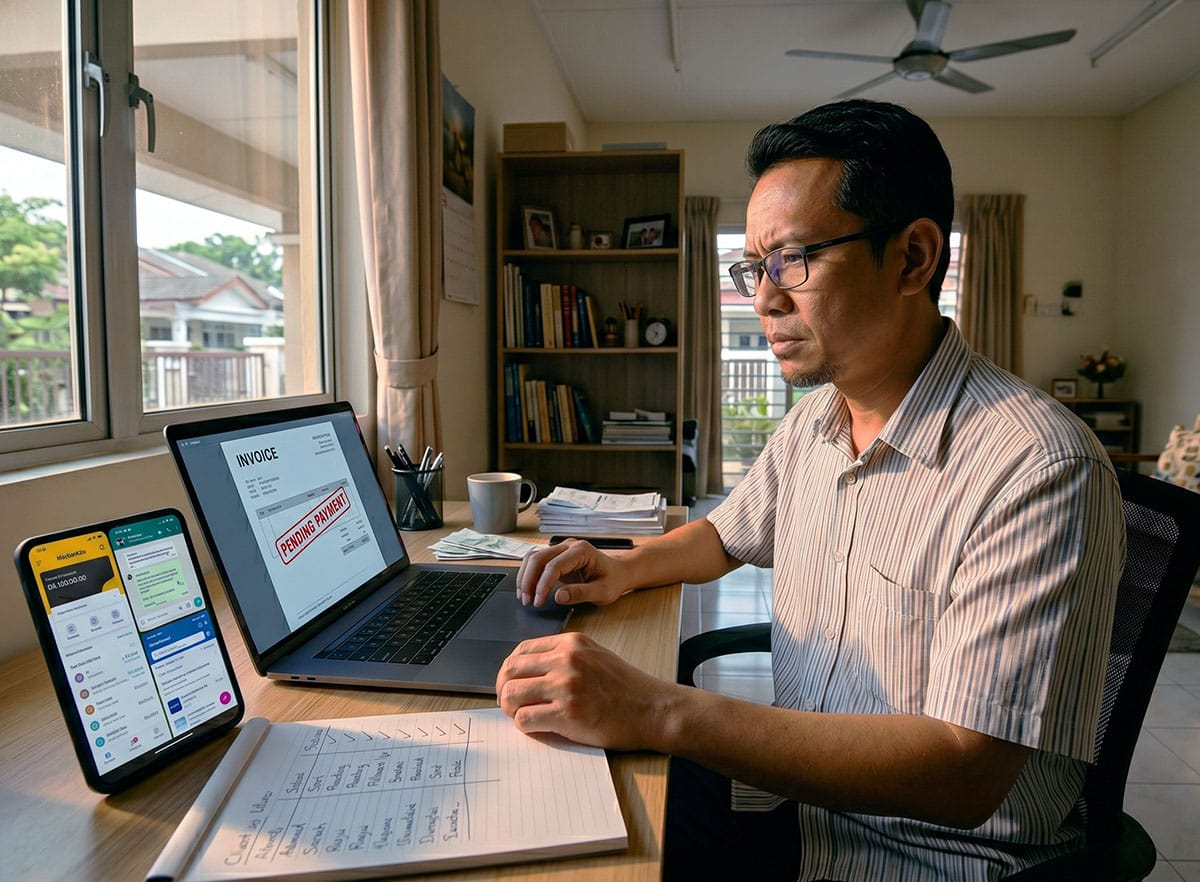
Freelancing income is not a salary. It does not arrive on the 25th of every month regardless of what happened that week. It arrives when the work is delivered, the invoice is sent, the client approves it, the payment cycle processes, and nobody has gone on leave or decided to "review the budget." That chain has more links than most people anticipate.
The practical response to this is to never rely on a single income stream. My own income currently comes from Creative Mojo client work, content writing for various platforms, sponsored posts on my blog, and affiliate marketing on TikTok. None of these individually covers everything. Together, they patch something that resembles a working income.
That diversification is not optional for most freelancers. It is survival mathematics.
The Skills That Actually Matter
There is a common assumption that freelancing success is about having a strong technical skill. A good designer, a good developer, a good writer. Technical skills matter, of course. But they are the minimum requirement, not the differentiator.
What separates Malaysian freelancers who build sustainable income from those who struggle is almost always a combination of people skills and marketing instinct.
You have to be able to sell yourself without appearing to be selling yourself. You have to write cold emails that actually get replies. You have to walk into a client meeting and immediately understand what they are trying to solve, not just what they asked for. You have to know when to push back on a brief and when to deliver exactly what was requested without editorial commentary.
For me, Creative Mojo targets small companies and SMEs specifically because they cannot afford large marketing agencies but still need professional marketing support. That is a conscious niche decision, not an accident. The market is saturated with marketing agencies. But the pool of agencies willing to work at SME budgets with genuine strategic input, not just templated social media posting, is smaller than people think. Finding and owning that gap is what keeps the business viable.
The extrovert-introvert switch is also real. As a naturally more reserved person, I have had to consciously develop the ability to turn on a more outwardly engaging mode for client meetings and pitches, and then turn it back off when I am alone doing the actual work. Most freelancers who have been at it for a while develop this same gear change. It is not fake. It is professional adaptability.
The "So Where Are You Working Now?" Problem
Here is the social dynamic that every Malaysian freelancer navigates and rarely discusses in public.
When you tell people you run your own business, two things happen simultaneously. First, they assume you are doing well financially, because in Malaysian culture, running your own business implies success and independence. Second, you have no simple answer to the most common small talk question in the country: where do you work?
The honest answer, "I run a small marketing consultancy and I am still building the client base and some months are better than others," is both accurate and socially exhausting to explain at every family gathering or social event.
So most freelancers default to "I'm doing okay lah" and move the conversation along. The burden is carried quietly. The image is managed carefully. And the real financial picture stays private, not out of dishonesty, but because nobody wants their daily stress to become a topic for collective family discussion.
According to the Malaysian Employers Federation, the cultural expectation that a "real job" comes with an employer, a payslip, and EPF contributions remains deeply embedded in Malaysian society. Going against that expectation requires a certain internal steadiness that not everyone has in the early months of freelancing.
The Practical Starting Points
If you are considering freelancing seriously, here is what to do before you take the leap.
Register your business with SSM through the EzBiz portal. A sole proprietorship under your own name costs RM30, under a trade name costs RM60, and the process is entirely online. This is not optional paperwork. It legitimises your business, lets you invoice professionally, and opens up the ability to claim business expenses as tax deductions.
Understand your tax obligations from day one. As a freelancer, you file Form B instead of Form BE and you are responsible for your own tax contributions. The good news is that internet bills, equipment, software subscriptions, and home office costs are all deductible as business expenses. Keep every receipt.
Have at least three to six months of personal expenses saved before going fully independent. Not to invest. Not to spend on the business. Just to cover rent, food, and utilities while the income pipeline builds. The single biggest reason Malaysian freelancers give up in the first year is running out of runway before the business has time to find its footing.
And accept early that the first clients will not be your dream clients. They will be the clients who say yes. Work with them professionally, deliver beyond what they expected, and use the results to build the portfolio and reputation that attracts better clients over time.
Who Should and Should Not Freelance
Freelancing is right for people who are genuinely skilled in something that businesses need, resilient enough to keep going through the quiet months, disciplined enough to work without external structure, and honest enough with themselves to know when something is not working and change it.
It is not the right move for people who are escaping a bad job without a plan, who need the certainty of a fixed income to function, who are still developing the core skills their market is paying for, or who are expecting the freedom of freelancing without accepting the responsibility that comes with it.
The freedom is real. So is the accountability. They come as a package and you cannot opt out of the second one while keeping the first.
My Take
Almost a year into running Creative Mojo independently, the honest summary is this. The work-life balance is genuinely better. The financial stress is genuinely harder. Both of those things are true at the same time and I do not expect that tension to fully resolve for another year or two.
What keeps me going is the belief that the foundation being built now, the clients, the reputation, the multiple income streams, compounds over time the same way a good investment does. It is just slower and lonelier than employment, and requires a tolerance for uncertainty that I am still actively developing.
If you are considering freelancing, go in with a plan, a buffer, and a very honest conversation with yourself about how long you can sustain the uncertainty before it starts affecting your mental health and your relationships.
The freedom is worth it. Just make sure you are ready to earn it.
Kamarul Azwan (k.azwan@gmail.com) is a content creator under the Newswav Creator programme, where you get to express yourself, be a citizen journalist, and at the same time monetize your content & reach millions of users on Newswav. Log in to creator.newswav.com and become a Newswav Creator now!
The User Content (as defined on Newswav Terms of Use) above including the views expressed and media (pictures, videos, citations etc) were submitted & posted by the author. Newswav is solely an aggregation platform that hosts the User Content. If you have any questions about the content, copyright or other issues of the work, please contact creator@newswav.com.