

In July this year, a former Japanese minister who was involved with India’s first bullet train project publicly blamed New Delhi for the delay in its implementation and accused the country of “pushing their own self-interest”.
Hideki Makihara, who was Japan’s justice minister during his time in government, wrote on X (formerly Twitter): “The Shinkansen project in India is something I was involved with myself, but what stood out in international meetings and negotiations was the sheer recklessness of the Indian side, repeated over and over.
“They just don’t keep promises, no matter what. Even if they make a promise, they flip it right away. They keep pushing their own self-interest right up to the very end .... For the honour of all Japanese folks who poured their hearts into this, I have to say it: I feel 100 per cent that the reason this hasn’t moved forward is entirely the Indian side,” he wrote.
The two countries agreed in 2015 to build a high-speed railway between the Indian cities of Mumbai and Ahmedabad, backed by favourable Japanese financing.
Nearly a decade after construction was launched, the 508km-line is yet to carry a single passenger. Services are now expected to begin on an initial stretch in 2027, years behind the original schedule.
The delays have tested a project that was meant to showcase the countries’ growing strategic partnership.
But the disagreement is no longer just about when the railway will open. It has become a dispute over the technology India should use, the role Japanese companies would play and how far New Delhi should go in developing its own high-speed rail industry.
Another feather in PM Modi and the Reel Minister's cap.
— Pawan Khera 🇮🇳 ಪವನ್ ಖೇರಾ (@Pawankhera) July 17, 2026
A former Japanese minister who was personally involved in the India–Japan Shinkansen project has claimed that, despite Prime Minister Takaichi's visit, the project failed and that Japan was excluded from the signalling… https://t.co/3ISN6NuhmN
India rejected Makihara’s criticism at the time, with foreign ministry spokesperson Randhir Jaiswal describing the remarks as a personal opinion that was at “considerable variance with the facts”. He said the discussions between the two countries were progressing well.
In September, a senior Japanese official was quoted as saying by The Hindu newspaper that the rate of progress on the Mumbai-Ahmedabad high-speed rail corridor project had not “lived up to” Japan’s initial expectations. But he added that now the work was going on at a steady pace.
The public statements, however, exposed a deeper disagreement over the project’s direction.
Japan had expected to supply a largely integrated Shinkansen system, while India increasingly wants to combine Japanese expertise with domestically developed trains and internationally standardised signalling technology.
Japan’s Shinkansen trains are known for their speed, reliability, and safety. Japan would also provide technology and a loan covering about 81 per cent of the original estimated cost. The loan, channelled through the administrative agency Japan International Cooperation Agency (JICA), carries an interest rate of 0.1 per cent and is repayable over 50 years.
The project was conceived as a centrepiece of Indian prime minister Narendra Modi’s efforts to modernise India’s rail network. The government said in a statement in 2017, “the new Shinkansen Technology by the Japanese shall ensure more growth opportunities”.
“The cost will go down further as the technology will grow massively and it will be developed under Make in India,” which aims to create millions of jobs and boost growth.
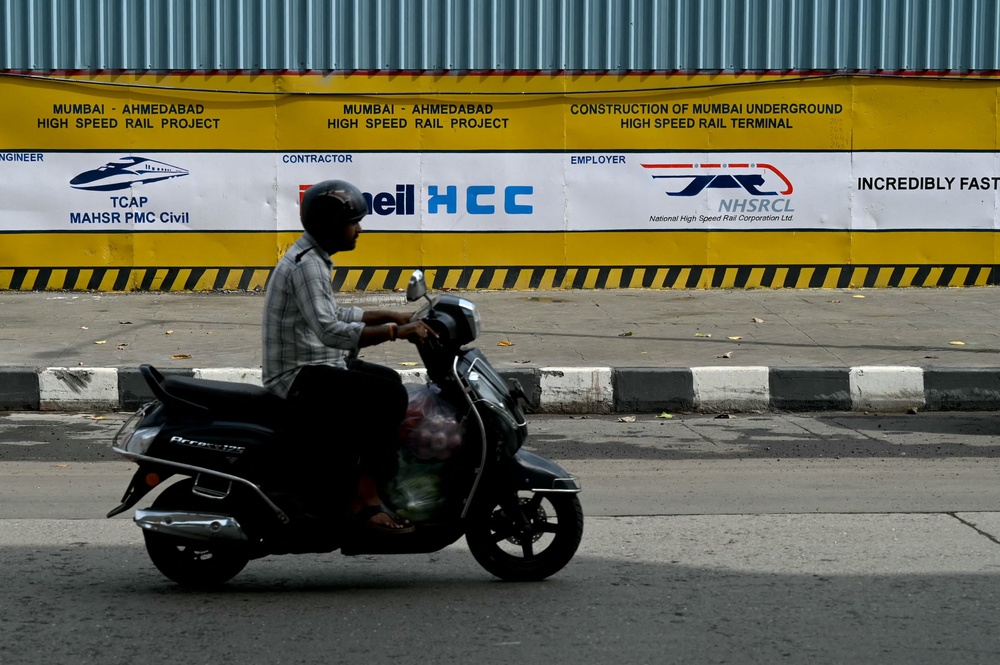
The original target was to complete the Mumbai-Ahmedabad line by 2022. That deadline passed because there were delays with lengthy land-acquisition procedures. The Covid-19 pandemic added further disruptions.
The estimated cost has also risen substantially. Indian government figures reported this year put it at around Rs 1.98 trillion (about £15.5bn), compared with an original estimate of roughly Rs 1.08 trillion (approximately £8.4bn).
The Independent has reached out to JICA for comment on delays and the project’s cost to date.
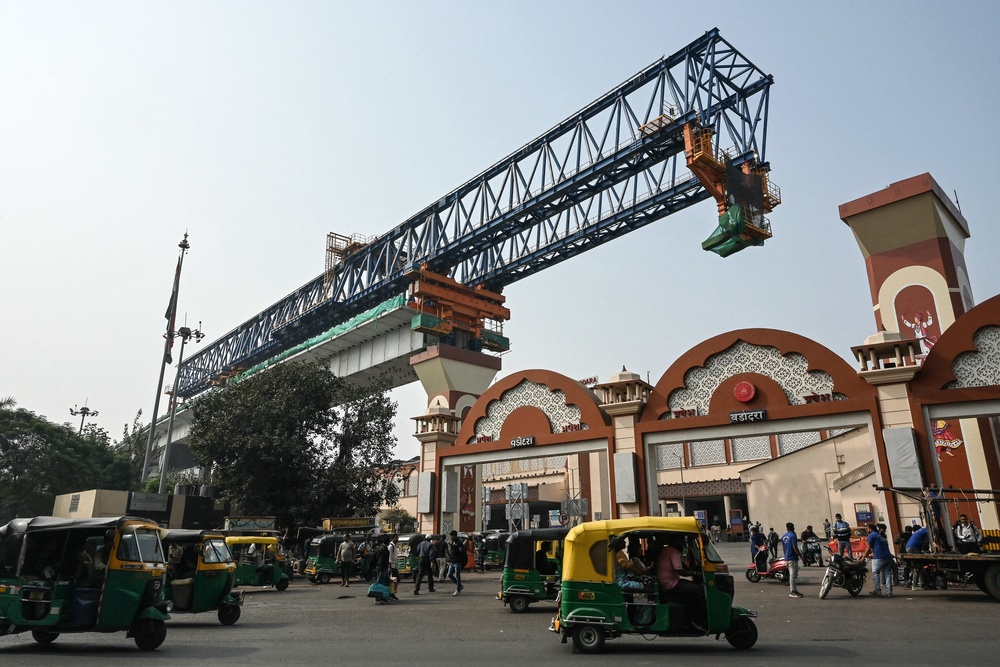
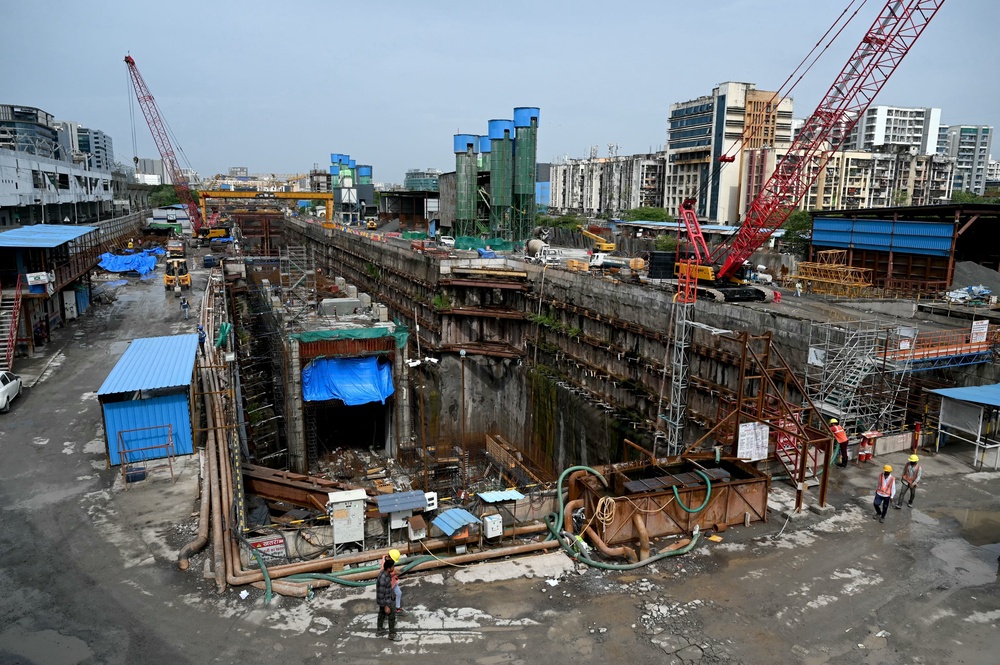
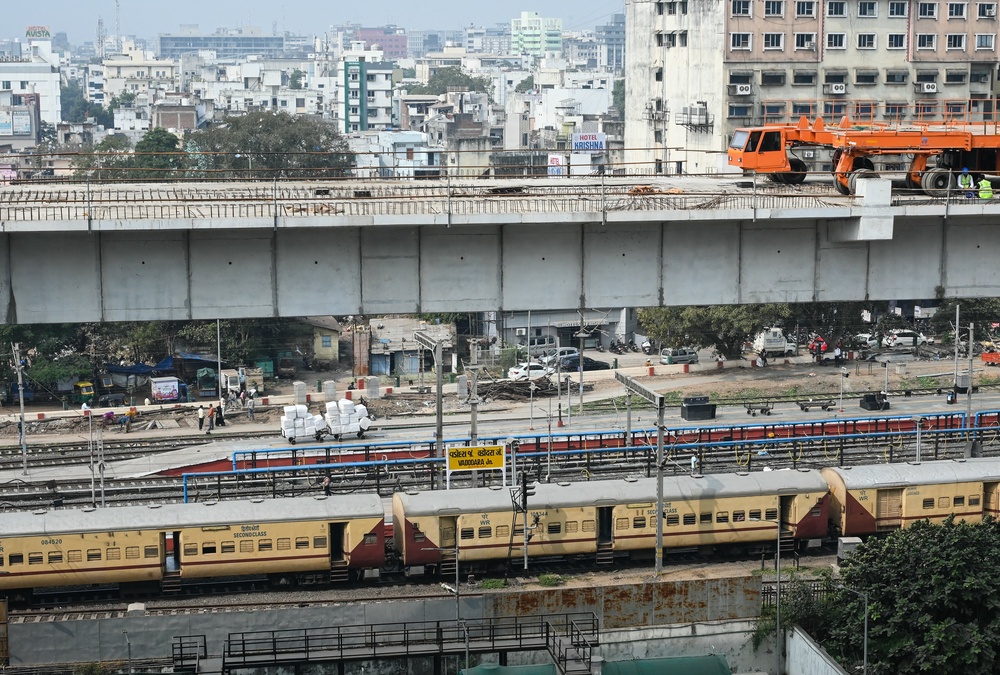
Construction has since advanced, with major sections of the elevated track and other infrastructure taking shape. The government says the necessary land has been acquired.
The delays have prompted differing assessments of how the project has been managed. While Makihara blamed India’s handling of the undertaking, Masafumi Shukuri, head of the International High-Speed Rail Association and chairman of the Japan Transport and Tourism Research Institute, has offered a different assessment.
He argued that delays caused by land acquisition, Covid-19, and other unforeseen problems needed to be considered in the context of the scale of the undertaking.
The era of delays is over. The era of delivery has begun 🔥
— Harsha Patel 🇮🇳 (@harshagujaratan) July 17, 2026
India's first Bullet Train project is becoming a reality under the visionary leadership of Prime Minister Shri @narendramodi.
What was once a long-awaited dream is now taking shape through decisive leadership, rapid… pic.twitter.com/M2DryXdTnA
“The first high-speed rail (project) in Japan was launched in 1964, which means Japan has 62 years of experience of constructing and operating the high-speed train. Now, let’s just say today Japan decides to make a high-speed rail track of 500km. It is not possible to complete it in 10 years. Even today’s Japan cannot do it… I think from this perspective, given the different conditions, building a high-speed rail of 500km long in India is a big deal,” Shukuri says.
As India prepares to begin services with its own trains, the two countries have diverged over the technology and suppliers that will be used to operate the railway.
Japan had originally been expected to supply three major components of the project: the Shinkansen trains, the signalling system, and the Operation Control Centre (OCC). India was responsible for the civil construction.
Japanese proponents have argued that the Shinkansen works as an integrated system, with trains, signalling and operational procedures designed to function together. They say preserving that integration is key to maintaining the railway’s safety, reliability, and punctuality.
India, however, wants greater flexibility over procurement and a larger role for domestic technology.
That is where the two have run into friction.
Japan’s next-generation E10 series Shinkansen is still under development and will not be available for the initial services on the Indian line. In July, India’s Ministry of External Affairs said Japan was expected to provide the E10 trains in the early 2030s.
The two countries had agreed to begin operations with Indian-built high-speed trains instead, an Indian railway official said.
An Indian railway official had also confirmed that Japan would not be able to supply the E10 before 2034.
According to the official cited by The Indian Express, India decided to proceed with its own trains and an internationally standardised signalling system after it became clear in 2024 that waiting for the Japanese model would delay the start of services.
“The Japanese side has still not been able to share the offers for E10 trains, signalling system, and Operation Control Centre (OCC) systems because the train is still under design,” said the official.
The first Indian-built trains are being developed by state-owned Bharat Earth Movers Limited (BEML). They are designed for speeds of up to 280kmph, below the 320kmph envisaged for the full high-speed service.
In a statement issued in July this year, the government of India said: “Under the Make in India and Aatmanirbhar Bharat initiatives, Indian Railways is promoting indigenous high-speed rail manufacturing. This aims to reduce dependence on imported systems and components. Integral Coach Factory (ICF), in collaboration with BEML, is designing and manufacturing indigenous 280kmph high-speed train sets. The tooling, testing and production ecosystem for future high-speed rail projects is also being developed in the country.”
India’s first bullet train will therefore begin operating with domestically developed trains before Japan’s next-generation Shinkansen becomes available.
The more contentious issue has been signalling.
Japan has also reportedly objected to India awarding a key signalling contract to Germany’s Siemens, arguing that the decision departs from the original plan for an integrated Japanese system. The Financial Times reported that the move dismayed Japanese project companies led by JR East.
Japan had expected to provide the system that controls train movements and helps prevent collisions. India has instead moved towards the European Train Control System (ETCS), an internationally used signalling standard.
“Both sides also agreed that the Indian train should run on the open standards-based international signalling system, ETCS. This same system is being used, with variations, in Korea, Taiwan, China, and Europe,” the senior railway official had confirmed.
The Independent has reached out to the public relations office of the government of Japan for comment.
The Japanese side has raised concerns about combining its railway infrastructure with European signalling and Indian-built trains, arguing that such a configuration has not been tested as an integrated system.
India has said the signalling equipment has been ordered in line with international specifications.
Jaiswal has previously said that no Japanese offer had been received for the signalling equipment, adding that the project was being carried out with the shared aim of starting high-speed rail services as soon as possible.
For Japan, the project offered an opportunity to promote its Shinkansen technology abroad and deepen its infrastructure partnership with India. For India, it was also intended to support domestic manufacturing and technology transfer, allowing Indian companies and workers to develop expertise in high-speed rail systems.
The stakes extend beyond the Mumbai-Ahmedabad line. The project could shape how India builds future high-speed rail corridors – and how much of that technology comes from Japan or is developed at home.
The government of India says that “seven high-speed rail corridors, covering nearly 4,000km, have been identified for future development”. The proposed network is expected to attract investments of around Rs 16 trillion (approximately £125bn).
The Mumbai-Ahmedabad line could become the template for that expansion.
For India, flexibility over technology and procurement is tied to the ambition of building a domestic industry. For Japan, preserving the integrity of its system and the role of its companies is central to the original proposition.
Despite the disagreements, neither government has suggested that the dispute should derail the wider relationship.
At a summit in Delhi in July, Japanese prime minister Sanae Takaichi said the two countries should develop their relationship “as brother and sister”.
A joint statement said “the two prime ministers reaffirmed the importance of the Mumbai-Ahmedabad High Speed Rail as a flagship project between India and Japan”.
“Prime minister Takaichi stated that Japan fully understands India’s target to commence commercial operations on priority sections in 2027 and remains committed to extending the necessary cooperation. They acknowledged the goal of introducing the E10. They also expressed willingness to explore possible ways to cooperate on future high-speed corridors to achieve India’s vision of a national High Speed Rail network of 7,000km.”
A senior Indian diplomat was quoted as saying by the Financial Times: “The velocity of the bilateral relation is faster than the velocity of the high-speed rail project.”The Independent has reached out to the Indian external affairs ministry for comment.
Read MoreBear kills man and seriously injures woman at their home in Mongolia
El Nino is now hottest ever recorded and still growing in strength, announces Japan
Elon Musk asks if billionaire Ambani is ‘real boss of India’ in dig at Modi
US-India trade talks grind to a halt. What went wrong?
Plane damaged by suspected lightning strike lands safely in India
Veteran Bollywood actor and Parinda star Nana Patekar dies at 75